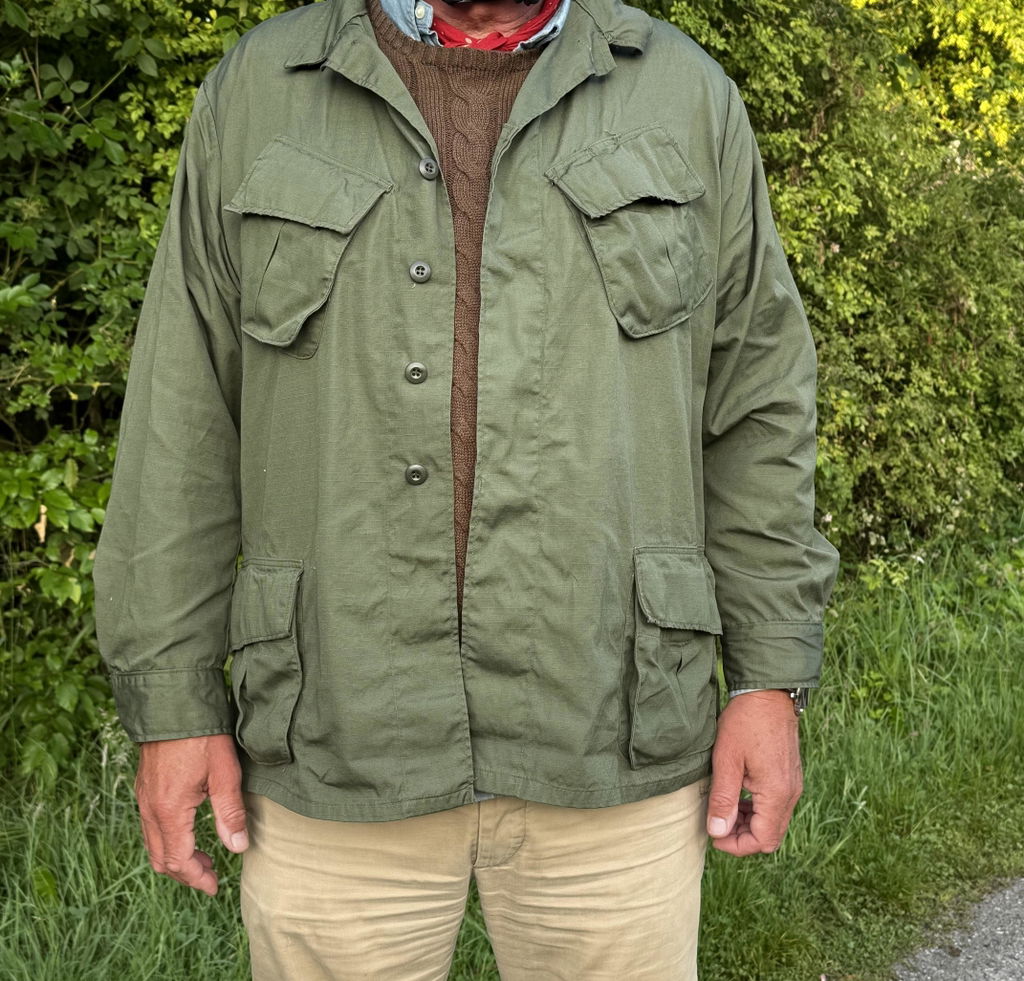
Vietnam-Era U.S. Army Tropical Combat Jackets: Patterns, Labels & Identification

Rare Gear USA’s original photography and research are protected. Images and text may not be reproduced or used commercially without prior written permission.
Collector's field reference · U.S. Army · Vietnam era · Original military garment identification
The Tropical Combat Coat—often called the jungle jacket—was developed for personnel in hot, humid conditions and standardized in the early 1960s. The distinctive four-pocket coat combines two slanted chest cargo pockets with two lower bellows pockets. Its evolving pocket closures, epaulets, waist tabs, interior protective flap, back yoke, fabric weave and sleeve construction create a detailed physical record of U.S. Army uniform development.
How to read this guide: We follow the familiar five-pattern collector classification used throughout Rare Gear USA's archived listings. Not every specialist uses the same names: some group the designs into three major types with subvariants. Pattern labels are therefore a research framework, not a substitute for a garment's actual construction and contract records.
The images below come exclusively from Rare Gear USA's photographed product archive. Each original listing is linked, and sold or archived examples are shown as reference material—not represented as current inventory. The article is arranged by pattern, then by construction and label features, so you can compare your own jacket directly to documented garments.
Five-pattern comparison: what changed?
| Feature | 1st | 2nd | 3rd | 4th | 5th |
|---|---|---|---|---|---|
| Approximate period | 1963–64 | Mid-1960s | Mid-1960s | Late-1960s | Late-1960s+ |
| Pocket buttons | Exposed | Concealed | Concealed | Concealed | Concealed |
| Shoulder epaulets | Yes | Yes | Removed | Absent | Absent |
| Waist tabs | Yes | Yes | Removed | Absent | Absent |
| Gas flap | Yes | Yes | Removed | Absent | Absent |
| Back yoke | Early design | Early design | Introduced | Retained | Retained |
| Fabric | Smooth poplin | Smooth poplin | Usually poplin | Ripstop associated | Ripstop common |
| Sleeve gusset | Early construction | Early construction | Retained | Retained | Removed |
| Identification priority | Exposed buttons | Covered buttons + tabs | No tabs + yoke | Drain/pocket and sleeve details | Simplified sleeve |
Reference note: Dates are approximate; production and issue overlap. In particular, chronology, hanger loops, pocket drain holes and ERDL transition details require inspection of individual garments and original specifications. Earlier patterns continued in field use after newer versions appeared.
Archive comparison: five original coats


What to photograph before identifying a jungle jacket
- Front and back, laid flat: pocket position, epaulets, waist tabs, length, back yoke and sleeve outline
- Each pocket open and closed: exposed versus hidden buttons; pen pockets, drainage grommets, fabric reinforcement and stitching
- Interior front closure: gas flap, button count, garment finishing and alterations
- Collar and care/contract labels: garment nomenclature, size, stock number, maker, contract number and washing instructions
- Underarm, cuffs and sleeves: gussets and construction changes important to later patterns
- Fabric macro photograph: smooth cotton poplin or square ripstop reinforcing grid
- Insignia front and reverse: original sewing, removal ghosts, rank, name tapes and unit markings
1. First pattern Tropical Combat Coat
Early issue, c. 1963–1964 · How to identify
Exposed pocket buttons are the most immediately recognizable distinction. Inspect both button positions on each pocket, shoulder straps, waist take-in tabs and the internal protective gas flap. The front closure and sleeve gusset construction offer additional cross-checks. The early OG-107 lightweight cotton poplin is typically smooth rather than grid-like.
Original Rare Gear USA image archive


Documented example: 1963 first-pattern archive example; the original listing documents the garment, while its precise individual service history is unknown. See the original Rare Gear USA listing and additional images.
Exposed buttons alone do not authenticate a garment; photographs of all closures, inside construction and labels are needed.
2. Second pattern Tropical Combat Coat
Mid-1960s revision · How to identify
Covered pocket buttons replaced exposed pocket fasteners to reduce snagging. Epaulets, waist adjustment tabs and the gas flap remained in this early design family. Compare concealed pocket-button flaps, collar and front closure; the January 1965 amendment specifies four front buttons excluding the collar button, versus five excluding the collar button on the original, although repairs can complicate this count.
Original Rare Gear USA image archive


Documented example: Rare Gear USA 1966 second-pattern archive example marketed as NOS/deadstock; use photographed contract data rather than the listing year alone. See the original Rare Gear USA listing and additional images.
‘Deadstock’ or NOS is a condition classification, not documented proof that this specific jacket was never issued.
3. Third pattern Tropical Combat Coat
Mid-1960s simplification · How to identify
The standard third pattern was simplified: no shoulder straps, waist tabs or gas flap; transitional second-pattern coats may also lack tabs or straps but retain the gas flap. a horizontal back yoke was introduced. Both chest cargo pockets retained pen-pocket compartments; inspect the gas flap carefully to separate this design from the transitional second-pattern variants. Check the lower edge of pockets for drain holes and examine chest pen-pocket organization. Smooth cotton poplin is associated with commonly documented third-pattern OG-107 coats. The precise chronology of ERDL variants and hanger loops requires a closer read of the garment and specifications.
Original Rare Gear USA image archive


Documented example: Rare Gear USA's original 1967 third-pattern listing includes front, back, interior and two tag photographs. See the original Rare Gear USA listing and additional images.
A hanger loop is not an infallible pattern identifier. Some archive captions conflict about the presence of loops on transitional ERDL coats; review the actual construction.
4. Fourth pattern Tropical Combat Coat
Later 1960s evolution · How to identify
Later versions commonly show ripstop cotton, a continuing back yoke, pocket drain openings and a reduced chest pen-pocket arrangement; hanger loops are generally absent in the collector-defined fourth type. The small reinforced ripstop grid should be documented with a close-up rather than inferred from a distant image.
Original Rare Gear USA image archive


Documented example: 1968 fourth-pattern original Rare Gear USA archive example; compare with later ERDL jackets without assuming that every 1968 garment is identical. See the original Rare Gear USA listing and additional images.
The fourth- and fifth-pattern distinction should also be checked at the sleeve gusset near the underarm/cuff construction, rather than only at the fabric.
5. Fifth pattern Tropical Combat Coat
Late 1960s onward · How to identify
In the five-pattern classification, the fifth pattern is distinguished from the preceding type particularly by removal of earlier sleeve-gusset construction. Ripstop cotton, no early shoulder straps or waist tabs, and the four slanted/straight bellows-pocket layout remain part of the late-war design language. Both OG-107 and ERDL pieces exist in later production.
Original Rare Gear USA image archive


Documented example: Comparative display includes two distinct Rare Gear USA 1969 listings; photographs are explicitly labeled to avoid mixing their provenance. See the original Rare Gear USA listing and additional images.
Late contract dates, especially postwar examples, do not prove service in Vietnam; avoid attributing a wearer or combat deployment solely from badges or camouflage.
Second-Pattern Transitional Variants: Epaulets, Waist Tabs and Gas Flaps
Second-pattern Tropical Combat Coats are not always identical. The familiar standard early second pattern has concealed cargo-pocket buttons, shoulder epaulets, adjustable waist tabs and an internal gas flap. Following the USARV Tropical Combat Uniform Board's November 1965 recommendations to simplify the coat, transitional examples may show different combinations of those early external fittings while retaining the gas flap. This can make them look deceptively like a third-pattern jacket.
| Second-pattern construction | Epaulets | Waist tabs | Internal gas flap |
|---|---|---|---|
| Early standard | Present | Present | Present |
| Transitional variant A | Present | Absent | Present |
| Transitional variant B | Absent | Present | Present |
| Transitional variant C | Absent | Absent | Present |
Identification checkpoint: A second-pattern transitional coat that lacks both epaulets and waist tabs may be mistaken for a third pattern when viewed from the front. Inspect the interior gas flap, rear yoke, pocket drainage, and complete construction before assigning a pattern. The third-pattern standard design removes the gas flap and incorporates a back yoke. A removed or altered flap requires additional evidence.
Rare Gear USA original 1966 second-pattern archive: details to compare
The following images come from archived jackets cataloged by Rare Gear USA as second-pattern 1966 examples. They are photographic comparison material, not confirmed photographs of each of the three transitional subvariants above. To document a specific variant, the interior gas flap and absence/presence of the epaulets and waist tabs must be clearly demonstrated on that same surviving coat.


View 1966 second-pattern patch-bearing archive coat · View second 1966 second-pattern example · View original deadstock example
Collector note: Do not confuse evidence of original manufacture with missing or removed fittings. A jacket with cut-off shoulder loops or waist tabs needs close inspection of stitch holes and seams. These transitional configurations make original inside photographs especially valuable.
Military specification, construction changes and pattern transitions
This section brings together the garment construction, specification history and identifiable features used by collectors to distinguish successive tropical combat coat patterns. MIL-C-43199 is the principal technical specification discussed here; amendments and contemporary Army records help explain the changes. Where original source documents have not been examined directly, dates and historical figures should be independently checked before publication. All illustrated coats and photographs are from the Rare Gear USA archive.
1962: why the Army developed the original jungle jacket
Natick Laboratories developed the Tropical Combat Jacket and matching trousers in 1962 for Special Forces personnel operating in Vietnam, after a request from Army Materiel Command. The original coat used approximately 5½-ounce wind-resistant OG-107 cotton poplin and paired two angled chest cargo pockets with two lower cargo pockets. Shoulder loops, adjustable waist tabs, dual chest pen-pocket compartments and a protective internal front gas flap were deliberate components of the early design. The coat was lightweight and relatively quick-drying, but exposed pocket buttons could catch on foliage.
Contemporary source to verify: Support to United States Army in Vietnam—Clothing & Equipment, Army Materiel Command, February 1967 (document to verify).
January 21, 1965: a documented second-pattern specification change
The second-pattern pocket revision is associated with Amendment 1 of MIL-C-43199, dated 21 January 1965. All four cargo-pocket buttons became concealed beneath pocket flaps. The front placket spacing also changed: four buttons excluding the collar button instead of the original five, according to the reference. The shoulder epaulets, waist tabs and interior gas flap were still present in the standard early second-pattern configuration.
November 1965: second-pattern transitional variants
The USARV Tropical Combat Uniform Board recommended eliminating epaulets and waist adjustment tabs in November 1965. Its concern was practical: shoulder-loop buttons and tabs could snag or interfere with pack straps, movement or carried equipment. The relevant board proceedings are dated 22 November 1965.
During a short production transition, some coats retained waist tabs without epaulets, some retained epaulets without waist tabs, and others had neither. Crucially, these intermediate second-pattern variants retained the internal gas flap. This means absence of shoulder straps and waist tabs does not automatically prove third-pattern manufacture. For a suspected transitional coat, open the front placket and inspect for the gas flap before making that determination.
1966 onward: third-pattern simplification
The third major configuration, described as appearing around 1966, removed the early gas flap, epaulets, waist tabs and pocket drain holes. A horizontal back yoke was introduced. The documented third-pattern examples in historical descriptions retain pen pockets behind both chest cargo pockets and are described as smooth wind-resistant cotton poplin in OG-107 or ERDL camouflage. The back yoke is particularly important: it is a feature of the third pattern and remains on the fourth and fifth patterns, so a back yoke alone does not distinguish the fourth from the third.
Fourth pattern: ripstop, one pen pocket and drain holes
Fourth-pattern coats are described in specialist identification literature as the first of these regular versions produced in ripstop cotton poplin, with continued production in OG-107 and ERDL. Three key changes relative to the third pattern are: one pen pocket behind the left chest cargo pocket rather than two; pocket drain holes reintroduced; and the internal hanger loop eliminated. Both the third and fourth retain the back yoke. Examine the sleeve-gusset construction when distinguishing fourth from fifth.
Fifth pattern: the sleeve gusset disappears
The fifth pattern retains the later ripstop material, single left-chest pen pocket, back yoke and drain-hole arrangements but removes the sleeve gussets found in earlier versions. Both OG-107 and ERDL examples are documented in period-surviving garments. The most instructive comparison is an original fourth- and fifth-pattern underarm/sleeve close-up shown side by side, with confirmed jacket labels and dating. Do not classify a jacket as fifth solely because it is ripstop or ERDL.
Experimental mosquito-resistant Tropical Combat Coat
An experimental model outside the regular five-pattern sequence was developed after USARV requested enhanced mosquito protection in March 1968; Natick experimented with a more tightly woven approximately 6.5 oz nylon-cotton textile. Reported trials indicated protection of around 98% against mosquito bites, compared with approximately 92% for standard fabric, but with reduced airflow. It records 4,500 experimental uniforms dispatched for Vietnam evaluation in June 1969 and says the design was not adopted after unfavorable comfort reports. This experimental account should be verified against Shelby Stanton, U.S. Army Uniforms of the Vietnam War, page 6.
The experimental garment reportedly shared the fifth pattern's general configuration—a back yoke, single pen pocket and no sleeve gussets—but fabric and experimental contract documentation would be essential to distinguish it from an ordinary fifth-pattern coat. We have not verified a matching example in the Rare Gear USA photo archive, so no ordinary jacket is presented as this experimental type.
Label cross-reference: documented FSNs from historical examples
| Reference example | Example FSN | Size stated |
|---|---|---|
| Early original coat | 8405-082-5565 | Small–Short |
| Second pattern | 8405-082-5569 | Medium–Regular |
| Second-pattern variant | 8405-082-5566 | Regular–Small (as shown) |
| Third-pattern ERDL | 8415-945-7656 | Medium–Regular |
| Fourth-pattern ERDL | 8415-945-7650 | X-Small–Short |
| Fifth-pattern ERDL | 8415-947-7652 | Small–Short |
| Fourth-pattern OG-107 | 8405-935-4704 | Small–Short |
| Fifth-pattern OG-107 | 8405-935-4705 | Small–Regular |
These are example size-specific supply numbers found in historical garment reference material, not unique serial numbers for individual coats or an exhaustive FSN directory. Cross-check the photographed label on each Rare Gear USA garment separately.
Primary documents to consult: MIL-C-43199 and Amendment 1 (21 January 1965); Proceedings of the USARV Tropical Combat Uniform Board (22 November 1965); Army Materiel Command, Support to United States Army in Vietnam—Clothing & Equipment (February 1967); and Shelby Stanton, U.S. Army Uniforms of the Vietnam War, page 6, for the experimental mosquito-resistant uniform. These sources are identified for verification before publication. Rare Gear USA's own original product photographs illustrate every garment example.
ERDL Camouflage Jackets: Original Sold Archive
ERDL camouflage is not a separate jungle-jacket pattern. It is a camouflage textile used on certain Tropical Combat Coat designs. Original Rare Gear USA archive examples document the collector-defined third, fourth and fifth patterns in camouflage. Identification begins with garment construction: inspect the back yoke, pocket drains, pen-pocket placement, fabric weave and sleeve gussets. A photographed garment's patches or camouflage coloration alone cannot establish precise date or wartime use.
| Detail | 3rd ERDL | 4th ERDL | 5th ERDL |
|---|---|---|---|
| Fabric | Cotton poplin (historically documented examples) | Ripstop poplin | Ripstop poplin |
| Back yoke | Yes | Yes | Yes |
| Pen pockets | Behind both upper pockets | One behind left upper pocket | One behind left upper pocket |
| Pocket drains | Not fitted in standard design | Reintroduced | Retained |
| Sleeve gussets | Earlier construction | Earlier construction | Removed |
| Identification warning | Missing label/modified examples need caution | Do not mistake ripstop for 5th | Confirm sleeve construction |
3rd Pattern ERDL — Cotton Poplin
The third-pattern camouflaged coat carries the simplified design with a back yoke and no original early gas flap, shoulder epaulets, waist adjustment tabs or pocket drain holes. Smooth cotton poplin and two chest pen-pocket compartments are expected features in the collector identification scheme. This archive example is described as 1960s ERDL, Medium Long; its original listing notes that the garment label is missing, so its dating cannot be established from a surviving contract tag.


View this original Rare Gear USA archive listing
4th Pattern ERDL — Ripstop Transition
The fourth-pattern ERDL jacket retains the back yoke and uses ripstop cotton poplin. It differs from the third type in its single left-chest pen pocket, reintroduced pocket drain holes and omission of the hanger loop. The earlier sleeve-gusset construction remains relevant for distinguishing it from the fifth type. Labels for one of Rare Gear USA's separate 1968 fourth-pattern ERDL archival pieces identify Elder Manufacturing, stock no. 8415-945-7659 and contract DSA 100-68-C-2343; those details belong to that specific example, not every garment pictured.


View this original Rare Gear USA archive listing
5th Pattern ERDL — Simplified Sleeve Construction
The defining distinction from the fourth pattern is the removal of the earlier sleeve gussets; ripstop fabric and a single pen pocket behind the left chest pocket continue. Rare Gear USA's archive includes a 1969 fifth-pattern ERDL Medium Long listed as deadstock and attributed to Tellico Manufacturing Company. Deadstock condition does not independently establish that a coat was never issued, and a 1969 contract does not prove deployment or wear in Vietnam.


View this original Rare Gear USA archive listing
Other noteworthy camouflage examples in the archive
In addition to the images above, Rare Gear USA has documented a 1968 fourth-pattern ERDL jacket by Henderson Manufacturing, a 1969 fifth-pattern ERDL coat attributed to Alpha Industries, and a Marine Corps-associated 1969 fifth-pattern ERDL example attributed to R. L. Davis. These archival labels and insignia offer useful manufacturer and organizational comparisons, but they do not by themselves document the individual wearer.
Collector's photo checklist: Photograph the whole front and back, the fabric weave in strong light, the pen-pocket opening behind the chest pocket, pocket drain holes, the inside of the front closure and the sleeve underarm seam. Take an uncropped image of each military label to preserve contract and size data.
Supplemental Historic Photo Archive: Early ERDL and Transitional Examples
These additional original photographs were preserved from the earlier Rare Gear USA published guide. They supplement, rather than replace, the new technical comparison. Each group is organized using its earlier catalog identification; jacket construction, original labels and possible seller-caption inconsistencies must take precedence over a title alone. Photos link back to the original Rare Gear USA archive and are presented as historical references.
Supplementary 1st Pattern Photographic References
Supplementary original images from Rare Gear USA's earlier guide provide additional garment and label views.

Supplementary 2nd Pattern Photographic References
Supplementary original images from Rare Gear USA's earlier guide provide additional garment and label views.

Supplementary 3rd Pattern Photographic References
This grouping includes rare third-pattern OG-107 and ERDL archive views, including close-ups retained from the original guide. Some old descriptions disagree on whether particular ERDL examples have a hanger loop or ripstop material. Treat those details as unresolved until their labels and construction are checked individually.


Supplementary 4th Pattern Photographic References
Compare these 1968 OG-107 and ERDL jacket views for back yoke, chest-pocket pen opening, pocket drains and sleeve gusset. Some archival listing descriptions are internally inconsistent; avoid assigning pattern solely from the photo filename.


Supplementary 5th Pattern Photographic References
Additional 1969 and earlier ERDL and solid-color examples are shown here with original Rare Gear USA labels, fabric and construction details.


Contract labels: deciphering dates, makers and stock numbers
Most serious identification work begins with a well-lit, legible contract label. Labels may be located inside the coat and a size label may sit separately at the neck. On some jackets, laundering, repairs or removed tags make the record incomplete.
What each line means
- “Coat, Man's, Combat, Tropical”: military nomenclature identifying the garment type rather than a civilian fashion name.
- Size (e.g., Medium Regular): the Army sizing designation. Compare the original garment measurements rather than assuming modern sizing equivalence.
- FSN/stock number: a supply identifier relating to the standardized garment/size; it is not an individual jacket serial number.
- DSA contract number: Defense Supply Agency procurement reference. Numbers can contain a year element, but that is not proof of the exact date of sewing or issue.
- Manufacturer name: contractor attribution when printed; verify exact spelling and compare factory variants.
- Fabric and care instructions: evidence about intended material, use and cleaning—not independent proof of authenticity.
Three actual Rare Gear USA archive label examples
| Archived garment | Recorded data | How to interpret |
|---|---|---|
| 1963 first pattern with patches | 8405-082-5567; DSA-1-2397-63-C | Early procurement-era identifiers to compare against physical construction; not proof of individual wearer. |
| 1967 third pattern, medium regular | 8405-082-5569; DSA 100-67-C-1915 | The “67” is consistent with the stated procurement-era year; date of field use remains unknown. |
| 1968 ERDL fourth-pattern listing | 8415-945-7653; DSA 100-68-C-2551; Henderson MFG. Co. Inc. | A contract, stock number and contractor reported for one ERDL item; compare the actual neck label, sleeve and pattern construction. |
Important: The identifiers above are transcribed from Rare Gear USA listing records. Where a detail appears differently on a label photograph, the photograph and official contract evidence should take precedence.
What a photographed 1969 label can reveal
Smooth poplin and ripstop under close inspection
Both fabrics are cotton, but they present differently to the eye. Earlier wind-resistant cotton poplin commonly appears relatively uniform; ripstop shows a small reinforcement grid of threads. Fading, compression, camera resolution and heavy wear can obscure this texture. Backlight or a close-up of a clean interior seam may help reveal the actual construction. The introduction of ripstop did not instantly remove earlier stock from service.
OG-107 versus ERDL camouflage
OG-107 identifies the olive-green shade used for many examples. ERDL refers to the camouflage pattern associated with later tropical-combat coats. Camouflage appearance alone does not determine which collector-defined cut is represented; inspect back yoke, pocket construction, sleeve and contract labels. Distinguish an ERDL military coat from commercial tiger-stripe garments and custom-made field items, which may require a different authentication method.
Insignia, named coats and real provenance
Rare Gear USA's archive includes jackets with unit patches, rank and name markings. A patch identifies a formation or qualification design, but does not by itself establish the wearer's identity, exact unit assignment or date. Photograph the reverse, stitch lines, threads and any fading where insignia was removed. A name tape should be presented as a name on the garment unless the associated individual can be independently documented through service records.
Deadstock, alterations and collecting value
Scarcity, clean labels, original fasteners, uncommon early construction, historic insignia and verifiable ownership can materially influence a collector's assessment. Deadstock describes how the garment was preserved or offered for sale, not a guarantee that military stores never issued it. Inspect replacement buttons, cuts, sleeve alterations and repairs. Archive prices are historical asking/listed values unless actual sold prices are independently verified.
Frequently asked questions
Is every ripstop jungle jacket a fifth pattern?
No. Fabric is only one piece of evidence; some fourth-pattern examples have ripstop construction. Compare sleeve and pocket construction as well.
Does a 1966 or 1967 contract mean the coat was worn that year?
No. A contract identifier supports an era of procurement, not a verified individual's date of use.
Are all third-pattern jackets fitted with a hanger loop?
Do not treat a loop as universal. Transitional production and documented archive inconsistencies make a multi-feature comparison safer.
Is an original patch proof that a named soldier wore a coat?
No. A patch may be genuine yet later applied. Establishing ownership requires independent historical documentation.
Further references and research method
For additional reference, see Moore Militaria's jungle fatigue reference, and original Army specification MIL-C-43199 and dated amendments. Different specialists use different pattern taxonomies; the present guide uses the five-pattern collector approach and cross-checks against original jackets.
Continue reading: Tropical Combat Trousers · Explore Tropical Combat Jackets
Historical interpretation is provided as collector research, and uncertain identifications are stated as such.
© 2026 Rare Gear USA. All rights reserved. To request permission to use our photographs or content, contact cs@raregearusa.com. Third-party names, trademarks and insignia belong to their respective owners. Copyright & Image Use Policy.