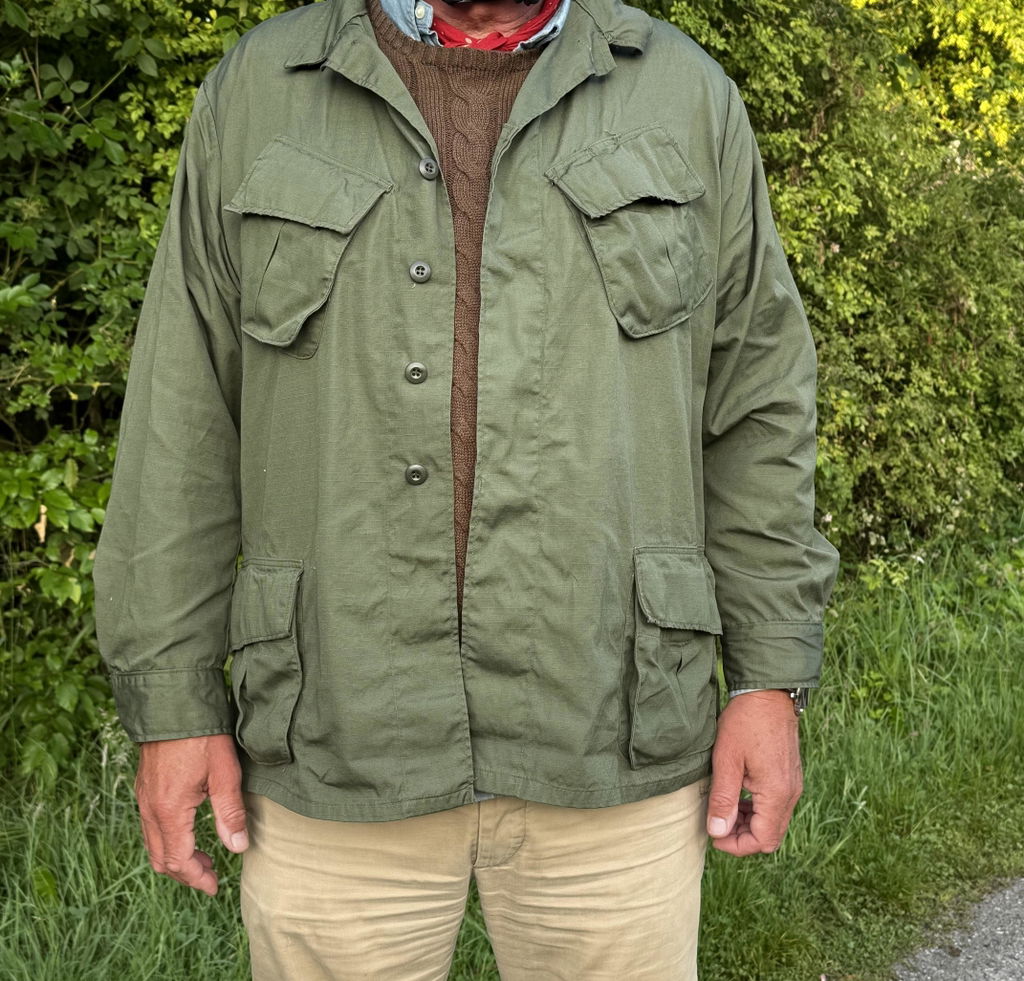
CWU-45/P & CWU-36/P Flight Jackets: The Advanced Collector’s Guide

RARE GEAR USA · MILITARY COLLECTOR REFERENCE
The CWU-45/P cold-weather jacket and CWU-36/P summer jacket share one of the most recognizable shapes in American flight clothing: a cloth collar, flapped front pockets, a sleeve utility pocket and knitted cuffs and waistband. Their similar appearance hides important differences in insulation, specifications and production history.
How do you tell a CWU-45/P from a CWU-36/P? Read the designation and specification on the label, then open the jacket. The CWU-45/P belongs to the MIL-J-83388 cold-weather family and has an insulated, quilted interior in the examples shown here. The CWU-36/P belongs to the MIL-J-83382 summer family and has a lighter, unquilted lining. Green or tan color alone does not identify the type.
This advanced reference uses original Rare Gear USA archive photographs, from an early Greenbrier jacket carrying a 1975 contract to green and tan examples carrying 2010 contracts. Each photograph opens at full size and links to its archive specimen. Dates below describe the evidence on the garment: a contract year, specification date and actual production date are separate things.
1. CWU-45/P vs CWU-36/P: the essential differences
Start with the jacket open. Exterior photographs can make a lightweight summer jacket look almost identical to a padded winter example. An interior photograph and a readable label usually resolve the question much faster than the apparent thickness of a sleeve or the seller’s use of “bomber jacket.”


| Feature | CWU-45/P | CWU-36/P |
|---|---|---|
| Official family | Cold-weather flyer’s jacket | Summer, fire-resistant flyer’s jacket |
| Specification root | MIL-J-83388 | MIL-J-83382 |
| Interior shown in this archive | Padded construction with quilted lining | Lightweight, unquilted lining |
| Exterior features | Cloth collar, flapped patch pockets, sleeve utility pocket, knitted cuffs and waist | The same broad family of exterior features |
| Colors illustrated | Sage-green and tan examples | Sage-green and tan examples |
| Best identification evidence | Designation + specification + interior construction | Designation + specification + interior construction |


The numbers 36 and 45 identify jacket types; they are not chest sizes or temperature ratings. “Summer” and “cold weather” describe intended clothing categories, not a guaranteed comfort range for every wearer. Wind, layering, activity, condition and individual fit all affect how a vintage jacket feels in use.
2. History and a specification timeline grounded in garments
The CWU family belongs to the development of fire-resistant flight clothing during the 1970s and its continued use through later decades. Compared with the familiar nylon MA-1 and L-2B, these archive examples combine a fold-over fabric collar with the distinctive flapped-pocket arrangement and fire-resistant material labels.
The most useful history is visible in specific objects. Our early Greenbrier label gives a 1973 specification date and a 1975 contract; another Greenbrier example explicitly names CWU-45/P on a 1978 contract. Centre summer jackets document MIL-J-83382B on 1979 and 1980 contracts. Later examples show how long individual specification revisions could remain in use.
| Evidence date | Document or archive evidence | Collector significance |
|---|---|---|
| 5 September 1973 | MIL-J-83388A date printed on the early Greenbrier label | A specification date, not the manufacture date of that jacket. |
| 1975 contract | Greenbrier DSA100-75-C-0225; cold-weather wording without CWU-45/P printed | An early labeled form within the cold-weather specification family. |
| 1978 contract | Greenbrier label names Type CWU-45/P under MIL-J-83388A | The type designation is explicit on this specimen. |
| 1979–1980 contracts | Centre Manufacturing summer jackets, MIL-J-83382B | Documented early summer-jacket examples. |
| 30 October 1981 | DLA lists MIL-J-83382C; Amendment 1 follows on 1 November 1985 | The 1985 amendment date should not be substituted for the original revision date. |
| 1984 contract | Avirex cold-weather jacket, MIL-J-83388C | A later winter specification and a plain-back example in this archive. |
| 18 June 1992 | DLA lists MIL-J-83388E | The E revision predates the 2000s jackets that also carry it. |
| 1993–2010 contracts | Summer C-revision and winter E-revision examples pictured below | A specification letter does not identify one production year. |
Specification dates: DLA ASSIST record for MIL-J-83382 and DLA ASSIST record for MIL-J-83388. The other entries come from the photographed labels in this guide.
This is a documented sequence, not a claim that every contractor changed every component on the same day. A specification issue date, contract award, production run, delivery and actual use can fall at different times. Treat broad era names as context; use the label and construction to describe the individual jacket.
3. Nomex, aramid and aromatic polyamide
Collectors often call these garments “Nomex flight jackets.” Nomex is a branded meta-aramid fiber with inherent flame resistance, according to the manufacturer’s technical explanation. Aramid is a material category; a generic aramid label does not itself establish a particular fiber trademark.
The archive demonstrates why exact transcription matters. Some labels state 100% aromatic polyamide; others say 100% aramid. The Centre summer labels pictured here say 100% polyamide, alongside the military specification and fire-resistant garment description. Record that wording as printed. Do not automatically reject one because its terminology differs from a later label.


Fabric sheen is a weak shortcut. Surface wear, lighting and camera exposure can change how the weave appears. Examine the cloth alongside the label, seams, lining and hardware. A smooth photograph does not prove nylon, and a matte photograph does not prove an original military garment. Avoid destructive burn tests on collectible fabric.
4. Early Greenbrier cold-weather jackets: what to examine
The early Greenbrier in our archive is particularly informative because the neck label separates two often-confused dates. It identifies MIL-J-83388A, dated 5 September 1973, while its contract line reads DSA100-75-C-0225. The visible nomenclature is a cold-weather flyer’s jacket; CWU-45/P is not printed on this particular label.
A careful catalog entry should preserve both facts: an early MIL-J-83388A jacket with a 1975 contract, within the family collectors associate with the CWU-45/P. Calling this exact garment “made in 1973” simply because 1973 appears prominently on the label would lose the stronger contract evidence.


The survival-cloth pouch and attachment evidence
John Chapman’s original flight-jacket reference documents an early Greenbrier jacket with a bi-swing back and a detachable internal pouch holding an orange rescue cloth. See his Greenbrier collection entry. Our photograph shows attachment strips in the lining, but does not establish that the original pouch survives with this specimen.
For an early jacket, request a full interior view and close-ups of any attachment points. If a pouch is offered with it, document the pouch separately, including its condition and how it attaches. An attachment strip is evidence of a feature; it is not proof that every loose accessory supplied by a seller originally belonged to that jacket.
5. How to read a CWU flight-jacket label
Work through the label in a consistent order. First record the garment description and type, then the specification, contract, maker, size, stock number and material. Finally read the separate care panel. This produces a useful record even when the label is partly faded.
- Garment type: distinguish CWU-45/P cold-weather wording from CWU-36/P summer wording.
- Specification: retain the complete number and suffix, such as MIL-J-83388C or MIL-J-83382B.
- Contract: copy every character; distinguish a zero from O and a one from I where possible.
- Manufacturer: preserve the actual company name, including meaningful variations in the printed business name.
- Size and stock number: record these separately from the date evidence.
- Material and care: photograph the whole panel rather than cropping away the lower instructions.


A label is central evidence, but it should agree with the jacket. Check its attachment stitches, wear, position and surrounding lining. A clean label on a worn jacket is a reason to inspect more closely, not an automatic verdict: protected interiors can age differently from exposed shell cloth.
6. Contract dating: practical examples from the archive
In the contract formats illustrated here, the two-digit group following the purchasing-office prefix supplies the contract fiscal year. Thus DLA100-84-C-0723 points to a 1984 contract, while SPM1C1-10-D-1034 points to 2010. Preserve the complete number in your notes.
The federal procurement identifier system distinguishes the issuing office, fiscal year, instrument type and serial number. The C or D in a contract is not the jacket’s specification revision. A contract year also need not equal the exact year an individual jacket was sewn or delivered, particularly when orders occur under an ongoing contract.
For the procurement-number structure, see FAR 4.1603. This reference explains the numbering principle; individual vintage entries below are transcribed from the archive labels.
| Contract year | Type / specification | Manufacturer | Visible contract number |
|---|---|---|---|
| 1975 | Early cold weather / 83388A | Greenbrier Industries | DSA100-75-C-0225 |
| 1979 | CWU-36/P / 83382B | Centre Mfg. Co. | DLA100-79-C-3124 |
| 1980 | CWU-36/P / 83382B | Centre Mfg. Co. | DLA100-80-C-2678 |
| 1984 | CWU-45/P / 83388C | Avirex Ltd. | DLA100-84-C-0723 |
| 1993 | CWU-36/P / 83382C | Isratex, Inc. | DLA100-93-C-0323 |
| 1995 | CWU-36/P / 83382C | Gibraltar PR, Inc. | SP0100-95-C-4015 |
| 2003 | CWU-45/P / 83388E | Valley Apparel | SP0100-03-D-4128 |
| 2005 | Tan CWU-45/P / 83388E | Ashland Sales and Service | SP0100-05-D-4010 |
| 2010 | Green CWU-45/P / 83388E | Valley Apparel | SPM1C1-10-D-1012 |
| 2010 | Tan CWU-36/P / 83382C | Valley Apparel | SPM1C1-10-D-1034 |


Stock numbers and dates are different kinds of evidence
The 13-digit stock number identifies a supply item; it is not a manufacture date or an individual jacket serial number. Compare the green Large CWU-45/P labels: the Avirex and later Valley examples repeat 8415-00-310-1133 across widely separated contracts. A shared stock number is therefore not evidence that two jackets came from the same production run.
When a date in an old product title conflicts with a legible contract, transcribe the label and explain the discrepancy. If a digit remains unreadable, mark it as uncertain. An honest partial reading is more useful than filling a gap with the date you expected to find.
7. Manufacturers: compare the label, not only the brand
This archive documents Greenbrier Industries, Centre Manufacturing, Avirex, Isratex, Gibraltar PR, Valley Apparel and Ashland Sales and Service. That is a useful comparison set, not an exhaustive list of every CWU contractor.
Manufacturer names add collecting interest, but do not replace contract research. Avirex is represented here by a photographed military-contract label, which matters more than assumptions based on the brand’s retail reputation. Conversely, a company’s history of government supply does not make every jacket it sells a government-contract garment.


For a manufacturer study, record label layout, lettering, attachment, hardware and interior construction together. A single label font is not a universal authentication rule. Different contracts, suppliers and surviving repairs can create legitimate variation. Build comparisons around fully documented garments rather than isolated label photographs with no jacket attached.
8. Bi-swing backs and later plain-back construction
Early examples in this archive have expansion folds beside the upper back, commonly described by collectors as a bi-swing or action back. Look for the actual folded construction near the rear armholes. Normal draping wrinkles across the middle of a jacket are a different feature.


The change is useful supporting evidence, but these two garments do not establish a universal changeover date for every CWU type and contractor. Date the examples from their labels, then describe what their backs show. This is more reliable than assigning an unlabeled jacket to one exact year from a pleat.
On a worn garment, inspect both sides of the back and the lining beneath it. Stitched-down folds, repairs or alterations can make an early construction harder to recognize. Ask for an evenly lit rear view with the jacket hanging naturally, without stretching the waistband to make the body appear longer.
9. Construction details: collar, pockets, knits and zippers
The collar and pocket arrangement
The fold-over fabric collar is an immediate visual distinction from the knitted collar of the classic MA-1 and L-2B. Examine its points, underside, topstitching and the seam joining it to the neck. Wear often concentrates along the fold and at the back of the neck.
The front patch pockets have flaps and hook-and-loop closures on the examples shown here. Study pocket shape, the stitching around the opening and the attachment at the corners. The sleeve utility pocket provides another useful close-up: check its zipper, seams and adjacent pen compartments rather than relying on a distant front view.


Knitted cuffs and waistband
Check both faces of each cuff, the elbow-side fold and the full circumference of the waistband. Small holes may disappear when the knit relaxes. Replacement knits can make a jacket very wearable while changing its originality; uneven attachment stitches, contrasting thread or a different wear level deserve a closer photograph.
Zipper evidence: Scovill, Gripper and YKK
The 1980 Centre summer jacket shown below has a slider marked Scovill and a Gripper Zipper pull. The 1984 Avirex example has a different Scovill-marked pull. A later Valley winter example carries YKK hardware. These are observations on specific garments, not a rule that one zipper brand belongs exclusively to one year.


A zipper can be replaced without replacing the jacket. Examine the tape, stitch holes, insertion pin, bottom box, top stops and lining seam around the installation. A different slider alone is weaker evidence than a visibly restitched entire zipper. Describe a suspected repair precisely instead of using one component to declare the whole garment fake.
10. Sage green and tan: both types need identification
Color and insulation are independent questions. The archive includes a tan Ashland CWU-45/P with a 2005 contract and a tan Valley CWU-36/P with a 2010 contract. Their interiors make the winter/summer distinction clear even though both have tan shells.


Green jackets can appear gray, olive or brownish in photographs. Lighting, white balance, fading and different exposed surfaces all affect the impression. Compare hidden cloth beneath pocket flaps and along covered seams before naming an unusual original shade.
A tan jacket does not establish service in a particular war, country, aircraft or unit. Those claims require evidence beyond color. Similarly, a late-contract green jacket is not automatically an early Cold War example because its overall shape looks familiar.
11. Military-contract originals, commercial jackets and reproductions
Separate three questions: who made the jacket, what standard it claims to meet, and whether this particular garment carries convincing government-contract evidence. Those questions overlap, but they are not interchangeable.
Valley Apparel’s own Mil-Spec Commercial catalog describes summer 36/P and winter 45/P jackets under the corresponding specifications. A contractor can therefore also offer commercial garments. A maker name or “mil-spec” description alone does not establish that a particular jacket was procured under a military contract.
- Government-contract example: document the complete procurement label and check that its type, materials and construction agree.
- Commercial garment: describe the maker, fabric and actual labeling accurately, even when its appearance closely follows a service jacket.
- Reproduction: identify the reproduction maker and intended pattern; judge fidelity separately from historical originality.
- Altered original: retain the original identification while disclosing replacement knits, zipper, lining work or added insignia.
Be especially cautious with labels that combine plausible-looking numbers but inconsistent garment descriptions. Compare complete labels from documented examples. A matching number printed on fabric is not independent proof of authenticity, and an attractive military-style patch adds no procurement evidence.
Commercial CWU-style jackets may also use different shell and lining materials. Read their actual composition rather than transferring the material description of an original service example to every similarly shaped jacket. The most informative listing shows the front, back, full interior, complete label and hardware in the same photographic set.
12. Condition, repairs, patches and provenance
For a wearable collection, structural condition often matters more than a fashionable level of fading. Inspect the zipper base, pocket corners, sleeve seams and attachment of the knitted waistband. Abrasion near a zipper can progress into a tear when the jacket is pulled closed.


On a CWU-45/P, inspect the quilted interior for opened seams, thinning areas and previous repairs. On a CWU-36/P, check the lighter lining around the underarms and pocket attachments. Turn pocket bags out carefully where possible and check that hook-and-loop closures have not torn the surrounding cloth.
What patches can—and cannot—tell you
Name fields, rank insignia and unit patches add visual and historical interest. Photograph attachment methods, stitch holes, backing, fading and any outline left by a removed patch. The jacket’s contract date dates the garment’s procurement evidence; it does not date every insignia currently attached to it.


A named label or patched jacket becomes stronger provenance when supported by contemporary photographs, records or a documented chain of ownership. Preserve the distinction between “carries this patch” and “documented as worn by this person in this unit.” Do not add period-looking patches merely to improve an undocumented story.
13. CWU sizing: read the label, then measure
Many photographed labels use letter sizes with chest ranges: Small 34–36, Medium 38–40, Large 42–44 and Extra Large 46–48. These describe intended body sizing, not the flat width of the finished jacket. They should not be converted directly into a modern retailer’s fit without measurements.
| Measurement | How to record it | Why it matters |
|---|---|---|
| Chest width | Lay flat and measure straight across from underarm to underarm | Compare with a jacket that already fits, allowing for insulation. |
| Shoulders | Measure between the shoulder seams across the back | Helps assess upper-body room and sleeve position. |
| Back length | Measure from the collar seam to the bottom of the waistband | Exclude the collar and state that the waistband is included. |
| Sleeve length | Measure from shoulder seam to cuff end | Include the knitted cuff and describe your method. |
| Waistband | Measure relaxed; add a gently extended measurement if useful | A tight or stretched waistband changes how the body sits. |
Compare like with like: a quilted CWU-45/P can have less usable internal room than a lighter jacket with a similar external chest width. Leave space for the layers you intend to wear. Sleeve and body lengths also matter because a short, bloused flight-jacket shape can be mistaken for shrinkage.
Do not stretch old knits aggressively to produce a larger measurement. Ask whether replacement cuffs or waistband have changed the fit. For online listings, a clear measurement method is more useful than “fits modern Large,” which can mean different things to different sellers.
14. Cleaning and preservation: read this jacket’s instructions
The labels in this guide do not give one universal cleaning instruction. Earlier Greenbrier, Avirex and Isratex examples permit laundering as well as dry cleaning, while several later examples specify dry cleaning only. The tan Valley summer label explicitly gives that restriction.
Follow the instructions attached to the individual garment and assess its present condition before cleaning. Fiber properties alone do not determine what is suitable for the complete assembly of shell, lining, insulation, knits, thread, patches and repairs. A fragile label or damaged lining may require a conservator’s judgment even when the original instructions allowed routine washing.
- Photograph the jacket, labels, insignia and defects before any treatment.
- Show a cleaner the full care panel and identify vulnerable labels or patches.
- Do not starch examples whose labels prohibit it, and avoid unnecessary pressing.
- Store clean, dry garments away from direct sunlight; support their weight rather than hanging them from a thin hook.
- Avoid prolonged compression of padded jackets and excessive strain on old shoulder seams or knits.
Preserving a collectible jacket is different from certifying protective equipment. A vintage aramid label does not establish the present safety performance of a decades-old garment with unknown use, contamination or repairs. Collect and wear it as vintage clothing; do not rely on it as tested protective equipment.
15. Building a focused CWU collection
A satisfying collection can begin with one clearly labeled summer jacket and one cold-weather jacket. That pair teaches more about the family than several similar exteriors with missing labels. Add an early Greenbrier, a different contractor or a tan example when each contributes a documented construction or label comparison.
For advanced collecting, organize your records by type, specification revision, contract and maker. Keep original listing photographs, measurements and condition notes together. Record changes you make after purchase so future owners can distinguish original details from your repairs.
- Confirm identity: type and specification agree with the interior.
- Record dating evidence: full contract, separate specification date and any uncertainty.
- Check originality: label attachment, zipper installation, knits and lining.
- Assess condition: functional hardware, sound seams, honest repair disclosure.
- Verify fit: consistent measurements and enough room for intended layers.
- Assess historical claims: separate documented provenance from an attractive story.
Rarity and value depend on the exact example, completeness, condition, size and supporting history. An early date can be interesting without making every early jacket scarce, and a clean later example can be a better study piece than a heavily altered earlier one. Compare completed sales of closely similar garments when assessing price; an unsold asking price is not evidence of market value.
16. CWU flight-jacket collector questions
What is the difference between CWU-45/P and CWU-36/P?
CWU-45/P is the cold-weather family under MIL-J-83388; CWU-36/P is the summer family under MIL-J-83382. In the archive examples, the winter jackets have quilted insulation and the summer jackets have lighter, unquilted linings. Read the label and inspect the interior together.
Is a CWU-36/P unlined?
The summer examples shown here have a lining. They lack the winter examples’ quilted insulation. Calling them lightweight or uninsulated is more informative than calling these particular garments unlined.
Does a 1973 specification date mean the jacket was made in 1973?
No. The early Greenbrier label shows a September 1973 specification date and a DSA100-75 contract. Record those separately. The contract supports a 1975 procurement date; neither line gives the exact sewing date of that individual garment.
Does MIL-J-83382C mean an early-1980s jacket?
No. The revision was issued in 1981, but this archive includes later contracts carrying the same C revision, including a 2010 tan example. Use the complete contract number for the individual garment’s dating evidence.
Can a genuine military-contract CWU have an Avirex label?
Yes. The photographed Avirex CWU-45/P carries MIL-J-83388C and DLA100-84-C-0723. Evaluate the complete garment and its label rather than assuming that a familiar commercial brand cannot appear on a government-contract example.
Are all jackets called CWU made from Nomex?
No. CWU-style commercial jackets can use other materials. Read the actual label. The original archive examples show several material descriptions, including aromatic polyamide and aramid; a generic fiber description alone does not prove a specific trademark.
Can both CWU-45/P and CWU-36/P be tan?
Yes. The tan Ashland winter jacket and tan Valley summer jacket pictured here demonstrate both types. Their labels and interiors distinguish them. Color alone does not establish the type or a deployment history.
Does a bi-swing back prove one exact year?
No. Folded back construction is useful supporting evidence, but the photographed examples do not establish one universal changeover date across all contractors and both types. Use the label to date the garment, then record its back construction.
Does a YKK zipper mean a CWU jacket is a reproduction?
No. A later Valley Apparel contract example in this guide has YKK hardware. Zipper brand alone cannot authenticate or reject a jacket. Inspect the label, full zipper installation, seams, lining and other construction details.
Can I wash a vintage CWU jacket?
Read the specific care label first. Some pictured labels permit laundering; others specify dry cleaning only. Condition, repairs and fragile insignia can create additional limitations. Do not apply one generic cleaning method to every jacket in the family.
Do the numbers 36 and 45 indicate size?
No. They are part of the jacket type designation. Size is recorded separately on the label, often as a letter size and chest range. Confirm actual chest, shoulder, sleeve and back measurements before buying.
Does a contract label prove a jacket was issued or worn in combat?
It supports identification as a government-contract garment when consistent with the jacket. It does not by itself establish that an individual received it, wore it in service or took it into combat. Those are separate provenance claims requiring additional evidence.
17. Sources, archive method and further reading
The garment photographs and label transcriptions are drawn from the Rare Gear USA archive. Captions link to the individual specimens, which may be sold or unavailable. This is a reference to those photographed objects, not a complete census of production contracts.
- DLA ASSIST: MIL-J-83382 — official summer-jacket designation and revision-history metadata.
- DLA ASSIST: MIL-J-83388 — official cold-weather specification record.
- Federal Acquisition Regulation 4.1603 — procurement-identifier structure.
- Nomex manufacturer: What is Nomex? — fiber terminology and inherent flame resistance.
- Valley Apparel Mil-Spec Commercial catalog — manufacturer’s commercial 36/P and 45/P descriptions.
- John Chapman: early Greenbrier collection entry — original collector documentation of the early pouch and back features.
Research note: official catalog records are used for document titles and revision dates; garment-specific claims are tied to the photographs shown. Where a label or photograph cannot establish an exact manufacture date, original accessory or service history, that distinction is retained.
Explore original flight jackets
Browse the CWU collection, the wider flight-jacket collection and the Rare Gear USA archive.
Continue with our MA-1 guide, L-2B guide and G-1 guide, or visit all military collector guides.