M-51 Field Jacket Collector’s Guide: History, Labels, Dates & Zippers

Rare Gear USA’s original photography and research are protected. Images and text may not be reproduced or used commercially without prior written permission.
RARE GEAR USA · MILITARY COLLECTOR REFERENCE
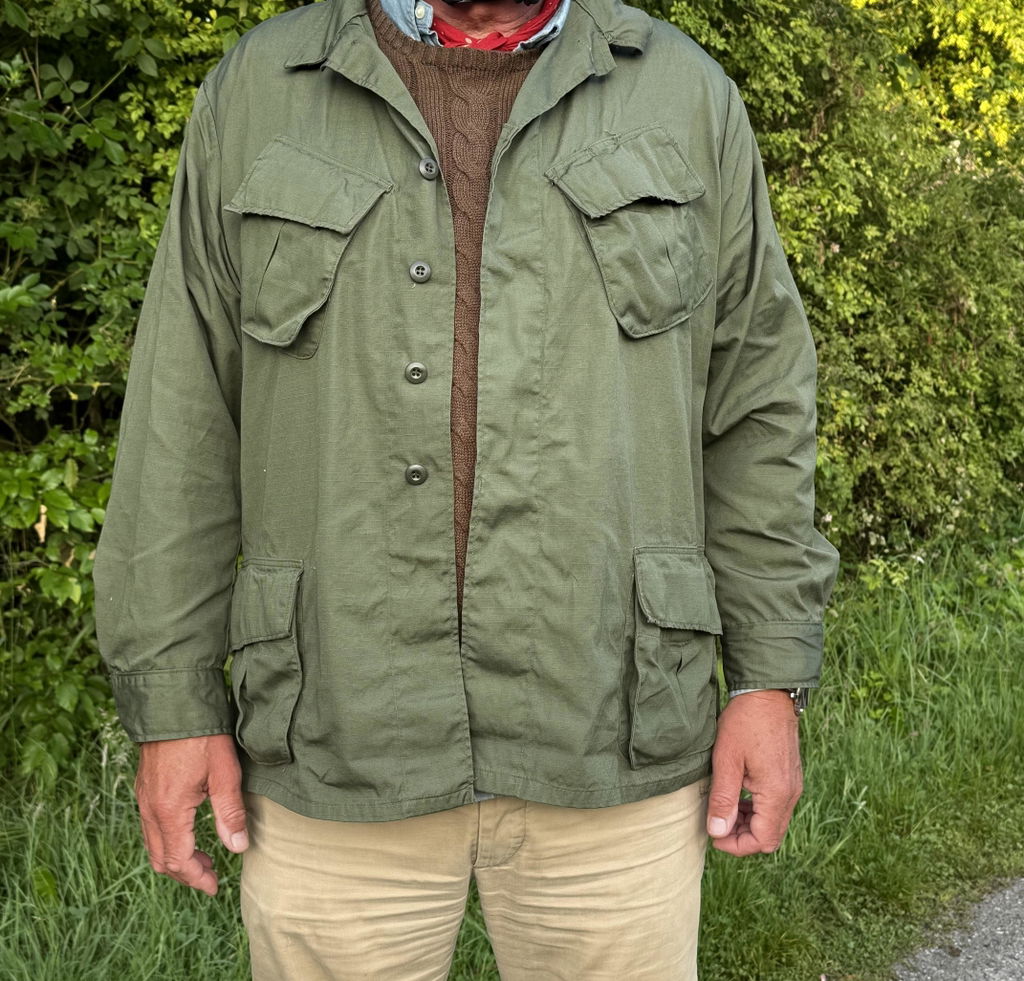
The M-51 field jacket bridges the World War II-era M-43 and the later M-65. Its pointed collar, four pockets, button cuffs and zipper-and-snap front are familiar to military collectors, but its labels and hardware show more variation than a single photograph can explain. This guide uses original Rare Gear USA jackets to compare construction, printed and sewn labels, dated contracts, liners and close-up zipper details.
Start with the complete garment, then read the label and inspect the zipper. A model designation, specification date, contract reference and evidence of a soldier’s service are different things. Tap any photograph for a larger view and follow its link to see the source jacket.
M-51 history: Korea, the Cold War and later service
The Korean War began in June 1950. During its first winter, American forces faced severe cold and depended on existing clothing and layered systems. The M-1951 emerged during the war, not before it: the specification history records MIL-J-11448 (QMC) on 13 September 1951. Older field jackets did not disappear overnight. The Korean armistice was signed in July 1953, so a later contract cannot be assumed to represent a jacket worn during the fighting.
The Army’s postwar field system carried the design forward into the Cold War and the Vietnam era. The M-65 was introduced later, but adoption and replacement were gradual. A jacket made in 1958 or 1964 can be described as a Cold War or Vietnam-era garment; its date alone cannot establish that its wearer served in Vietnam.
Which branches and units used it?
The M-51 is principally documented as a U.S. Army field jacket. The archive also contains an example cataloged to the U.S. Marine Corps; its photographs show a Marine Corps supply marking. That marking is evidence about the garment, not proof that this particular jacket was issued or used in a specific theater. Army examples include unit and rank insignia. Personnel, assignments and supply practice varied; we do not infer universal issue across other branches without supporting records.


How to identify an original M-1951 field jacket
- Pointed collar: folds like a shirt collar; the separate hood is not stored inside a zippered stand collar.
- Four pockets: two chest and two lower front pockets with flaps.
- Zipper and storm flap: a separating zipper lies beneath the snap-fastened wind flap.
- Button cuffs: sleeve tabs adjust with buttons.
- Drawcords: waist and bottom-hem adjustments help close the shell against wind; exterior waist openings are a useful comparison point.
- Layering: internal buttons accommodate a detachable liner.
- Label or stencil: compare the wording and procurement details to the complete garment.


M-51 vs. M-43, M-50, M-65 and fishtail parka
| Garment | Useful first distinction | What to check |
|---|---|---|
| M-43 | Earlier four-pocket jacket, button-front closure. | Compare front and liner provisions. |
| M-50 | Transitional jacket with button-in liner provision. | Check label and closure; a liner alone is not definitive. |
| M-51 | Pointed collar, front zipper, snap flap and button cuffs. | Inspect the entire garment and label. |
| M-65 | Standing collar with hood compartment and different cuffs. | Color or shoulder straps alone are insufficient. |
| M-51 fishtail parka | Separate longer parka with split rear hem. | Do not confuse its liner or hood with the field jacket’s. |
How to read M-51 labels, pattern dates and contracts
Early examples can have printed markings inside the shell; others have sewn size and instruction labels. A pattern date identifies a design reference, not automatically manufacture or issue. A contract date is procurement evidence, not a confirmed day of manufacture or battlefield use. The liner can have its own date. Stock numbers help identify size; names and patches are leads, not definitive proof of service.
1951 pattern and 1952 contract date
A named Army jacket shows Cohen-Fein Co., a 13 September 1951 pattern date, and a separate 14 January 1952 date beside a quartermaster reference. The listing records MIL-J-11448 (QMC). Its name and insignia do not establish where the wearer served.


1955 pattern versus 1956 contract
A jacket cataloged as 1955 has a printed 26 January 1955 pattern date and a separate 24 October 1956 contract-line date. It names Cohen-Fein. The pattern year should not be presented as a confirmed production year.


1958 and 1961 sewn labels
A Cohen Fein example shows MIL-C-11448B, a 14 March 1957 pattern date and a separate 26 February 1958 contract-line date. A different 1961 example has a sewn contract and instruction label. Label presentation is not a precise universal dating rule.


The specification history records MIL-J-11448 in 1951; MIL-C-11448 revision A in 1953, B in 1956, C in 1959, D in 1961 and E in 1963. These are specification milestones, not exact production dates for individual jackets.
M-51 pattern dates, contracts and manufacturers: archive chart
The M-51 did not have a new, neatly defined pattern every calendar year. The dates below are pattern references seen on specific garments, paired with the separate date or contract marking on that example. This is a growing archive, not a complete list of military contracts or proof that each date marks a distinct physical model.
Contractor names refer to the jacket shell when printed on that garment; a zipper maker is a different supplier. “Not shown” means that field was not established from the photographed label. Follow each link to examine the original.
| Pattern date | Separate date or contract | Jacket contractor | Specification / observations | Archive |
|---|---|---|---|---|
| 13 Sep 1951 | 7 Jan 1952 | Sigmund Eisner Co. | MIL-J-11448 (QMC) | View example |
| 13 Sep 1951 | 14 Jan 1952 | Cohen-Fein Co. | MIL-J-11448 (QMC); Crown-marked slider | View example |
| 13 Sep 1951 | 27 Jun 1952 | Parkside Clothes, Inc. | MIL-J-11448 (QMC) | View example |
| 13 Sep 1951 | Jan 1952 | Southern Sportswear Co. | MIL-J-11448 (QMC) | View example |
| 13 Sep 1951 | Not shown | Not shown; Philadelphia Quartermaster Depot is named | Sewn MIL-J-11448 (QMC) label; depot is not automatically manufacturer | View example |
| 7 Nov 1952 | 16 Apr 1953; TAP 1245 | Westmill Farbman, Inc. | MIL-J-11448; RAPID-marked slider | View example |
| 7 Nov 1952 | 16 Apr 1953; DA-30-352-TAP-1237, 01-1295-C-53 | Cohen-Fein Company | MIL-J-11448 (QMC) | View example |
| 26 Jan 1955 | 24 Oct 1956 contract line | Cohen-Fein Company | Listing title says 1955; the pattern and separate contract date differ | View example |
| 26 Jan 1955 | 29 Jul 1957; QM (CTM)-577, 01-22-C-58 | Cohen Fein Company | MIL-C-11448B; preserve both contract-line date and C-58 | View example |
| 14 Mar 1957 | 26 Feb 1958 contract line | Cohen Fein Company | MIL-C-11448B; pocket flannel is labeled 80% wool / 20% cotton | View example |
| 14 Mar 1957 | 2 Oct 1958; QM (CTM)-3058, 01-435-C-59 | Cohen Fein Company | MIL-C-11448B; retain both the date and C-59 | View example |
| Not shown | DA 36-243-QM (CTM)-8037-C-60 | Not shown on photographed label | 1960 contract reference | View example |
| Not shown | DSA-1-1672-63-C | Not shown on photographed label | 1963 contract reference | View example |
Compare the original labels


Another zipper maker: RAPID
The RAPID name is legible on the gold-tone slider of the 1953-cataloged Westmill Farbman jacket. This documents the individual assembly, not all jackets from the contractor or pattern.


M-51 zipper close-ups: Crown, Conmar, Talon and Rapid
These are actual archive close-ups. Compare the maker’s mark, slider, pull, teeth, tape, bottom box and stitching. A slider can be repaired or replaced; color alone cannot establish alloy.
Crown: 1952 contract-dated jacket
The named Army example has CROWN visible on its silver-tone slider. Its catalog calls the zipper aluminum; the photo alone cannot establish alloy or prove the zipper was never changed.


Conmar: 1951-cataloged example
The Small Short example has a CONMAR-marked slider with a gold-tone appearance. Its catalog year should be checked against its label; a zipper does not establish the year alone.


Talon: Marine Corps catalog example and later jacket
The Marine Corps-cataloged jacket shows TALON on the slider and bottom box. A separate 1958 contract-line example has a Talon-marked slider. These are individual observations, not a universal maker timetable.


Rare Gear USA archive: construction, insignia and dates
1952: named and patched Army jacket
The 1952 contract-dated example has a Ramsdell name tape, U.S. Army tape, 24th Infantry Division shoulder insignia and infantry regimental insignia, according to the listing. These details offer useful research leads but do not independently establish a wearer’s deployment.


1951–52 cataloged Marine Corps example
The archive identifies this jacket as a Marine Corps example and describes it as possibly unissued. Its interior photograph shows a Marine Corps supply marking and its front zipper is Talon-marked. The listing’s assessment of issue status is not a verified service record.


1958: jacket and separate pile liner
This Medium Regular coat has the sewn Cohen Fein label described above and was photographed with a removable liner. Record the shell and liner separately: a liner can be substituted and may have its own label and date.


1960 and 1964 contract-era jackets
The Small Regular example has a 1960 contract reference and a Crown-marked bottom box. The Medium Short jacket is cataloged 1964 with DSA-1-3571-64-C and was photographed with a pile liner. A Vietnam-era date does not prove that either jacket was worn in Vietnam.


Insignia and conflicting catalog descriptions
A Special Forces-patched jacket shows an airborne tab and parachutist badge, but its title and description use different conflict labels. We present the insignia without assigning a theater from either title.


M-51 liners, hoods and layering
The M-51 system combined a shell with an optional button-in liner. CIE Hub identifies a detachable mohair-frieze liner and lists shell and liner specifications separately. An M-51 hood is a separate component rather than a hood stored in the collar. Check attachment points, size and labels before buying accessories. Some later liners may fit some buttons, but compatibility and originality should be checked on the actual pair.
The original label describes wear as an outer layer in cold-wet conditions and as an intermediate layer in cold-dry conditions. An unlined shell is not the same as an insulated parka.
Original, modified or reproduction? A practical checklist
- Compare collar, pockets, cuffs, zipper, snaps, waist and hem together.
- Photograph every label and transcribe dates without conflating pattern and contract.
- Inspect zipper marks, tape and stitching; replacement hardware is not automatic proof that the shell is fake.
- Examine patches, replacement buttons, cut labels and seams for alteration; photographs may not establish when changes occurred.
- Record dates and sizes for shell, liner and hood separately.
- Seek independent evidence before claiming a particular wearer or combat history.
Fit, condition and care
M-51 jackets were designed for layers. Compare laid-flat chest, shoulder, sleeve and back length measurements against a jacket that fits you. Ask whether measurements include the liner. Washing and storage can affect individual fit.
Inspect cuffs, pocket corners, collar, fabric strength, drawcords, zipper, snaps, odors and repairs. Do not assume decades-old water repellent treatment still works. Consult a textile conservator before aggressive cleaning of fragile or historically important garments; never force a stiff vintage zipper.
M-51 field jacket frequently asked questions
Was every M-51 made in 1951?
No. M-1951 is a model designation and contracts continued later. Compare the individual label, pattern date and contract reference.
Was every M-51 worn in Korea?
No. The model originated during the Korean War, but later production and continued use prevent a blanket claim. A contract date does not prove theater service.
How do I distinguish an M-51 from an M-65?
Begin with the M-51’s pointed collar and button cuffs versus the M-65’s standing hood-storage collar and different cuff construction, then check the label.
Are all original M-51 zippers Crown?
No. Our documented examples include Crown, Conmar, Talon and Rapid. Zippers can also be replaced.
Does a 1951 pattern date prove manufacture in 1951?
No. It identifies a pattern reference; compare it with any separate contract date.
Is an M-51 jacket the same as a fishtail parka?
No. They are separate garments with different construction and components.
Is a missing liner proof a jacket is incomplete?
The liner is a separate removable component and surviving shells are often sold without one. Check the listing.
Sources and research notes
- U.S. Army history of uniforms, 1950–2000 — historical context.
- CIE Hub: MIL-J/MIL-C-11448 specification history — revisions and document references.
- CIE Hub: M-1951 field jacket shell and liner — nomenclature and stock sizes.
- U.S. Army Center of Military History: Korea 1951–1953 — conflict background.
- Rare Gear USA original product records and photographs, linked beside each example. A listing alone is not a service record.
© 2026 Rare Gear USA. All rights reserved. To request permission to use our photographs or content, contact cs@raregearusa.com. Third-party names, trademarks and insignia belong to their respective owners. Copyright & Image Use Policy.