The Ultimate G-1 Flight Jacket Guide: History, Contracts, Labels & Zippers

RARE GEAR USA · MILITARY COLLECTOR REFERENCE
A G-1 flight jacket can carry several histories at once: a government specification, a manufacturer's contract, years of repairs, and the personal record of the aviator who wore it. The brown leather and fur collar make the family recognizable. The label, hardware and construction tell you which member of that family you are looking at.
This guide traces the Navy leather flight-jacket lineage from M-422 and M-422A through 55J14, MIL-J-7823 and its revisions, to MIL-DTL-7823F. Original Rare Gear USA photographs show military contract examples, later production and commercial comparisons. Every close-up comes from an actual archive jacket; labels and zipper marks have not been reconstructed.
© 2026 Rare Gear USA. Original archive photography and editorial content. Copyright & Image Use Policy.


What specification does the label actually show? What is the complete contract identifier? Do the jacket's physical details agree with that evidence? Keep specification date, contract fiscal year, manufacturing date and service history separate.
G-1 history: the Navy leather flight-jacket family
The wartime ancestors: M-422 and M-422A
The G-1's recognizable architecture predates the G-1 name: a leather shell, fur collar, knitted cuffs and waistband, front patch pockets and a back designed to let the wearer reach forward. The M-422 belongs to 1940; the M-422A became a major wartime Navy intermediate flight jacket. Calling every wartime Navy leather jacket a “G-1” is convenient shorthand, but it conceals the actual specification printed on the label.
John Chapman's original-garment archive documents M-422 jackets by Willis & Geiger and Monarch, followed by M-422A examples from makers including Edmund T. Church, Gordon & Ferguson, Fried, Ostermann, H. & L. Block and Willis & Geiger. Their patterns and proportions vary. A reconstruction of the family should therefore begin with a particular maker and contract, rather than one supposed universal wartime shape.
Original-garment references: Chapman: M-422 and M-422A.
AN-J-3 and AN-J-3A: keep the designations distinct
The 1943 Army-Navy specification sequence introduced AN-J-3 and AN-J-3A. They belong in the historical development, but the near-identical names should not be treated as interchangeable garment descriptions. In particular, a leather-collared AN-J-3-style jacket should not be identified as the familiar fur-collared G-1 merely because it has an action back. Read the actual specification and compare the whole pattern.
Original-garment comparison: Chapman: AN-J-3A.
55J14: the early G-1 designation
The 55-J-14 specification established the G-1 name in the late 1940s. Historical accounts use both 1947 and 1949: the collector bibliography records a 31 October 1947 specification, while the subsequent 1949 revision and procurement period figure prominently in discussions of surviving jackets. Neither date means that every jacket bearing “55J14” was made in that particular year.
Chapman's photographed 55J14 group includes L. W. Foster, Star Sportswear, A. Pritzker, B-G and other makers. Small differences in pocket shape, body length and hardware matter within this early family. Modern commercial jackets can also print “55J14” on a label; an example from our archive appears later in this guide, explicitly as a commercial comparison.
Compare Chapman: original 55J14 jackets; chronology and early designation references: Vintage Leather Jackets, “A Better Fighting Garment…” 3.0, 55J14 section.
MIL-J-7823: a long specification family
MIL-J-7823 replaced 55J14 in 1951 and developed through lettered revisions A, B, C, D and E. The short designation on the label is a design standard, not a manufacturer's model number. Different contractors supplied jackets to that standard, and an amendment could change a requirement without changing the large revision letter visible to a collector.
The result is continuity with variation: the same basic Navy silhouette across decades, but changes in collar material, leather requirements, knit construction, labels and hardware. The long E period is particularly easy to oversimplify. Our early E example still has a dark label; the later examples include light labels and a jacket manufactured in January 2005 under a fiscal-year 2004 contract.
The specification did not stop at E
DLA's official record lists MIL-DTL-7823F dated 9 June 2020, followed by a validation notice dated 15 May 2025. The record is active and describes fifteen sizes in two lengths. A validation notice keeps a document current; it does not create a new “G” revision. Older guides that describe E as the current final specification need this update.
Official record and revision dates: DLA ASSIST / Quick Search: MIL-DTL-7823 (checked October 2026).
Specification timeline: dates are not production cutoffs
The early entries below follow the cited collector bibliography; the E/F record and 1984 amendment date are independently supported by the official DLA index. The E specification's cover identifies its predecessor as D dated 19 April 1966. Some online tables print 16 April instead. Use the document date, and remember that a contract can continue delivering after a later specification appears.
| Specification or event | Reference date | What it tells the collector |
|---|---|---|
| M-422 | 28 March 1940 | Wartime ancestor; do not expect a G-1 designation on its original label. |
| M-422A | 1 October 1940 | Wartime development with substantial maker variation. |
| AN-J-3 / AN-J-3A | 1943 | Related Army-Navy standards; distinguish the actual patterns. |
| 55-J-14 / 55J14 | 31 October 1947; subsequent 1949 revision | Early G-1 designation. A specification number alone cannot date an individual jacket. |
| MIL-J-7823 | 21 November 1951 | Unsuffixed standard of the 1950s; several makers and amendments. |
| MIL-J-7823A | 28 November 1958 | A revision date can precede the year of an A-labeled contract. |
| MIL-J-7823B | 7 October 1960 | Our Ralph Edwards B provides an early-1960s archive comparison. |
| MIL-J-7823C | 3 September 1963 | Mid-1960s development; construction transitions require contract-level comparison. |
| MIL-J-7823D | 19 April 1966 | Our D labels include FY1967, FY1968 and FY1969 contracts. |
| MIL-J-7823E | 15 January 1971 | Long-lived revision; early and later examples differ. |
| E, Amendment 3 | 18 October 1984 | Changes the referenced leather standard from kidskin/goatskin to cattlehide. |
| MIL-DTL-7823F | 9 June 2020 | Later detail specification; fifteen sizes and two lengths in DLA’s scope. |
| F, Notice 1 | 15 May 2025 | Validation of F, not a new jacket revision. |
Sources: VLJ bibliography; MIL-J-7823E cover, reproduced scan; DLA revision history. Early dates are bibliographic references, not claims that every original document has been independently inspected.
How to read a G-1 label and date the jacket
Read the whole label in order
- Garment designation: look for G-1 and the stated garment name. Spelling, punctuation and wording vary across periods.
- Specification: record 55J14, MIL-J-7823 and its actual suffix, or MIL-DTL-7823F. Do not silently add a missing letter.
- Manufacturer: transcribe the company exactly, including whether it is Star, Brill, Ralph Edwards, Imperial, Orchard or another maker.
- Contract: copy every group, retaining the hyphens and any order suffix. Photograph doubtful characters instead of guessing.
- Size and stock number: record these separately. They are not the contract date.
- Manufacturing date or additional labels: check below the neck label and inside the lining. Later jackets can supply a month and year that is more specific than the contract.
Parenthetical marks such as (AER), (WEP), (WP) and (AS) belong to the specification's administrative history. They are not sleeve lengths, leather grades or unit identifications. Our photographed D examples show both WEP and WP. Transcribe the photographed form rather than forcing every label into a single template.
Contract year versus manufacture: a photographed example


MIL-J-7823E (AS)
SPO100-04-D-4247-0001
JANUARY 2005
SIZE 44 · NSN 8415-00-268-7801
For the DSA100-67-C-1095, DSA100-68-C-0099 and DLA100-86-C-0481 formats illustrated here, the two-digit group identifies the contract fiscal year. In the Pharr example, 04 points to FY2004; “January 2005” is the separately printed manufacturing date. Cataloging it simply as “made in 2004” loses the stronger evidence on the jacket itself.
Earlier N383s, QM and DSA-1 formats need their own contract references. Do not read the final two digits of every serial or contract sequence as a year. A short commercial number such as “1982-1” also needs independent verification; familiar-looking digits alone do not establish government procurement.
A stock number answers a different question. The eleven-digit number on an older label and a thirteen-digit NSN on a later label identify a supply item and size. Numbers such as 8415-268-7800 or 8415-00-268-7801 should not be decoded as manufacturing years. Likewise, a handwritten “81,” “82” or other inventory mark may be a later ownership or stores mark.
For the broader formats, see our DA, DSA, DLA and SPO dating guide. For the individual jacket, keep its label photographs with your research notes.
Nine military-contract archive examples
These records are comparisons, not a complete contract census. Several jackets are sold archive pieces. A listing's abbreviated year refers to its catalog context; the transcriptions below prioritize the photographed label. We have not assigned an unseen maker mark or hidden specification character.
1. Ralph Edwards MIL-J-7823B: the B. K. Lloyd jacket


The early-1960s contract attribution, B-revision label and dark-finished zipper give a starting point for this jacket's manufacture. The patches and name tag add another layer. Our archive identifies the owner and documents the jacket alongside a second garment associated with him. The guide preserves that attribution without treating every patch as original to the day the jacket left the factory.
Its back photographs also show the older waistband's visibly different knit zones, useful for comparison with the folded knits on later examples. Do not generalize the presence or absence of repairs from an attractive overall photograph; inspect seams and the reverse side when possible.
2. Star Sportswear MIL-J-7823D: FY1967


The photographed contract is DSA100-67-C-1095. This provides a direct counterexample to the oversimplified claim that all D jackets begin in 1968. The archive describes the zipper as Conmar; the hardware section distinguishes that catalog identification from the characters actually visible in its photograph.
3. The Martin Lane Co. MIL-J-7823D: FY1968


The full contract matters more than an assumed “1968 pattern.” A different maker's size 44 may have different useful measurements, even under the same specification. The back and waistband views later in the guide make this example useful for examining the action pleats and folded-knit arrangement.
4. Star Sportswear MIL-J-7823D: FY1969, with replacement knits


This is a particularly good lesson in evidence. Some compiled lists associate the 0475 ending with a different year. The photographed label here reads 69-C-0475. That discrepancy should be recorded, not silently “corrected.” The listing's replacement-knit disclosure also shows why originality needs to be assessed component by component.
5. Brill Brothers MIL-J-7823E: FY1971
The dark label illustrated in the dating section reads DSA100-71-C-1343, MIL-J-7823E(AS), size 42. It is an early E example and an important check against dating by label color. The shell's visible grain does not by itself prove an animal species, nor does the E suffix alone prove cattlehide.
6–7. Brill FY1975 and Imperial FY1976: later E labels


These light labels show change within E, not a new specification letter. The Imperial jacket also supplies a clear Scovill-marked zipper box for the hardware comparison. Differences between a 1971 Brill and a 1976 Imperial should be described as observed differences in these garments unless a specification or wider contract sample establishes a general rule.
8. Orchard: FY1986 contract, partly obscured specification line


The contract places the jacket in the FY1986 procurement context. Its exact manufacturing date is not separately established by the photograph. In particular, an obscured line deserves a note, not a confident restoration of missing text. The label and construction can still be compared with documented Orchard contracts.
9. Pharr: FY2004 contract, January 2005 manufacture

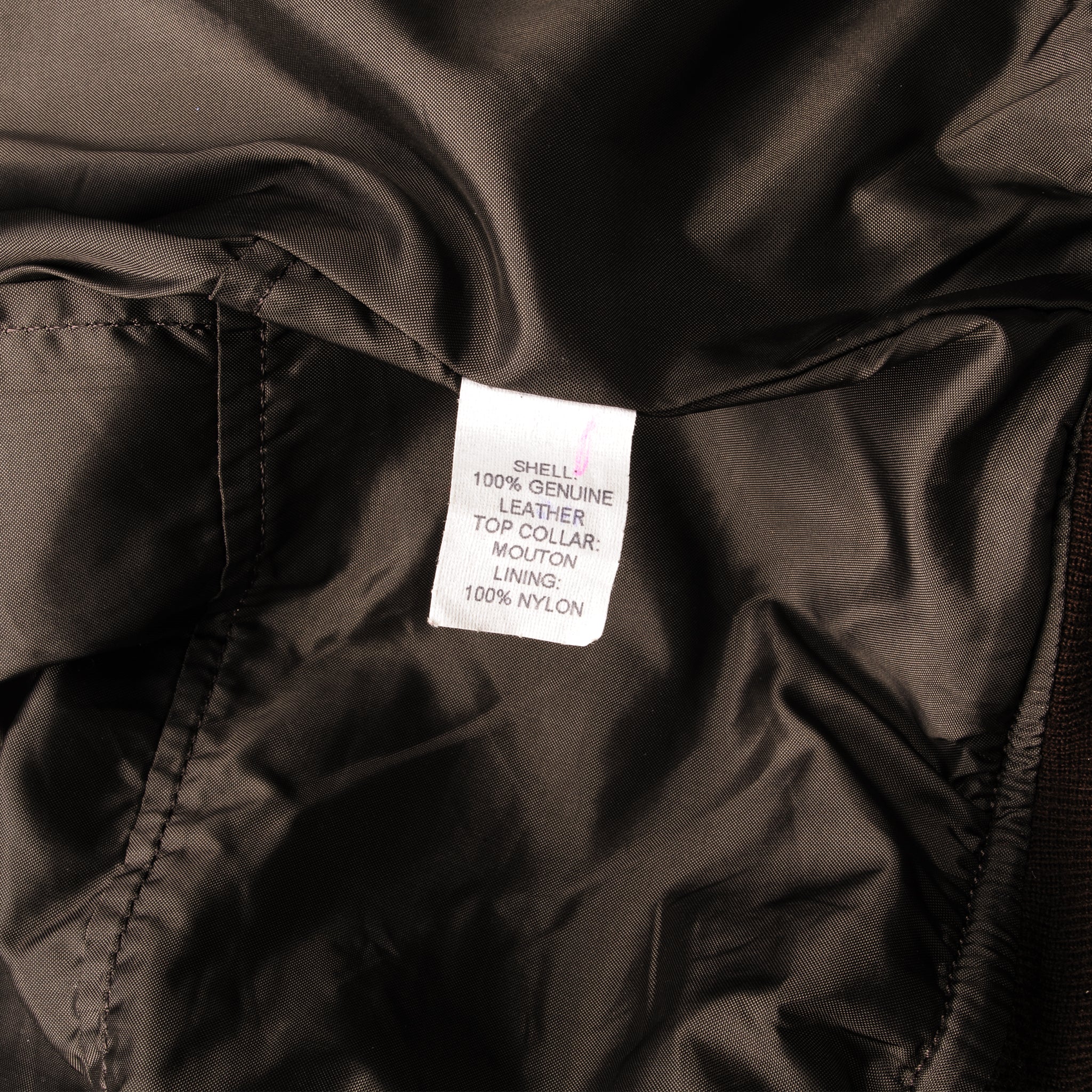
The neck label and DSCP maker label establish Pharr Brand Name Apparel. Do not substitute another contractor's name merely because both companies appear in lists of later G-1 suppliers. Its YKK-marked zipper also demonstrates why a modern zipper brand is not, by itself, a reason to dismiss a later contract jacket.
Leather and collars: replace simple rules with evidence
Goatskin, cattlehide and the important 1984 amendment
Goatskin is central to the early Navy leather-jacket tradition. A frequent shortcut says that the E revision immediately introduced cowhide in 1971 and that every E is therefore cowhide. The specification history is more precise: E Amendment 3, dated 18 October 1984, deletes the reference to KK-L-170, kidskin or goatskin, and adds KK-L-162, cattlehide. That is a documented material-standard change within E.
It does not give permission to identify the leather in every surviving jacket from the suffix alone. Jackets can have replacement panels, commercial counterparts and production histories that require closer examination. A source's catalog date can also be wrong: the official amendment is dated 1984, even where a mirror's index gives a different year.
Primary evidence: MIL-J-7823E Amendment 3, first page, official document link; reproduced document in the VLJ guide. Date independently confirmed in DLA’s revision history.
Modern material requirements also resist the shortcut “later always means cowhide.” NAVAIR's August 2021 request for leather sources for jackets made to F permits full-grain cattlehide with a goatskin-grain finish or goatskin. Consequently, visible pebbling is not a reliable species test. Lighting, finish thickness, wear and an embossed grain can all affect the appearance.
Primary government notice, reproduced by HigherGov: NAVAIR, RFI for Leather Sources for the G-1 Leather Jacket, 18 August 2021; SAM.gov source record.
Mouton and synthetic collars
Traditional mouton is processed sheepskin. Synthetic pile collars can resemble it at first glance, especially in photographs. Color is a poor dating instrument: fading, surface wear, grooming and replacement can change the appearance. A golden collar is not an automatic early-date certificate, and a dark collar is not proof of synthetic material.
The D and E periods require particular care. Chapman's photographed Martin Lane D is described with a natural mouton collar, while his Star E example is described with a synthetic collar. Those are identified garments, not a universal rule that every D has one material and every E the other. A seller's use of the word “fur” may be descriptive rather than a verified material identification.
Look for documentary material information and, when it is already exposed, the backing at a loose edge or seam. Do not unpick an intact collar or use destructive tests to settle a purchase question. Where photographs do not establish the material, record “collar material unconfirmed” instead of turning an impression into a fact.
Individual comparison jackets: Chapman: Martin Lane D and Star E.


Construction details that deserve a closer look
Action back, half-belt and mobility
The pleats behind the shoulders allow the upper back to open as the arms move forward. The horizontal leather section above the knitted hem is often called a half-belt. In a photograph, study the pleat position, the seams that join the back panels and the way the waistband is attached. A distorted or flattened pleat can reflect wear or fit; it is not automatically a different specification.


Pockets, pencil opening and throat latch
The familiar G-1 front has two buttoned flap pockets. Pocket shape, flap curvature and the treatment of the pencil opening can help compare makers, particularly among earlier contracts. They are supporting details: a single curved flap does not identify a maker, and a repaired pocket may no longer match the original construction.
Photograph both pockets straight on and examine the wearer's left pocket for its pencil opening. Also inspect the under-collar fastening arrangement. These small details are more useful when compared with the same maker and contract than with a jacket several decades later.


Rib-rack versus folded waistband
Collectors use “rib-rack” for the earlier waistband construction with visually distinct knit sections. Later folded, double-layer waistbands are an important comparison. Chapman's C-series notes describe variation during that period, so the change should not be treated as a perfectly clean boundary at one letter or one calendar year.
Replacement cuffs and waistbands are common survival repairs. Examine stitch holes, thread, attachment seams, color and elasticity together. Fresh knits do not necessarily make the leather shell a reproduction, but they affect the completeness of an original example. Our Star FY1969 jacket is disclosed as having both cuffs and waistband replaced.
Construction comparison: Chapman: MIL-J-7823C. The replacement disclosure comes from the Rare Gear USA Star FY1969 record.
USN stencil and windflap perforations
Earlier examples may have USN marked beneath the collar; many later examples have USN punched through the zipper windflap. Chapman's unsuffixed 7823 archive notes variation, including examples with both. The change belongs to the 1950s development, but the often-repeated exact amendment attribution is not firmly established by the sources examined here.
A perforated USN is a useful detail, not a complete authentication test. Commercial jackets can have it too, and a windflap can be replaced or removed. Check the quality and placement of the perforations, the flap's attachment and whether the rest of the jacket agrees with the label.


Earlier transition and overlapping markings: Chapman: unsuffixed MIL-J-7823; qualified amendment discussion in VLJ guide, 7823 section.
Lining and interior repairs
Inspect the lining at the neck, underarms, pockets and hem, where stress and abrasion often reveal repairs first. Fabric color can vary with age and photography. A lining replaced during service or later ownership may be useful for wear but removes some original evidence. Look for labels sewn through an existing lining, uneven attachment, old stitch holes and mismatched thread; none of these observations should be judged in isolation.
G-1 zippers: actual close-ups, not brand shortcuts
Inspect the slider, pull, teeth, tape, bottom box, insertion pin and stitching. The pull's shape and the brand name are only part of the assembly. A replacement slider can sit on an older chain, and a period zipper can be installed in a commercial jacket. Record which component bears a mark.


What zipper names can and cannot establish
Talon, Conmar and Scovill recur in the broader original Navy flight-jacket literature; later and commercial jackets add more variations. The useful question is whether a particular assembly agrees with a documented maker and contract. A seller's list of famous zipper brands is not a dating method. Nor should a YKK-marked later example be judged against the expected hardware of a 1940s jacket.
Look closely at the stitch line beside the tape and at the lower leather corners. Extra holes, a different thread path or shortened tape can suggest replacement. Wear alone is inconclusive: a heavily used jacket can retain a good zipper, while a less-used jacket may have needed a repair. A leather pull extension is also replaceable and does not date the zipper.
For early 55J14 hardware, use the linked original-garment references. This guide does not use a later zipper photograph as a stand-in for an unphotographed wartime assembly.
Government contract, private purchase, commercial and reproduction
These categories overlap in appearance but describe different histories. A government-contract jacket was produced under an identifiable procurement contract. A private-purchase jacket may have been bought and worn by a service member. A commercial G-1 can be an excellent jacket without being a government-issued example. A reproduction deliberately recreates an earlier pattern and may also reproduce an old-style label.
Manufacturer history is not enough. Companies can make both contract and civilian jackets, sometimes with very similar construction. “Made in USA,” “USN,” an eagle emblem or a specification number is not conclusive by itself. A genuinely old civilian jacket is still vintage; it should simply be described accurately.
Willis & Geiger with a 55J14-style label


Cooper and Flight Apparel Industries: read beyond the headline


The Cooper comparison has USN perforations as well as a branded label. The Flight Apparel Industries example has an E-style specification line and the word “contract.” Both show why official-looking features need corroboration. These examples are kept out of the military-contract dating table.
The San Diego Leather jacket shown in the zipper section likewise requires independent checking of its label and procurement claim; an IDEAL zipper cannot resolve that question. Our Avirex archive example has its own “Genuine Goatskin” branding, useful evidence of what the maker labeled the material, but not proof of Navy issue. Manufacturer, material, age and procurement status are four separate questions.
Comparison records: Cooper · Flight Apparel Industries · San Diego Leather · Avirex.
Patches and provenance: a jacket is not a service record
The G-1 often becomes a record of a career. Name tags, squadron insignia, ship patches and test-center patches can be added at different times. A jacket made in the early 1960s may display earlier career associations or later assignments. A Vietnam-era contract does not establish use in Vietnam, and a unit patch does not establish that the wearer belonged to that unit.


Strong provenance can include a documented chain of ownership, named family material, dated photographs showing the same jacket and distinctive repairs, or service records that can be compared with the insignia. Stitching and fading may help assess when a patch was attached, but a photograph of the front cannot prove its full history.
Our Captain Bruce K. Lloyd Jr. archive story records Rare Gear USA's attribution. This guide uses the jacket to demonstrate the difference between an observed label, visible name and documented ownership claim; it does not infer individual missions from the garment.
A practical collector's inspection
Ask for photographs that answer specific questions
- Full front, back and open lining: establish the pattern and overall condition.
- Sharp neck label and secondary labels: retain the full contract, size, stock number and manufacturing date.
- Collar top and underside: inspect wear, backing where naturally visible, attachment and throat latch.
- Zipper from both sides and at the bottom: identify readable marks and inspect tape, pin, box and stitch lines.
- Cuffs, waistband and attachment seams: ask directly whether either has been replaced.
- Pocket interiors, action pleats and underarms: check stress points, lining tears and repairs.
- Patch edges and any removed insignia: separate the jacket's condition from claims about its service.
Measure the jacket, not just the tag
Record pit-to-pit width, shoulder width, sleeve length and back length, stating whether the knitted cuffs and waistband are included. Measure the waistband relaxed. Compare those figures with a jacket that fits you, then allow for the lining and how you intend to wear it. A short flight-jacket body should not be evaluated as if it were a field coat.
Old knits can shrink or stretch, replacement knits can change sleeve and body length, and makers can differ within the same labeled size. A civilian 42L is not an automatic fit comparison for a military size 42 from another decade. Avoid a universal instruction to size up or down.
Originality, condition and value
Decide whether you want a wearable jacket, an example of a specific contract, or a documented personal artifact. Those goals place different weight on repairs. Replaced knits may improve wearability while reducing untouched originality; a fragile original collar may have greater documentary value than practical use.
Assess leather splits, surface finish loss, cracking at folds, seam failure, collar damage, moth holes, lining tears and zipper function. Distinguish a surface scuff from a split through the hide. Value also depends on fit, completeness, contract interest and provenance. An asking price alone is not evidence of a completed sale, and an unfamiliar maker is not automatically rare.
Conservative handling and storage
Support the jacket's weight and avoid narrow hangers that concentrate it at the shoulders. Keep it away from direct sunlight, heat and damp storage. Do not force a jammed zipper or flex brittle leather repeatedly for inspection. Follow the garment's own care information, taking its age and repairs into account.
For a fragile or important collector piece, consult a conservator familiar with leather and textiles before cleaning or applying dressings. Household oils, aggressive conditioning and attempts to wash the entire jacket can alter evidence and appearance. Photograph the condition before any treatment or repair, and keep removed original components when practical.
Conservation references: National Park Service, Conserve O Gram 9/1 and Canadian Conservation Institute, Notes 8/2. Their guidance concerns preservation; a wearable garment should be assessed individually.
G-1 collector questions
Is a WWII Navy leather jacket a G-1?
It may be an ancestor such as an M-422A or AN-J-3A. Use its actual specification. The G-1 designation belongs to the later 55J14 sequence, even though collectors sometimes use G-1 loosely for the whole family.
What is the difference between a G-1 and an A-2?
The classic G-1 combines a fur collar and action back with its Navy specification lineage. The classic Army Air Forces A-2 has a leather collar and a different pattern. A brown leather shell and knitted hem are not enough to identify either model.
Is the G-1 the same as an MA-1?
No. The G-1 is the leather, fur-collared Navy family discussed here. The MA-1 belongs to the nylon, knit-collared flight-jacket family. See our MA-1 collector guide for its separate history.
Does MIL-J-7823E always mean cowhide?
No. The 1984 amendment changed the referenced leather standard within E. Identify an individual jacket from its full evidence; do not assign leather species from E alone.
Does real mouton prove an early jacket?
No. A collar can have been replaced, and material availability and specifications must be considered by period. Color and texture in one photograph are insufficient.
Does USN punched into the windflap prove issue?
No. The Cooper commercial-label example in this guide also has USN perforations. Combine the mark with the contract, maker, construction and provenance.
Can an authentic military jacket have replaced knits or a zipper?
Yes. Repairs do not automatically turn the remaining garment into a reproduction. They should be disclosed and considered when judging originality and value.
Is a 2004 contract the same as a 2004 manufacturing date?
No. Our Pharr example carries a fiscal-year 2004 contract and explicitly states January 2005. Record both.
Can I date a jacket by a Conmar, Scovill, Talon or YKK zipper?
Only as supporting evidence. Brands span periods and can be replaced. Match the actual marked component and assembly to a documented contract.
Does a Top Gun-style patch layout prove a military history?
No. A film-inspired arrangement can be applied to an old or new jacket. Costume resemblance does not establish procurement, unit membership or service provenance.
Are these archive jackets currently for sale?
Some are sold archive examples. Use the individual records for photographs and the G-1 collection for current listings.
Research sources and how they were used
The guide gives priority to readable garment labels and original documents. Published collector archives help compare construction and identify historical gaps. Where an older generalization conflicts with a photographed example, the example is described narrowly rather than used to invent another universal rule.
- DLA ASSIST / Quick Search, MIL-DTL-7823 — official E/F revision history, amendment date, validation notice and current scope. The index alone does not establish every earlier date or material clause.
- MIL-J-7823E Amendment 3, 18 October 1984 — leather-standard change, checked against the reproduced first page linked in the materials section.
- MIL-J-7823E, 15 January 1971, reproduced specification cover — identifies the superseded D document as dated 19 April 1966.
- NAVAIR leather-sourcing notice, August 2021, reproduced by HigherGov — primary government text permitting cattlehide with a goatskin-grain finish or goatskin for F procurement; the source SAM.gov record is linked above.
- John Chapman's U.S. Flight Jackets archive — photographs of original garments. The individual M-422, M-422A, 55J14, 7823, C, Martin Lane D and Star E pages are linked in the relevant sections. Older date summaries are not used as rigid production boundaries.
- “A Better Fighting Garment…” 3.0, Vintage Leather Jackets — collaborative collector research, early specification bibliography, document reproductions and contract comparisons. A compiled contract list remains a research aid; the FY1969 Star label in our archive is transcribed as photographed.
- Rare Gear USA G-1 archive and collection — all embedded garment photographs. Each caption links its source product record. Secondary material descriptions are qualified where photographs cannot independently establish them.
Coverage and limits. The illustrated military sequence begins with the Ralph Edwards B and continues through D and E examples. Earlier M-422, M-422A, AN-J-3/3A, 55J14, unsuffixed 7823, A and C, and the modern F standard are covered through text and linked research. The civilian 55J14-style jacket is not presented as an original late-1940s example. All photographs preserve the archive originals; no missing lettering, zipper marking or patch detail has been generated.
Vintage G-1 flight jackets · Military flight jackets · More collector guides
© 2026 Rare Gear USA. Original archive photographs and editorial content. For permission requests, contact cs@raregearusa.com. Third-party trademarks and insignia belong to their respective owners. Copyright & Image Use Policy.