The Ultimate MA-1 Flight Jacket Guide: History, Contracts, Labels & Zippers

RARE GEAR USA · MILITARY COLLECTOR REFERENCE
The MA-1 flight jacket changed substantially during its military career. A 1950s example with a dark neck label and oxygen-hose attachment, a reversible Vietnam-era jacket, and a late Cold War ground-crew jacket belong to the same family, but they tell different stories. Their labels, insulation, pockets and hardware should be read together.
This guide follows that development from the original MIL-J-8279 specification through revisions A–G, then shows how to date and examine surviving jackets. Original Rare Gear USA photographs illustrate selected D, F and G contract examples and commercial variations. Earlier revisions and military E examples are covered through documented references, with links for further comparison.
Which specification is printed on the label? What does the complete contract identifier say? Does the jacket's construction agree with that evidence? Record a specification date, contract year and separately printed date as different pieces of information.
MA-1 history: a flight jacket shaped by the jet age
From the B-15 family to a purpose-built knit collar
The MA-1 emerged in the 1950s from the nylon flight-clothing tradition of the B-15 family. Its defining change was the low knitted collar, replacing the bulky fur collar associated with earlier intermediate flight jackets. This made the neckline better suited to flight helmets and equipment. A short body, elastic knitted waist and cuffs, insulated construction and sleeve utility pocket formed the familiar MA-1 silhouette.
A modified B-15 can also have a knitted collar. That does not turn it into an MA-1: its original model designation, modification label and construction remain relevant. The resemblance explains why early flight-jacket photographs and sales listings are sometimes misidentified. John Chapman's photographic archive treats the B-15 modification and MA-1 families separately.
Reference: John Chapman, U.S. Flight Jackets: MA-1.
Why different histories give different introduction dates
Development, specification approval, contract placement and widespread issue did not happen on one day. Collector chronologies commonly place the original specification in 1953 and production in the following years; broader histories often use a mid-1950s introduction. The exact original issue date is not established here from a scanned first-edition specification. For a collector, 1950s origin is a sound starting point; a surviving jacket needs its own label and contract evidence.
The same care applies to color. Sage green is the standard reference for the military MA-1s discussed here. Dark blue belongs prominently to related B-15C and L-2A history and to later commercial jackets. A blue bomber or a blue jacket with a knitted replacement collar should not automatically be cataloged as an early military MA-1.
Chronological discussion: Creases Like Knives, MA-1 history, Part 1. Introduction dates in general histories differ; the timeline below uses approximate eras where original specification documents have not been verified.
1960s: the reversible jacket and Alpha's arrival
By the C-revision period, documented jackets combined a sage exterior with an orange reverse, making the wearer easier to see when the jacket was turned inside out for rescue visibility. This is the foundation of the familiar orange-lined MA-1, and it predates the D examples illustrated below.
Alpha Industries records its first MA-1 contracts in 1963. It became strongly associated with the model, but the MA-1 was a government specification manufactured by several contractors. Earlier and contemporary labels include names such as Skyline, Dobbs, Lion Uniform, John Ownbey, Satellite and Sportsmasters. A contractor's name is part of the identification, not the model's inventor or an automatic quality ranking.
1970s onward: military development and commercial success
The E generation added the recognizable front pocket flaps. Later F and G jackets belong to the MA-1's ground-crew era, while fire-resistant CWU flight clothing took over the aircrew role. The MA-1 therefore did not simply disappear when a replacement flight jacket arrived. Our 1985 F and FY1989 G examples demonstrate its continuing procurement.
Commercial development ran alongside military procurement. Alpha dates its entry into the consumer market to 1970 and explains that its three-bar logo distinguished commercial products. HOUYHNHNM's retrospective traces the subsequent importance of the MA-1 in Japan and fashion. That second history is worth collecting in its own right, but a civilian MA-1 is a different category from a documented U.S. government-contract garment.
References: Alpha's company chronology; HOUYHNHNM, All Of MA-1.
MA-1 specification timeline: MIL-J-8279 through G
The era column is an orientation, not a universal production-date decoder. Revisions overlap in contract records, and contractors used different fittings. Only the G issue and amendment dates below are presented as exact dates verified in the official ASSIST record. “Original” means the specification without a letter suffix.
| Specification | Approximate era / verified date | Recognition points | Evidence to compare |
|---|---|---|---|
| MIL-J-8279 | Early to mid-1950s | Early green/gray interior; dark neck label; oxygen-hose tab and communication-cord loops; early squared wind-flap top. | Original Skyline and other early-contract photographs. Distinguish from B-15 MOD. |
| MIL-J-8279A | Mid to late 1950s | Early non-orange configuration continues. Rounded wind-flap tops are associated with this development period; equipment tabs remain relevant. | Read the A suffix. Flap shape alone cannot distinguish every early contract. |
| MIL-J-8279B | Late 1950s–around 1960 | Transitional removal of hose and cord attachments. Dark neck labels and non-orange interiors are typical. | Dobbs B examples can retain attachments that other B jackets lack. |
| MIL-J-8279C | Early 1960s; FY1961 and FY1964 examples documented | Orange reversible lining and white printed pocket labels documented; early attachment hardware largely gone. | Skyline DA/QM C contracts and Alpha DSA-1-3075-64-C. |
| MIL-J-8279D | Late 1963 / FY1964 through the later 1960s | Classic orange-lined, flapless-pocket configuration. Wool-pile insulation; contract-dependent hardware and stitching. | Our 1965, FY1967 and FY1968 Alpha examples below. |
| MIL-J-8279E | Circa 1970–71 through the later 1970s | Front pocket flaps; military examples continue the wool-pile era. Scovill and contractor-specific alternatives occur. | Documented Alpha FY1971 and Greenbrier FY1976 jackets. Commercial E labels need separate assessment. |
| MIL-J-8279F | Late 1970s–1980s | Ground-crew-era development; synthetic insulation and green interiors are important late features. | Our DLA100-85-C-0505 example, dated 6 February 1985. |
| MIL-J-8279G | Issued 18 March 1988; late 1980s–1990s examples | Late ground-crew generation, flap pockets and synthetic insulation; compare actual lining construction. | Our DLA100-89-C-0332 example and the official G record. |
| G, Amendment 1 | 31 October 1990 | An amendment to G, not a new MA-1 model or proof that a jacket was made in 1990. | ASSIST revision history lists the document separately. |
Table synthesized from Chapman's original-jacket archive, the WRG collection index, Klaxon's construction guide, the linked contract examples below and DLA ASSIST. The official specification record was canceled on 20 March 2023; that administrative date is not the end date of MA-1 flight service.
The changes that matter most when comparing generations
Early attachments: oxygen tab and communication loops
The chest tab retained an oxygen-hose fitting; smaller loops managed communication leads. These are useful early features, but their removal was not perfectly uniform across every B contract. Chapman's Dobbs B jacket retains both types of attachment, while his John Ownbey example lacks them. That comparison is more useful than a rigid rule that every B must have, or must lack, a chest tab.
Check whether a tab is intact, cut off or replaced. A small rectangle of needle holes can reveal a removed component, but holes alone do not establish what was once attached. Compare location, dimensions and seams with a documented jacket of the same contract.
Original comparisons: Dobbs B and John Ownbey B.
C versus D: orange lining was already present
A documented Skyline C jacket carries DA-36-243-QM(CTM)8922-C-61 and an orange lining. A documented Alpha C carries DSA-1-3075-64-C, also with orange lining. These examples establish that an orange reverse is not exclusive to revision D. Chapman's C specimen also shows a white label inside the pocket and a Crown main zipper.
C and D can look very similar from the front. Read the actual suffix and contract rather than trying to identify them by orange shade or a supposedly definitive silhouette. The documented early Alpha D contract DSA-1-3607-64-C bears a separate 23 December 1963 date: C and D therefore both occur in the FY1964 contract record. The fiscal year does not identify the revision by itself.
Garment records: Skyline C, FY1961; Alpha C, FY1964; Alpha D, FY1964; Chapman's Skyline C.
D versus E: pocket flaps are the strongest visible change
The front pockets on our D examples have slanted openings without covering flaps. E-generation jackets introduce the familiar snap-fastened flaps. For collectors this is a useful first separation, followed by the label. An E-looking civilian jacket can reproduce the pocket arrangement without belonging to a military E contract.
Hardware also varies within a revision. The documented 1971 Alpha E example uses Scovill hardware; the 1976 Greenbrier E example uses Serval main and sleeve zippers. The same E suffix does not require the same zipper maker. Keep a contractor comparison separate from a revision comparison.
References: Alpha E, FY1971; Greenbrier E, FY1976. The first page's heading has an inconsistent DLA transcription; the collection index identifies its FY1971 contract as DSA. Do not copy that heading as a label reading.
F and G: green lining can be late
Early MA-1s and late ground-crew-era examples can both have non-orange interiors. Our 1985 F makes the distinction concrete: its green interior accompanies flap pockets, a DLA contract and a label describing synthetic-fiber insulation. That combination belongs decades after the early dark-label jackets.
The 1989-contract G adds another late reference. Its label names Alpha Industries and Summit Apparel as manufacturer, and its interior has visible quilting. A green lining should therefore start a comparison of labels, pockets and insulation, rather than end the dating process.
How to read MA-1 labels and contract dates
Separate the model, specification, stock number and contract
A label is a small document with several different numbering systems. MA-1 is the garment designation. MIL-J-8279D identifies the specification revision printed on that label. A number beginning 8415 is clothing stock information. A DSA or DLA sequence identifies procurement. None of those lines should be substituted for another.
Label layout changes too. Early dark neck labels give way to white printed labels associated with reversible jackets and pocket placement. Our later F label has a different surface and print style from the woven D labels. Study the typography, label material and attachment along with the wording; reproductions can copy a correct contract number.
| Element | What it tells you | Collector's check |
|---|---|---|
| Garment name | Flying / flyer's / intermediate nomenclature varies. | Copy the complete wording rather than modernizing it. |
| Specification suffix | The labeled version of MIL-J-8279. | D is a revision letter, not a decade or a size. |
| Contract identifier | The procurement reference; later formats include a fiscal-year field. | Retain prefixes, separators and every digit. |
| Separate date | A calendar date printed with the procurement information. | Do not automatically describe it as the day the garment was sewn. |
| Stock number and size | Supply identification and the labeled size. | Stock-number digits are not a hidden manufacturing date. |
| Maker and materials | Named companies and the stated construction. | Preserve a separate “MFG.” role and distinguish shell, lining and interlining. |
Contract formats change: one shortcut cannot decode every era
Early MA-1 labels may use Air Force, Army or Quartermaster procurement formats. The Skyline C example above uses a long DA/QM identifier ending in a year reference. Early DSA formats can place a fiscal-year reference near the end, as in DSA-1-3075-64-C. Other mid-1960s DSA contracts lack that familiar explicit two-digit-year position.
Our DSA-100-1579 jacket is the practical trap: its label separately reads 1 NOV. 1965. Reading the last two digits as “1979” would put it in the wrong decade. In the later DSA 100-67-C-1472 and DLA100-89-C-0332 formats, the 67 and 89 fields are fiscal-year references. Identify the format before interpreting the digits.
| Archive specimen | Contract as photographed | Separate printed date | Accurate description |
|---|---|---|---|
| D, Small | DSA-100-1579 | 1 NOV. 1965 | D revision with a November 1965 label date. |
| D, Large | DSA 100-67-C-1472 | 2 NOV. 1966 | FY1967 contract with a November 1966 printed date. |
| D, X-Large | DSA 100-68-C-1746 | 1 MARCH 1968 | FY1968 contract and March 1968 printed date. |
| F, Medium | DLA100-85-C-0505 | 6 FEB 1985 | FY1985 contract and February 1985 printed date. |
| G, Medium | DLA100-89-C-0332 | DTD. 08 NOVEMBER 1988 | FY1989 contract with a November 1988 printed date. |
These are photographed label readings, not a list of every MA-1 contract. The 1966/67 and 1988/89 pairs are not contradictions: a fiscal year can include months from the preceding calendar year. A procurement date also precedes or differs from manufacture, delivery, issue and actual wear. Keep those events separate in a listing or collection record.
A useful catalog entry: “Alpha Industries MA-1, MIL-J-8279D, size Large; DSA 100-67-C-1472; label dated 2 November 1966; orange reverse; Conmar main pull visible in archive photograph.” This gives another collector information they can check. “1967 Vietnam combat pilot jacket” adds a service story that the label does not establish.
For other clothing families, see our guide to military contract numbers.
Original archive jackets: full garment and its own label
Each pair shows one jacket and a label photographed from that same garment. The links preserve the source listing even when the piece is sold. Photographs document the surviving object; an untouched appearance alone does not prove that every component is factory-original.
1. Alpha MIL-J-8279D — 1 November 1965
The Small example shows the flapless front-pocket arrangement and a readable D label. Its insulation wording is 58% wool, 42% cotton. The main and sleeve zipper photographs later in this guide both show Conmar markings.


2. Alpha MIL-J-8279D — FY1967 contract
The Large jacket has DSA 100-67-C-1472 and 2 NOV. 1966 on its label. Its insulation is described as wool pile with cotton backing. The orange reverse and triangular stitching on the leather zipper extension can be studied in the detail photographs below.


3. Alpha MIL-J-8279D — FY1968 contract
This X-Large example reads DSA 100-68-C-1746 and 1 MARCH 1968. Its Scovill main zipper offers a useful comparison with the Conmar pulls on the preceding D jackets. This is a dated example of variation within D, not proof that every contractor changed hardware at the same time.


4. Alpha MIL-J-8279F — 6 February 1985
This Medium F jacket provides the bridge to later construction: flap pockets, green interior and a label specifying synthetic fiber with cotton covering, plus nylon shell and lining. Its contract is DLA100-85-C-0505. Read “synthetic fiber” as printed; the label does not name a more specific fiber here.


5. Alpha / Summit MIL-J-8279G — FY1989 contract
The G label reads DLA100-89-C-0332 and DTD. 08 NOVEMBER 1988. It identifies Alpha Industries and Summit Apparel Inc. (MFG.). Its Scovill hardware and quilted green interior extend the comparison beyond the Vietnam-era configuration.


MA-1 zippers: Crown, Conmar, Scovill and other suppliers
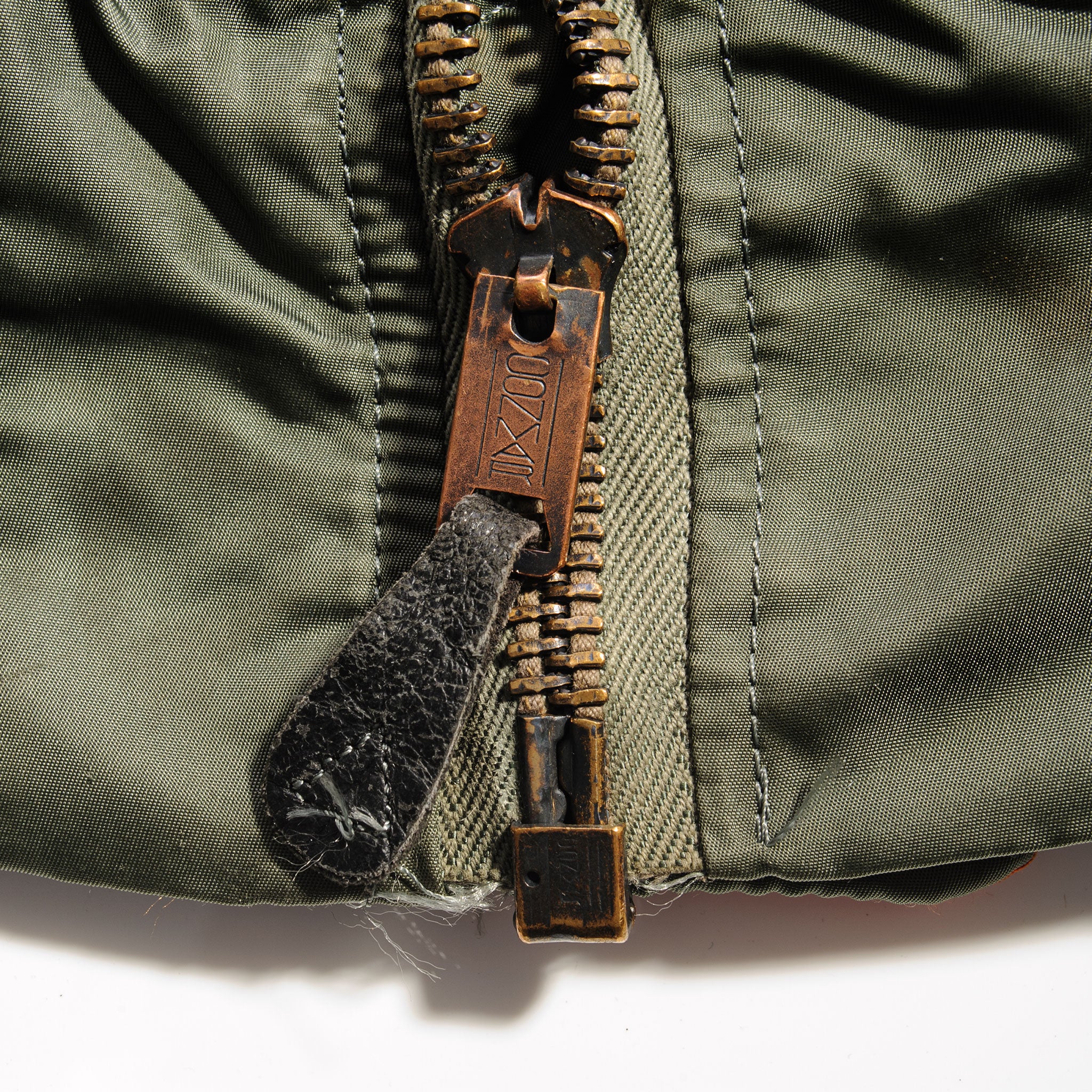
A zipper can help connect an MA-1 to a period and contractor, but it is a component with its own history. Photograph the stamped pull, slider, teeth, tape, stops and bottom box. A leather extension can obscure the maker; move it gently for inspection rather than pulling hard on old leather or a stiff slider.
Conmar: two dated D examples
Our 1965 and FY1967 D jackets both have clearly readable CONMAR main pulls. Their leather extensions differ in appearance and wear. The FY1967 example shows triangular stitching; that is useful to record, but a replacement extension can imitate an original shape or stitch pattern.

Scovill: a late-1960s example and a late-contract example
The FY1968 D main pull is marked SCOVILL. Our FY1989 G also has Scovill hardware, with a visibly different pull marking. These two garments show why “Scovill zipper” cannot supply a precise jacket date: the name spans a long period. Compare the actual component style and installation with a known contract.


The sleeve zipper deserves its own photograph
Main and sleeve zippers perform different jobs and have different pull shapes. The 1965 jacket's sleeve pull reads Conmar. The FY1989 jacket shows SCOVILL and GRIPPER markings on its sleeve hardware. Record each component separately; a main zipper photograph cannot establish what is fitted to the utility pocket.


Where Crown and Serval fit
Crown is documented on early MA-1s and on C and early D specimens; a Crown zipper is not exclusive to the first version. The Skyline C reference includes Crown main and sleeve hardware, while the early Alpha D reference also records Crown components. A Crown marking or distinctive slider can be valuable comparative evidence, but reproductions also recreate these details.
Serval is documented on the 1976 Greenbrier E jacket. That is a useful contractor-specific example of why an unfamiliar maker should prompt research rather than immediate rejection. Our archive plates show Conmar and Scovill; Crown and Serval examples are linked in the references instead of illustrated with a substitute jacket.
Hardware references: Skyline C, Crown; early Alpha D, Crown; Greenbrier E, Serval.
How to inspect a possible zipper replacement
Follow both tape seams from collar to waistband. Look for old needle holes beside the current seam, altered seam allowances, abruptly different thread, or mismatched wear between tape and surrounding cloth. Check whether the bottom reinforcement has been disturbed. These observations justify closer examination; a photograph alone may not resolve when or why work was done. A functional replacement can make a jacket wearable, but it should be disclosed in a collector listing.
Construction details: what changed and what to photograph
Shell, lining and interlining are three different layers
The outer shell is the visible nylon surface. The lining is the inner fabric against the wearer. The interlining is the insulation between them. Calling every MA-1 “polyester-lined” collapses those separate layers and misdescribes our 1960s examples.
The 1965 label gives a combined wool/cotton percentage; the FY1967 and FY1968 labels describe wool pile and cotton backing separately. Those are different ways of reporting a pile-and-backing construction, so the wording alone does not prove a complete redesign of the insulation between the contracts. The 1985 F label explicitly introduces a different category in our comparison: synthetic fiber. Do not cut open a jacket to identify its filling; begin with its own label and construction record.
Orange reverse, green interior and quilting
The orange reverse is both a practical feature and a major visual dividing point in the history. Compare the inside pockets, reversible zipper arrangement and seams, not just the color. A faded orange can photograph pale yellow or salmon; camera settings, wear and light all affect color comparisons.


The late G example below has a visibly quilted green interior. This is a stronger construction comparison than simply calling both the F and G “green lined.” Check where quilting occurs and how the body, sleeves and pocket bags are assembled. A single cropped view of a cuff does not show the whole insulation arrangement.

Wind flap and stitch patterns
The insulated flap behind the main zipper blocks the opening. Its top shape and rows of stitching are useful comparative details. Early squared and later rounded tops belong to the historical development, but stitching also varies by contractor. Sportsmasters D examples, for instance, are documented with straight vertical stitching. A stitch pattern should be matched to a labeled example rather than used as a universal “early” or “late” rule.
Contractor comparison: Chapman's Sportsmasters D jacket.
Pockets, sleeve utility pocket and knit trim
Front pocket flaps are easy to compare in the full-jacket plates. Look inside as well: pocket bags, snap placement and label position can add information that the silhouette misses. The sleeve utility pocket combines a zip compartment with narrow pen channels. Check the seams between those channels and the pocket body, where stress and repairs are easy to overlook.
Inspect collar, cuffs and waistband separately. The exposed cuff ends may be frayed while the collar remains intact; that difference does not automatically imply replacement. Look at rib structure, elasticity, color and the joining seam. Replacement knits may be well fitted and period-appropriate, yet still need to be recorded as replacements.

Military contract, commercial MA-1 or reproduction?
These are three legitimate collecting categories. A commercial Alpha is an authentic product of Alpha without necessarily being a U.S. military issue garment. A reproduction can be a carefully made study of an earlier contract. The mistake is treating a military-looking label, American manufacture or a familiar brand as proof of procurement.
Commercial-style E label: why a specification line is insufficient
This archive jacket carries MIL-J-8279E wording and states 100% polyester batting. It also prints AF/64-11-3069 in a contract-style line. We have not established that identifier as a U.S. government procurement contract for this garment. It is shown here as a commercial-style comparison, not as our historical military E specimen. The “64” in that string is not sufficient evidence to call it a 1964 jacket.


Black Alpha jacket with retail branding
This black patched example combines an Alpha brand label with white military-style nomenclature. It illustrates the civilian branch of the family. Patches and USAF lettering are visible decoration; they do not establish a government contract or a named wearer's service history.


For a claimed military original, compare the contract, specification, size/stock-number relationship, label material and construction. For a claimed reproduction, identify the actual maker and product. A copied historical date belongs to the design being reproduced; it is not the reproduction's manufacturing date. Missing labels leave less evidence, but they do not by themselves prove a jacket is civilian or fake.
MA-1 versus L-2B, B-15 MOD, CWU and G-1
| Jacket family | Useful distinction | Common identification trap |
|---|---|---|
| MA-1 | Intermediate insulated nylon-jacket family; MIL-J-8279. | Assuming every example has orange lining or flap pockets. |
| L-2B | Lighter flight-jacket family; MIL-J-7448 rather than 8279. | Identifying by knit collar and sleeve pocket alone. |
| B-15 MOD | A modified earlier jacket can carry a knit collar. | Ignoring its B-15 designation and modification evidence. |
| CWU-36/P / CWU-45/P | Separate flight-jacket families associated with fire-resistant military fabrics. | Applying MA-1 contract or material assumptions to a CWU. |
| G-1 | Leather naval flight-jacket family, with a different collar and pocket design. | Calling any short leather bomber a leather MA-1. |
Browse the flight-jacket collection to compare complete garments. Confirm the model from its label before applying the dating rules for that family.
Buying, sizing and caring for a vintage MA-1
A focused collector's inspection
- Request a coherent photo set: front, back, full label, both zippers, complete interior, knits and every flaw. Confirm that all details belong to the jacket offered.
- Transcribe before interpreting: save the exact specification, contract, date, maker, size and material wording.
- Compare a matching contract: use the same maker and revision where possible. A 1980s commercial jacket is a poor control for a 1960s military example.
- Check alterations: replaced zippers, knits, shortened sleeves, lining repairs and removed patches affect the garment's history and fit.
- Evaluate provenance separately: a wartime date does not prove theater use. A named veteran's documents or contemporary photographs are stronger evidence than a patch alone.
- Keep a record: preserve photographs, measurements and seller disclosures with the jacket.
Value depends on the particular contract, completeness, condition, size, alterations and documented provenance. A scarce early configuration may interest one collector more than a cleaner later example. Avoid treating an asking price as a verified sale or calling a jacket rare solely because its maker is unfamiliar.
Measure the actual jacket
Compare pit-to-pit width, shoulders, sleeve length and back length with a jacket you wear. Specify whether measurements include the knits and whether the waistband is relaxed. The MA-1's short body can fit very differently from a field jacket with the same chest measurement. Insulation thickness, knit shrinkage and repairs also change how a labeled size feels.
Condition and care
Check nylon for tears, abrasion, staining and old stitch holes; inspect knits for moth damage and broken yarns. Test a zipper gently without forcing it. Read the individual care label: the illustrated military examples call for dry cleaning, but aged fabrics, patches and repairs still need assessment by a cleaner experienced with vintage textiles. For a fragile collector piece, consult a textile conservator before treatment.
Store away from direct sun and damp conditions, with support that avoids concentrating the jacket's weight on narrow shoulder points. See our condition guide and the listing's measurements and flaw photographs.
MA-1 collector questions
When was the MA-1 introduced?
It emerged in the 1950s. Frequently quoted dates refer to different milestones—specification, production or issue. This guide uses approximate early eras and dated garment records rather than assigning every jacket to a single launch year.
Did orange lining begin with MIL-J-8279D?
No. Documented Skyline and Alpha C-revision jackets already have orange interiors. D is an important later generation of that reversible design.
Does green lining mean a 1950s MA-1?
No. Our photographed 1985 F also has a green interior. Combine lining color with the label, pocket design and insulation.
Why does a 1967 contract jacket have a 1966 date?
The contract uses a fiscal-year reference; the separately printed date is a calendar date. Our FY1967 and FY1989 examples show this distinction directly.
Which MA-1 revision introduced front pocket flaps?
E is the established milestone for that change in the military sequence. Commercial jackets can reproduce the feature, so read the contract label too.
Does Conmar, Crown or Scovill prove authenticity?
No single zipper authenticates a jacket. Hardware can be replaced, reused or reproduced. The archive demonstrates maker variation within D and the continued use of Scovill on a later G.
Is an Alpha MA-1 always military issue?
No. Alpha manufactured for military contracts and civilian buyers. The illustrated commercial-style labels show why the brand and specification wording are not sufficient by themselves.
Are all the photographed jackets available?
Archive pieces may be sold. Use the source pages for garment evidence and the MA-1 collection for current listings.
Sources, conflicting dates and photographic coverage
This guide combines original Rare Gear USA photographs, published collections of identifiable garments, manufacturer history and the official specification index. It separates observed label text from historical interpretation. Exact changeovers are not inferred from one jacket or a reproduction product description.
- DLA ASSIST: MIL-J-8279 — authoritative G-revision, amendment and cancellation dates. The index does not establish every earlier revision's date.
- John Chapman's U.S. Flight Jackets archive — original early, B, C and D specimens; links in the relevant sections identify the individual garments.
- WRG MA-1 collection and label comparisons — photographed contracts, variations and explicitly separated original, reproduction and commercial categories.
- Alpha Industries chronology — company milestones and commercial branding.
- Alpha, The Complete Bomber Jacket History — broader bomber-jacket context. Its early MA-1 dates and blue-origin account differ from the original-garment references; those claims are not used as contract-dating rules here.
- Klaxon, MA-1 Flight Jacket Guide — construction overview and reproduction context.
- HOUYHNHNM, All Of MA-1 — Alpha retrospective and civilian/fashion history.
- Creases Like Knives, MA-1 history, Part 1 — supplementary collector chronology; exact early dates remain qualified.
Two points where evidence matters: some overviews attach the orange-lining change to D or to Alpha's first contracts; surviving C examples show it earlier. Some summaries make the B-revision removal of equipment tabs absolute; the documented Dobbs B retains them. The guide follows the more specific garment evidence in both cases.
Every embedded garment photograph comes from Rare Gear USA's archive. Missing early and military E photographs are represented by text and source links, not by mislabeled later jackets. The E-style commercial comparison is clearly identified as such. No label text or zipper marking has been reconstructed.
Vintage MA-1 jackets · Military flight jackets · More collector guides
© 2026 Rare Gear USA. Original archive photographs and editorial content. Permission requests: cs@raregearusa.com. Third-party trademarks and insignia belong to their owners. Copyright & Image Use Policy.