カート
代替案を閉じるアイコン
🎖️ すべてのご注文に米国内送料無料 📦 🎖️ すべてのご注文に米国内送料無料 📦

ニュース

Vintage Vietnam War Tropical Combat Jackets Accurate Pattern Identification Guide

Vintage Vietnam War Tropical Combat Jackets Accurate Pattern Identification Guide

U.S. Vietnam War Tropical Combat Jackets

Accurate Pattern Identification Guide (1st–5th Pattern)

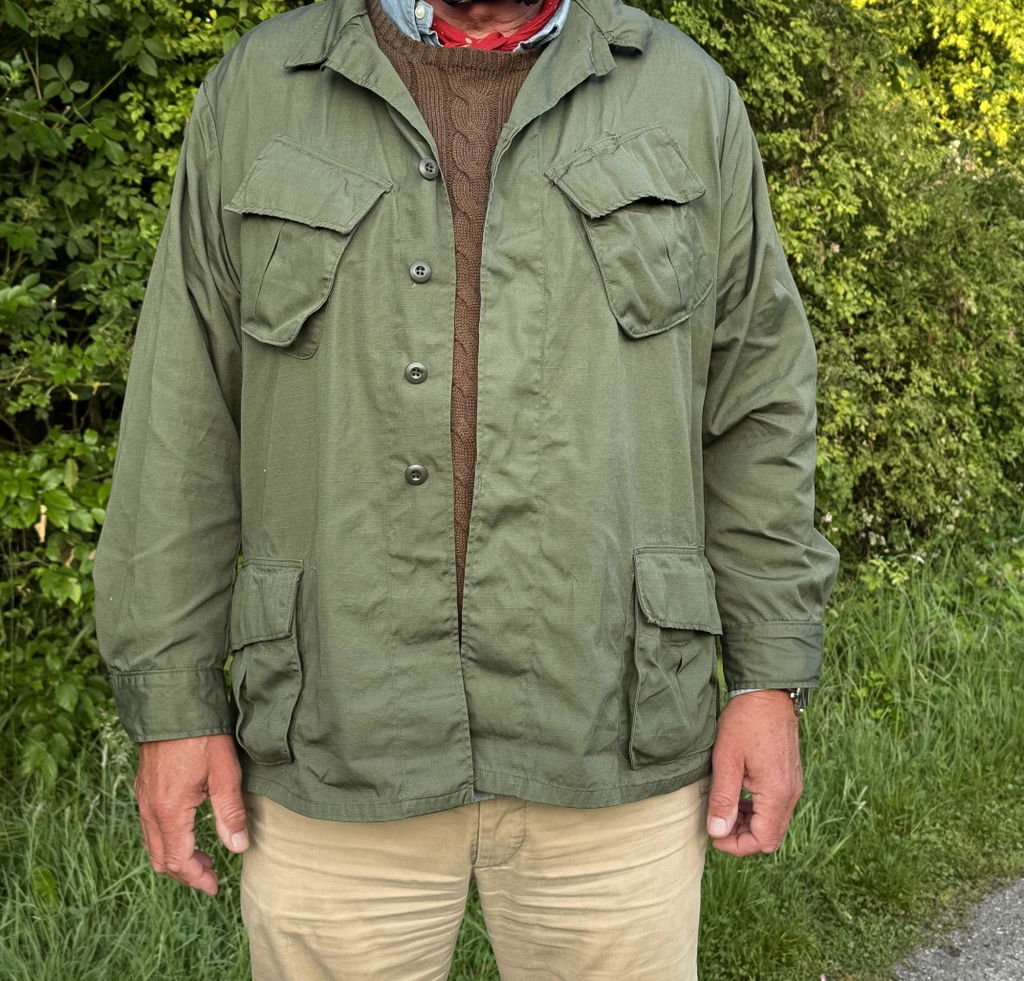
The U.S. Tropical Combat Jacket — commonly called the “Jungle Jacket” — was developed for combat in Vietnam’s extreme heat and humidity. Lightweight cotton construction replaced heavier utility uniforms, and between 1963 and the early 1970s the jacket evolved through five distinct patterns.

These patterns are identified by construction changes — not by speculation or fabric alone. Critical identifiers include:

  • Gas flap presence

  • Epaulets

  • Waist adjustment tabs

  • Pocket drain holes

  • Back yoke

  • Fabric type (poplin vs. ripstop)

  • Hanger loop

Below is the accurate breakdown.


1st Pattern (1963–1964)

The earliest standard-issue jungle jacket.

Construction features:

  • 5.5 oz wind-resistant cotton poplin (smooth weave)

  • Exposed pocket buttons

  • Epaulets

  • Adjustable waist tabs

  • Interior gas flap behind zipper

  • Slanted chest pockets

  • Drain holes in pockets

  • Hanger loop present

The hanger loop is sewn into the interior collar seam and is consistent on 1st pattern production.

These are scarce and command strong collector interest.

Vintage US Army Tropical Combat Jacket First Pattern 1963 Vietnam War Size Large Regular. Slant Pocket

Vintage US Army Tropical Combat Jacket First Pattern 1963 Vietnam War Size Large Regular. Slant Pocket

Vintage US Army Tropical Combat Jacket First Pattern 1963 Vietnam War Size Large Regular. Slant Pocket

Vintage US Army Tropical Combat Jacket First Pattern 1963 Vietnam War Size Large Regular. Slant Pocket

View Item


2nd Pattern (1965)

Refinement of the 1st pattern, primarily modifying pocket closures.

Construction features:

  • Cotton poplin (non-ripstop)

  • Concealed (covered) pocket buttons

  • Epaulets retained

  • Waist tabs retained

  • Gas flap retained

  • Drain holes retained

  • Hanger loop present

The concealed buttons were introduced to reduce snagging in vegetation.

If a jacket has covered buttons + epaulets + gas flap + hanger loop, it is a 2nd pattern.

Vintage Us Army Tropical Combat Poplin Slant Pocket Jacket 2Nd Pat 1966 Vietnam War Large Short Nos Deadstock  DSA-100-1387

Vintage Us Army Tropical Combat Poplin Slant Pocket Jacket 2Nd Pat 1966 Vietnam War Large Short Nos Deadstock  DSA-100-1387

Vintage Us Army Tropical Combat Poplin Slant Pocket Jacket 2Nd Pat 1966 Vietnam War Large Short Nos Deadstock  DSA-100-1387

Vintage Us Army Tropical Combat Poplin Jacket 2Nd Pat 1966 Vietnam War Large Short Nos Deadstock  DSA-100-1387

Vintage Us Army Tropical Combat Poplin Jacket 2Nd Pat 1966 Vietnam War Large Short Nos Deadstock  DSA-100-1387

Vintage Us Army Tropical Combat Poplin Jacket 2Nd Pat 1966 Vietnam War Large Short Nos Deadstock  DSA-100-1387

View Item


3rd Pattern (1966–1967)

Significant simplification of the jacket’s structure. Introduction of the ERDL camo version

Construction features:

  • Cotton poplin

  • No epaulets

  • No waist tabs

  • No gas flap

  • No pocket drain holes

  • Back yoke added

  • Hanger loop present

This is the last pattern to include the hanger loop.

Collectors sometimes misidentify this pattern due to the stripped appearance. The absence of drain holes combined with the presence of a hanger loop is the key identifier.

Vintage Us Army Tropical Combat Poplin Slant Pocket Jacket 3rd Pat 1966 Vietnam War Medium Long Nos Deadstock

DSA100-4257

The 3rd major version of the Tropical Combat Coat was first produced in 1966 and had no gas flap, epaulets, waist tabs or pocket drain holes. It was the first jungle jacket to have a back yoke and was made in both OG-107 and ERDL camouflage. Like all prior models it was made from wind-resistant cotton poplin and had pen pockets behind both chest cargo pockets.

Vintage Us Army Tropical Combat Poplin Slant Pocket Jacket 4Th Pat 1967 Vietnam War Medium Long Nos Deadstock  DSA 100-67-0 3214  The 4th pattern Tropical Combat Coat was the first to be made from rip-stop cotton poplin. Like the 3rd model jungle jacket it had a back yoke and was produced in both OG-107 and ERDL camouflage.

Vintage Us Army Tropical Combat Poplin Slant Pocket Jacket 4Th Pat 1967 Vietnam War Medium Long Nos Deadstock  DSA 100-67-0 3214  The 4th pattern Tropical Combat Coat was the first to be made from rip-stop cotton poplin. Like the 3rd model jungle jacket it had a back yoke and was produced in both OG-107 and ERDL camouflage.

Vintage Us Army Tropical Combat Poplin Slant Pocket Jacket 4Th Pat 1967 Vietnam War Medium Long Nos Deadstock  DSA 100-67-0 3214  The 4th pattern Tropical Combat Coat was the first to be made from rip-stop cotton poplin. Like the 3rd model jungle jacket it had a back yoke and was produced in both OG-107 and ERDL camouflage.

View Item

The Tropical Combat Jacket Was Designed In 1962 By Natick Labs For The Special Forces In Vietnam.

Vintage Us Army Tropical Combat Jacket 3rd Pat Erdl Camo 1966 Vietnam Size Medium Long

There Is A Total Of 5 Different Patterns Produced In Og-107 And 3 Of Them Produced In Erdl Camouflage.

Made From Rip Stop Wind Resistant Cotton Poplin.

8415-915-7657

The Tropical Combat Jacket Was Designed In 1962 By Natick Labs For The Special Forces In Vietnam.

Vintage Us Army Tropical Combat Jacket 3rd Pat Erdl Camo 1966 Vietnam Size Medium Long

There Is A Total Of 5 Different Patterns Produced In Og-107 And 3 Of Them Produced In Erdl Camouflage.

Made From Rip Stop Wind Resistant Cotton Poplin.

8415-915-7657


The Tropical Combat Jacket Was Designed In 1962 By Natick Labs For The Special Forces In Vietnam.

Vintage Us Army Tropical Combat Jacket 3rd Pat Erdl Camo 1966 Vietnam Size Medium Long

There Is A Total Of 5 Different Patterns Produced In Og-107 And 3 Of Them Produced In Erdl Camouflage.

Made From Rip Stop Wind Resistant Cotton Poplin.

8415-915-7657

*Some of the ERDL Camo Jacket don't have the Hanger Loop

The Tropical Combat Jacket Was Designed In 1962 By Natick Labs For The Special Forces In Vietnam.

Vintage Us Army Tropical Combat Jacket 3rd Pat Erdl Camo 1966 Vietnam Size Medium Long

There Is A Total Of 5 Different Patterns Produced In Og-107 And 3 Of Them Produced In Erdl Camouflage.

Made From Rip Stop Wind Resistant Cotton Poplin.

8415-915-7657

 The Tropical Combat Jacket Was Designed In 1962 By Natick Labs For The Special Forces In Vietnam.

Vintage Us Army Tropical Combat Jacket 3rd Pat Erdl Camo 1966 Vietnam Size Medium Long

There Is A Total Of 5 Different Patterns Produced In Og-107 And 3 Of Them Produced In Erdl Camouflage.

Made From Rip Stop Wind Resistant Cotton Poplin.

8415-915-7657

View Item


4th Pattern (Late 1967–1968)

Structural reinforcement reintroduced while continuing simplification.

Construction features:

  • Rip Stop Cotton

  • Back yoke retained

  • Drain holes returned

  • No epaulets

  • No waist tabs

  • No gas flap

  • Hanger loop removed

This is the first pattern without a hanger loop.

The addition of the back yoke distinguishes it from the 3rd pattern.

VINTAGE US ARMY TROPICAL COMBAT JACKET 4TH PATTERN 1968 VIETNAM WAR SIZE LARGE LONG

VINTAGE US ARMY TROPICAL COMBAT JACKET 4TH PATTERN 1968 VIETNAM WAR SIZE LARGE LONG

VINTAGE US ARMY TROPICAL COMBAT JACKET 4TH PATTERN 1968 VIETNAM WAR SIZE LARGE LONG

VINTAGE US ARMY TROPICAL COMBAT JACKET 4TH PATTERN 1968 VIETNAM WAR SIZE LARGE LONG

View Item

Vintage US Army Tropical Combat Jacket 5th Pattern ERDL 1968 Vietnam War Size Large Regular.  Stock No. 8415-945-7659  DSA 100-68-C-2343

Vintage US Army Tropical Combat Jacket 5th Pattern ERDL 1968 Vietnam War Size Large Regular.  Stock No. 8415-945-7659  DSA 100-68-C-2343

Vintage US Army Tropical Combat Jacket 5th Pattern ERDL 1968 Vietnam War Size Large Regular.  Stock No. 8415-945-7659  DSA 100-68-C-2343

View Item


5th Pattern (1968 onward)

Final Vietnam-era jungle jacket production version.

Construction features:

  • Rip-stop cotton poplin (visible grid weave)

  • Back yoke retained

  • Drain holes present

  • No epaulets

  • No waist tabs

  • No gas flap

  • Simplified single sleeve pen pocket

  • No hanger loop

Ripstop fabric becomes standard with this pattern.

This is the most commonly encountered Vietnam-era jungle jacket today.

Vintage US Army Tropical Combat Slant Pocket Jacket 5th Pattern Rip-Stop Poplin 1969 Vietnam War Size XL Regular Deadstock NOS (New Old Stock).  CARWOOD MANUFACTURING COMPANY  DSA 100-69-C-1175  The 5th version of the Tropical Combat Coat did away with the sleeve gussets that had been a feature of all prior models. Like the 4th pattern jungle jacket it had only one pen pocket, was made from rip-stop cotton poplin and was produced in both OG-107 and ERDL camouflage.

Vintage US Army Tropical Combat Slant Pocket Jacket 5th Pattern Rip-Stop Poplin 1969 Vietnam War Size XL Regular Deadstock NOS (New Old Stock).  CARWOOD MANUFACTURING COMPANY  DSA 100-69-C-1175  The 5th version of the Tropical Combat Coat did away with the sleeve gussets that had been a feature of all prior models. Like the 4th pattern jungle jacket it had only one pen pocket, was made from rip-stop cotton poplin and was produced in both OG-107 and ERDL camouflage.

Vintage US Army Tropical Combat Slant Pocket Jacket 5th Pattern Rip-Stop Poplin 1969 Vietnam War Size XL Regular Deadstock NOS (New Old Stock).  CARWOOD MANUFACTURING COMPANY  DSA 100-69-C-1175  The 5th version of the Tropical Combat Coat did away with the sleeve gussets that had been a feature of all prior models. Like the 4th pattern jungle jacket it had only one pen pocket, was made from rip-stop cotton poplin and was produced in both OG-107 and ERDL camouflage.

Vintage US Army Tropical Combat Slant Pocket Jacket 5th Pattern Rip-Stop Poplin 1969 Vietnam War Size XL Regular Deadstock NOS (New Old Stock).  CARWOOD MANUFACTURING COMPANY  DSA 100-69-C-1175  The 5th version of the Tropical Combat Coat did away with the sleeve gussets that had been a feature of all prior models. Like the 4th pattern jungle jacket it had only one pen pocket, was made from rip-stop cotton poplin and was produced in both OG-107 and ERDL camouflage.

View Item

US Army Tropical Combat Jacket 5th Pattern ERDL 1968 Vietnam War Size Large.  Stock No. 8415-945-7658  DSA 100-68-C-1562

US Army Tropical Combat Jacket 5th Pattern ERDL 1968 Vietnam War Size Large.  Stock No. 8415-945-7658  DSA 100-68-C-1562

US Army Tropical Combat Jacket 5th Pattern ERDL 1968 Vietnam War Size Large.  Stock No. 8415-945-7658  DSA 100-68-C-1562

View Item


Fabric Transition

Poplin (smooth weave):
Used in 1st, 2nd, 3rd, and early 4th pattern jackets.

Ripstop (grid weave):
Introduced with 4th pattern production to prevent tearing from spreading.

Fabric alone should never determine pattern identification without checking structural features.


Camouflage & Color Variants

OG-107 (Olive Green)

Standard solid olive drab used throughout the war.

ERDL Camouflage

Four-color leaf pattern.

  • Early green-dominant version

  • Later brown-dominant version

ERDL appears in later production runs (3rd–5th patterns), with higher collector demand compared to OG-107.


Quick Identification Table

Pattern Fabric Gas Flap Drain Holes Back Yoke Hanger Loop
1st Poplin Yes Yes No Yes
2nd Poplin Yes Yes No Yes
3rd Poplin No No Yes Yes
4th Ripstop No Yes Yes No
5th Ripstop No Yes Yes No

Final Notes for Collectors

  • Hanger loop present = 1st–3rd pattern only.

  • Hanger loop absent = 4th–5th pattern.

  • Back yoke appears starting in 3th pattern.

  • Ripstop appears in 4th pattern.

  • No single feature should be used in isolation.

Accurate identification requires examining all construction elements together.


続きを読む

Vintage Vietnam War Tropical Combat Trousers Pattern Accurate Identification Guide

Vintage Vietnam War Tropical Combat Trousers Pattern Accurate Identification Guide

U.S. Vietnam War Tropical Combat Trousers

Accurate Pattern Identification Guide (1st–6th Pattern)

The Tropical Combat Trousers were designed specifically for jungle warfare in Vietnam. They were lightweight, fast-drying, and built for mobility — not heavy reinforcement.

All patterns share a relatively lightweight construction throughout.

Identification is based on:

  • Fabric (poplin vs ripstop)

  • Fly type (button vs zipper)

  • Cargo pocket construction

  • Drain holes

  • Internal pocket tie tapes

  • Waist adjustment tabs


1st Pattern (1963–1964)

Earliest jungle trouser issued.

Construction Features:

  • 5.5 oz wind-resistant cotton poplin (smooth weave)

  • Button fly

  • Large bellows cargo pockets

  • Internal tie tapes inside cargo pockets

  • Early production often without drain holes

  • Side waist adjustment tabs

  • Slanted front pockets

  • Rear flap pockets


2nd Pattern (1965)

Refinement of the original design.

Construction Features:

  • Cotton poplin

  • Button fly

  • Cargo pocket drain holes added

  • Internal tie tapes retained

  • Waist adjustment tabs retained

  • Same overall pocket configuration

The addition of drain holes is the primary visual update.

Vintage US Army Tropical Combat Trousers Pants 2d Pattern Poplin With Wind Resistant Cotton Poplin OG 107 1966 Vietnam War Size Large Short Waist size adjustable and Length size from Crotch to Botton Hem 29in. Deadstock Nos (New Old Stock)  DSA 100-1292

Vintage US Army Tropical Combat Trousers Pants 2d Pattern Poplin With Wind Resistant Cotton Poplin OG 107 1966 Vietnam War Size Large Short Waist size adjustable and Length size from Crotch to Botton Hem 29in. Deadstock Nos (New Old Stock)  DSA 100-1292

Vintage US Army Tropical Combat Trousers Pants 2d Pattern Poplin With Wind Resistant Cotton Poplin OG 107 1966 Vietnam War Size Large Short Waist size adjustable and Length size from Crotch to Botton Hem 29in. Deadstock Nos (New Old Stock)  DSA 100-1292

Vintage US Army Tropical Combat Trousers Pants 2d Pattern Poplin With Wind Resistant Cotton Poplin OG 107 1966 Vietnam War Size Large Short Waist size adjustable and Length size from Crotch to Botton Hem 29in. Deadstock Nos (New Old Stock)  DSA 100-1292

Vintage US Army Tropical Combat Trousers Pants 2d Pattern Poplin With Wind Resistant Cotton Poplin OG 107 1966 Vietnam War Size Large Short Waist size adjustable and Length size from Crotch to Botton Hem 29in  DSA 100-1292 Waistband button tabs, which allowed the waist size to be adjusted by two inches

Vintage US Army Tropical Combat Trousers Pants 2d Pattern Poplin With Wind Resistant Cotton Poplin OG 107 1966 Vietnam War Size Large Short Waist size adjustable and Length size from Crotch to Botton Hem 29in  DSA 100-1292

Vintage US Army Tropical Combat Trousers Pants 2d Pattern Poplin With Wind Resistant Cotton Poplin OG 107 1966 Vietnam War Size Large Short Waist size adjustable and Length size from Crotch to Botton Hem 29in  DSA 100-1292Leg ties in the thigh cargo pockets

View Item


3rd Pattern (1966–1967)

Minor construction refinements.

Construction Features:

  • Cotton poplin

  • Button fly

  • Cargo pocket drain holes present

  • Internal tie tapes retained

  • Waist adjustment tabs retained

  • Slight pocket proportion adjustments

Still lightweight poplin construction.

Vintage US Army Tropical Combat Trousers Pants 3rd Pattern Poplin With Wind Resistant Cotton Poplin OG 107 1966 Vietnam War Size Large Short Waist size adjustable and Length size from Crotch to Botton Hem 30in. Deadstock Nos (New Old Stock)

DSA 100-2150

Vintage US Army Tropical Combat Trousers Pants 3rd Pattern Poplin With Wind Resistant Cotton Poplin OG 107 1966 Vietnam War Size Large Short Waist size adjustable and Length size from Crotch to Botton Hem 30in. Deadstock Nos (New Old Stock)

DSA 100-2150

Vintage Us Army Tropical Combat Pants 3Rd Pat 1966 Vietnam Size Medium Reg

DSA 100-2650

Vintage Us Army Tropical Combat Pants 3Rd Pat 1966 Vietnam Size Medium Reg

DSA 100-2650

Vintage US Army Tropical Combat Trousers Pants 3rd Pattern Poplin With Wind Resistant Cotton Poplin OG 107 1966 Vietnam War Size Large Short Waist size adjustable and Length size from Crotch to Botton Hem 30in. Deadstock Nos (New Old Stock)

DSA 100-2150

View Item


4th Pattern (1967–1968)

Transitional poplin production before ripstop becomes standard.

Construction Features:

  • Cotton poplin

  • Button fly

  • Cargo pocket drain holes

  • Waist adjustment tabs retained

  • Internal tie tapes removed

Very similar to 3rd pattern — differences are subtle and often require close inspection.

Vintage US Army Tropical Combat Trousers Pants 4Th Pattern Poplin With Wind Resistant Cotton Poplin 1966 Vietnam War Size Medium Regular. Deadstock Nos

DSA 100-2226

The 4th pattern Tropical Combat Trousers were made from wind-resistant cotton poplin and were produced in both OG-107 and ERDL camouflage. The 4th pattern design retained the 3rd model's knee pleats, waistband straps and seams above the back pockets, but had no pocket drain holes and was the first version to do away with the cargo pocket

Vintage US Army Tropical Combat Trousers Pants 4Th Pattern Poplin With Wind Resistant Cotton Poplin 1966 Vietnam War Size Medium Regular. Deadstock Nos

DSA 100-2226

The 4th pattern Tropical Combat Trousers were made from wind-resistant cotton poplin and were produced in both OG-107 and ERDL camouflage. The 4th pattern design retained the 3rd model's knee pleats, waistband straps and seams above the back pockets, but had no pocket drain holes and was the first version to do away with the cargo pocket

Vintage US Army Tropical Combat Trousers Pants 4Th Pattern Poplin With Wind Resistant Cotton Poplin 1967 Vietnam War Size Large Short Waist size 37 adjustable and Length size from Crotch to Botton Hem 30in. Deadstock Nos (New Old Stock)

APPAREL CORP. OF AMERICA DSA 100-67-C-3346

Vintage US Army Tropical Combat Trousers Pants 4Th Pattern Poplin With Wind Resistant Cotton Poplin 1967 Vietnam War Size Large Short Waist size 37 adjustable and Length size from Crotch to Botton Hem 30in. Deadstock Nos (New Old Stock)

APPAREL CORP. OF AMERICA DSA 100-67-C-3346

Vintage US Army Tropical Combat Trousers Pants 4Th Pattern Poplin With Wind Resistant Cotton Poplin 1966 Vietnam War Size Medium Regular. Deadstock Nos

DSA 100-2226

The 4th pattern Tropical Combat Trousers were made from wind-resistant cotton poplin and were produced in both OG-107 and ERDL camouflage. The 4th pattern design retained the 3rd model's knee pleats, waistband straps and seams above the back pockets, but had no pocket drain holes and was the first version to do away with the cargo pocket

Vintage US Army Tropical Combat Trousers Pants 4Th Pattern Poplin With Wind Resistant Cotton Poplin 1966 Vietnam War Size Medium Regular. Deadstock Nos

DSA 100-2226

The 4th pattern Tropical Combat Trousers were made from wind-resistant cotton poplin and were produced in both OG-107 and ERDL camouflage. The 4th pattern design retained the 3rd model's knee pleats, waistband straps and seams above the back pockets, but had no pocket drain holes and was the first version to do away with the cargo pocket

View item


5th Pattern (1968–Early 1970s)

Introduction of ripstop fabric.

Construction Features:

  • Ripstop cotton (visible grid weave)

  • Button fly

  • Cargo pocket drain holes present

  • Waist adjustment tabs retained

  • Internal tie tapes largely discontinued

Ripstop + button fly = 5th pattern

This is the most commonly encountered Vietnam-era jungle trouser.

Vintage US Army Tropical Combat Trousers Pants 5Th Pattern Rip Stop Poplin With Wind Resistant Cotton Poplin 1967 Vietnam War Size Large Short W37 L30   DSA 100-67-C-3346  APPAREL CORP. OF AMERICA Deadstock Nos (New Old Stock)

Vintage US Army Tropical Combat Trousers Pants 5Th Pattern Rip Stop Poplin With Wind Resistant Cotton Poplin 1967 Vietnam War Size Large Short W37 L30   DSA 100-67-C-3346  APPAREL CORP. OF AMERICA Deadstock Nos (New Old Stock)

Vintage US Army Tropical Combat Trousers Pants 5Th Pattern Rip Stop Poplin With Wind Resistant Cotton Poplin 1967 Vietnam War Size Large Short W37 L30   DSA 100-67-C-3346  APPAREL CORP. OF AMERICA Deadstock Nos (New Old Stock)

Vintage US Army Tropical Combat Trousers Pants 5Th Pattern Rip Stop Poplin With Wind Resistant Cotton Poplin 1967 Vietnam War Size Large Short W37 L30   DSA 100-67-C-3346  APPAREL CORP. OF AMERICADeadstock Nos (New Old Stock)

Vintage US Army Tropical Combat Trousers Pants 5Th Pattern Rip Stop Poplin With Wind Resistant Cotton Poplin 1967 Vietnam War Size Large Short W37 L30   DSA 100-67-C-3346  APPAREL CORP. OF AMERICA

Vintage US Army Tropical Combat Trousers Pants 5Th Pattern Rip Stop Poplin With Wind Resistant Cotton Poplin OG 107 1967 Vietnam War Size Large Short Waist size adjustable and Length size from Crotch to Botton Hem 30in  DSA 100-67-C-3346  APPAREL CORP. OF AMERICA

View Item


6th Pattern (Late Vietnam / Early 1970s)

Final wartime evolution.

Construction Features:

  • Ripstop fabric

  • Zipper fly (replaces button fly)

  • Cargo pocket drain holes present

  • Waist adjustment tabs retained

  • Simplified internal finishing

The zipper fly is the defining structural change.

Ripstop + zipper fly = 6th pattern.

VINTAGE US ARMY TROPICAL COMBAT TROUSERS 6TH PATTERN 1969 VIETNAM WAR SIZE MEDIUM SHORT

VINTAGE US ARMY TROPICAL COMBAT TROUSERS 6TH PATTERN 1969 VIETNAM WAR SIZE MEDIUM SHORT

VINTAGE US ARMY TROPICAL COMBAT TROUSERS 6TH PATTERN 1969 VIETNAM WAR SIZE MEDIUM SHORT

VINTAGE US ARMY TROPICAL COMBAT TROUSERS 6TH PATTERN 1969 VIETNAM WAR SIZE MEDIUM SHORT

View Item

Vintage Us Army Tropical Combat Trousers 6Th Pattern Erdl 1969 Vietnam Size Small Regular Nos Deadstock

DSA 100-69-C-1405

The 6th version of the Tropical Combat Trousers featured a zip rather than the button fly that had been a feature of all prior models. The pocket drain holes, which had been missing from the 4th and 5th patterns, were reintroduced, but the seams above the back pockets were removed. Like the 5th pattern trousers, they were made from rip-stop cotton poplin and were produced in both OG-10

Vintage Us Army Tropical Combat Trousers 6Th Pattern Erdl 1969 Vietnam Size Small Regular Nos Deadstock

DSA 100-69-C-1405

The 6th version of the Tropical Combat Trousers featured a zip rather than the button fly that had been a feature of all prior models. The pocket drain holes, which had been missing from the 4th and 5th patterns, were reintroduced, but the seams above the back pockets were removed. Like the 5th pattern trousers, they were made from rip-stop cotton poplin and were produced in both OG-10

Vintage Us Army Tropical Combat Trousers 6Th Pattern Erdl 1969 Vietnam Size Small Regular Nos Deadstock

DSA 100-69-C-1405

The 6th version of the Tropical Combat Trousers featured a zip rather than the button fly that had been a feature of all prior models. The pocket drain holes, which had been missing from the 4th and 5th patterns, were reintroduced, but the seams above the back pockets were removed. Like the 5th pattern trousers, they were made from rip-stop cotton poplin and were produced in both OG-10

Vintage Us Army Tropical Combat Trousers 6Th Pattern Erdl 1969 Vietnam Size Small Regular Nos Deadstock

DSA 100-69-C-1405

The 6th version of the Tropical Combat Trousers featured a zip rather than the button fly that had been a feature of all prior models. The pocket drain holes, which had been missing from the 4th and 5th patterns, were reintroduced, but the seams above the back pockets were removed. Like the 5th pattern trousers, they were made from rip-stop cotton poplin and were produced in both OG-10

Vintage Us Army Tropical Combat Trousers 6Th Pattern Erdl 1969 Vietnam Size Small Regular Nos Deadstock

DSA 100-69-C-1405

The 6th version of the Tropical Combat Trousers featured a zip rather than the button fly that had been a feature of all prior models. The pocket drain holes, which had been missing from the 4th and 5th patterns, were reintroduced, but the seams above the back pockets were removed. Like the 5th pattern trousers, they were made from rip-stop cotton poplin and were produced in both OG-10

Vintage Us Army Tropical Combat Trousers 6Th Pattern Erdl 1969 Vietnam Size Small Regular Nos Deadstock

DSA 100-69-C-1405

The 6th version of the Tropical Combat Trousers featured a zip rather than the button fly that had been a feature of all prior models. The pocket drain holes, which had been missing from the 4th and 5th patterns, were reintroduced, but the seams above the back pockets were removed. Like the 5th pattern trousers, they were made from rip-stop cotton poplin and were produced in both OG-10

View Item


Fabric Summary

Poplin (1st–4th Patterns)

  • Smooth weave

  • No grid reinforcement

Ripstop (5th–6th Patterns)

  • Visible cross-hatch reinforcement grid

  • Tear-resistant weave


Camouflage Variants

OG-107 (Olive Green)

Standard solid olive drab used throughout the war.

ERDL Camouflage

Four-color leaf pattern:

  • Early green-dominant

  • Later brown-dominant

Ripstop ERDL examples (5th–6th pattern) are particularly desirable among collectors.


Corrected Quick ID Table

Pattern Fabric Fly Type Drain Holes Waist Tabs
1st Poplin Button Early none Botton
2nd Poplin Button Yes Botton
3rd Poplin Button Yes Metal
4th Poplin Button Yes Metal
5th Ripstop Button Yes Metal
6th Ripstop Zipper Yes Metal
続きを読む

Vintage US Navy Peacoat Label History From WW2 until Now - Rare Gear USA

Vintage US Navy Peacoat Label History From WW2 until Now - Rare Gear USA

Vintage US Navy Peacoat Label History From WW2 until Now - Rare Gear USA

Dating a vintage U.S. Navy peacoat involves examining specific characteristics that evolved over time, including labels, buttons, pocket styles, and contract numbers. Here's a guide to help you determine the era of your peacoat:

World War I Era (1910s–1920s)

  • Material: Heavy kersey wool, known for its smooth and durable texture.
  • Buttons: 13-star buttons, symbolizing the original 13 U.S. colonies.
  • Pockets: Both hand-warmer pockets (chest-level) and lower flap pockets were present.
  • Labels: No standardized labeling, though some early examples may have simple tags or stamps indicating the Navy Clothing Factory.


World War II Era (1939–1945)

  • Material: Thick kersey wool, designed for extreme durability and warmth at sea.
  • Buttons: Large fouled anchor buttons replaced the 13-star design.
  • Pockets: Lowered hand-warmer corduroy pockets for easier access. Flap pockets were removed.
  • Labels: Common label reads “Manufactured by Navy Clothing Factory,” often with anchor symbols in the corners.

View Item


1947 – 1956

  • Material: Retained thick kersey wool but saw minor refinements in construction.
  • Buttons: Continued use of the large fouled anchor design.
  • Pockets: Hand-warmer corduroy pockets remained, with consistent placement.
  • Labels: Now marked “Naval Clothing Depot” or "Clothing Supply Office"

View item

Vintage USN US Navy Korean War 1950S Naval Clothing Depot Peacoat Size 46


1956 – 1965

  • Material: Still kersey wool but slightly lighter than WWII versions.
  • Buttons: No significant change from prior decades.
  • Pockets: Standardized lower hand-warmer pockets.
  • Labels: Changed to read simply “U.S. Navy.”

View Item


1965–1970s

  • Material: Transition from kersey wool to melton wool, which had a rougher texture but remained durable.
  • Buttons: Fouled anchor buttons persisted, some have metal buttons
  • Pockets: No major design changes.
  • Labels: Contract numbers were introduced, beginning with DSA-1 (1962–1964) and DSA-100 (1965–1977). These numbers can be used to date coats precisely.

View item

Vintage Usn Us Navy Peacoat 1969 Size 40R

DSA100-69-C-1448

Vintage Usn Us Navy Peacoat 1967 Size 40R

DSA100-67-C-1279

Vintage Usn Us Navy Peacoat 1974 Size 40R  DSA100-74-C-1291


1980s–2000s

  • Material: Primarily melton wool, which became the standard fabric.
  • Buttons: Standardized fouled anchor design.
  • Pockets: No major design differences from earlier models.
  • Labels: Continued use of contract numbers, with prefixes changing over time (e.g., DLA for the Defense Logistics Agency).

View item

Vintage Us Navy Usn 2002 Dscp Peacoat Size 48L

SP0100-02-D-0303

Vintage Us Navy Usn 2002 Dscp Peacoat Size 48L

SP0100-02-D-0303


By examining these features, you can determine the approximate era of a vintage U.S. Navy peacoat. If you need help identifying a specific coat, details like label text, button design, and wool type can provide strong clues.

続きを読む

How to Date U.S. Military Jackets and Pants Using DA, DSA, DLA, and SPO Numbers

How to Date U.S. Military Jackets and Pants Using DA, DSA, DLA, and SPO Numbers

For collectors and enthusiasts of U.S. military surplus, determining the production date of jackets, pants, and other gear is an essential step. By examining procurement numbers like DA, DSA, DLA, and SPO, you can easily pinpoint when an item was made. These numbers often include the year, helping to uncover the garment’s historical context.

To determine the era of a U.S. military garment, first identify the type of contract number on the label:

  • DA (Defense Agency): Used from 1953 to 1962.
  • DSA (Defense Supply Agency): Active from 1962 to 1977.
  • DLA (Defense Logistics Agency): In use from 1978 to 1993.
  • SPO, SPM, and similar numbers: Found on items from 1994 to the present.

If the label only has a manufacturer stamp, the item likely predates 1953, aligning with the Korean War era.


Understanding DA, DSA, DLA, and SPO Numbers

1. DA Numbers (Defense Agency)

Used from 1953 until 1962, DA numbers were primarily used during the Korean War and the early years of the Vietnam War. These numbers often don't include a specific year but can be traced to items from the early Cold War period.

  • Example: DA-36-243-QM(CTM)11459-C-62 (1962)

View item

Additionally during this time period it is very common to see the date directly printed on the label including the pattern date and the manufacturing date. 

  • Example:
    CONT: QM - (CTM)- 1711-01-748-C-58
    DATE: 31 JANUARY 1958
    SPEC. MIL-C.11448B, AMEND #1
    PATT. DATE: 14 MARCH 1957


View item

2. DSA Numbers (Defense Supply Agency)

From the 1962 until 1978, the DSA system was used. These numbers can be more complex, with several variations:

  • 1962-1964: The DSA-1 prefix was used, with a suffix like YY-C, where Y stands for the year.

  • Example: DSA-1-2157-63-C (1963)


View item

  • 1965: The DSA-1 prefix appeared, but with no suffix for the year.

  • Example: DSA-1-8599


View item

  • 1966: The DSA-100 prefix was used, again with no dating suffix.

  • Example: DSA-100-2151


View item


View item

  • 1967-1977: The DSA-100 prefix was followed by a YY-C suffix, where YY represented the year.

  • Example: DSA-100-69-C-1162 (1969)


View item

  • Example: DSA-100-69-C-0762 (indicates 1969)


View item

3. DLA Numbers (Defense Logistics Agency)

The DLA system, began in 1978 until 1993, follows a simpler format:

  • Example: DLA100-91-C-0450 (indicates 1991)

View item

4. SPO Numbers (System Program Office)

From the 1994 onward, SPO numbers became more common, and these typically followed the format of SPO100-97-D-1234, where the first two digits (e.g., "97") indicate the year (1997).


View item


Conclusion

By understanding how to read DA, DSA, DLA, and SPO numbers, you can easily identify the production year of U.S. military jackets, pants, and other gear. This knowledge not only adds value for collectors but also provides fascinating insights into the historical context of the item.

続きを読む

戦争の英雄たち: ブルース・K・ロイド・ジュニア大尉 ストーリー レアギアUSA

戦争の英雄たち: ブルース・K・ロイド・ジュニア大尉 ストーリー レアギアUSA

レアギアUSAは、ブルース・K・ロイド大尉が所有していた2枚のジャケットを入手することができました。 1961年と第二次世界大戦時代のビンテージ米国海軍 M-69F レザー輸送機コート。下の写真をご覧ください。

ビンテージの米国海軍 G1 USS フランクリン D ルーズベルト パッチ 1961 レザー ジャケット、USN スタンプ付き、素晴らしいコンディション、ファー サイズ 40 MIL -J-7823 B 契約番号 OM (CTM) 10276-C-61 パッチ: USS フランクリン D. ルーズベルト、B.K. ロイド大尉、ブリオン コンポジット飛行隊 8、サービス テスト、ファントム フライアー。このジャケットは、ブルース K. ロイド ジュニア大尉が所有していました。

ビンテージ アメリカ海軍 M-69F レザー輸送機用コート 1940 年代 WW2 サイズ 38 契約番号 NXs-5133 このジャケットは、ブルース K. ロイド ジュニア大尉が所有していました。

ブルース・K・ロイド・ジュニア大佐:海軍航空とエンジニアリングの卓越性の遺産

ブルース・K・ロイド・ジュニア大佐は、1917 年 12 月 7 日にペンシルバニア州サマーセットで、マリオンとブルース・K・ロイド・シニアの息子として生まれました。ロイドは、急速な技術進歩と世界的な緊張の時代に育ち、やがて国に奉仕する人生へと導かれました。高校卒業後、ロイドは、その学問とリーダーシップの素質の証として、名誉ある議会任命を受けて米国海軍兵学校に入学しました。

1940 年 6 月、ロイドは海軍兵学校を卒業し、世界戦争の瀬戸際にある世界に足を踏み入れました。彼は義務的な海上任務を終えた後、海軍航空士官に選ばれました。この道は、すぐに海軍航空史に名を残すことになります。彼の最初の任務は、ニューオーリンズ級重巡洋艦 USS タスカルーサ (CA-37) の砲術士官の 1 人でした。タスカルーサは 8 インチ砲を装備し、長距離戦闘用に設計された強力な艦で、アメリカ海軍の力の象徴でした。

アメリカ海軍兵学校:歴史の画像

1941 年 12 月 7 日、日本軍の真珠湾攻撃はロイドの 24 歳の誕生日にあたり、彼の人生と国家の進路を永遠に変える日となりました。攻撃を受けて、ロイドはすぐにフロリダ州ペンサコーラに派遣され、そこで飛行訓練を開始しました。1942 年後半には、海軍飛行士としての地位を示す念願の「金の翼」を獲得しました。その後、水陸両用哨戒爆撃機および偵察機であるコンソリデーテッド PBY カタリナの操縦を任されました。PBY は太平洋の広大な海域での捜索救助活動に役立ち、ロイドは戦時中、この任務を立派に遂行しました。

コンソリデーテッド PBY カタリナ – 第二次世界大戦で連合国の勝利に貢献した飛行艇 - MilitaryHistoryNow.com

第二次世界大戦の終結後、ロイドは卓越性を追求するあまり、マサチューセッツ工科大学 (MIT) に進学し、航空工学の修士号を取得しました。この高度な教育は、海軍航空技術への彼の将来の貢献の基礎となりました。その後、ロイドは海上哨戒機および対潜水艦戦闘機であるロッキード P2V ネプチューンのパイロットを務めました。彼は、パタクセント リバー海軍航空基地 (PAX リバー) に駐留する P2V 飛行隊 VC-8 の指揮官にまで昇進しました。

ロッキード P-2 ネプチューン - Wikipedia

ロイドは、その技術と経験により、名門テストパイロットスクールのクラス 16 の一員として入学し、そこで新型航空機の評価能力を磨きました。PAX リバーでのテストパイロットとしての任務の後、ミッドウェイ級航空母艦、USS フランクリン D. ルーズベルト (CVA-42) の副長に任命されました。強力な航空部隊と先進的なレーダーシステムを備えたルーズベルトは、冷戦中に重要な役割を果たしました。

USS フランクリン・D・ルーズベルト - Wikipedia

ルーズベルトでの勤務を終えたロイドは、ハワイで統合参謀本部に配属され、1960 年に PAX リバーに戻りました。そこで彼はサービス テストの司令官を務め、その後は全域のテスト コーディネーターを務め、最終的には海軍航空テスト センター (NATC) の司令官を務めました。この間、ロイドはヘリコプターの訓練を受け、数々の国際速度記録を樹立し、その功績により、彼と副操縦士は殊勲飛行十字章を授与されました。

NATC F-14A トムキャット BuNo 158616 | 海軍航空試験センター パトゥークス… | Flickr


ロイド大尉は、固定翼機、ジェット機、ヘリコプターなど、海軍が保有するあらゆる種類の航空機の操縦資格を取得して、1963 年に海軍を退役しました。退役後は、ボーイング エアクラフト社に入社し、同社のヘリコプター部門の主任エンジニア兼主任テストパイロットを務めました。この役職で、ロイド大尉は、ベトナム戦争で重要な役割を果たしたデュアルローター ヘリコプターであるボーイング CH-47 チヌークの設計と武装のアップグレードに尽力しました。

1966年頃、ベトナムの水田で泥沼にはまったM113(重量約24,000ポンド以上)を引き上げている第242重輸送中隊「ミュールスキナーズ」のボーイングCH-47チヌーク。この部隊は後に

ボーイング社を退職した後、ブルース・K・ロイド・ジュニア大尉は、自身の豊富な知識と経験を教育に活かすことを選択しました。彼は教師の役割を引き受け、フィラデルフィア地域の私立高校の生徒たちに物理学と上級数学の知識を伝えました。彼の学習への情熱と若者の指導への献身は、彼の人生の新たな章となり、あらゆる形での奉仕への献身を反映しています。

ロイド大尉は 1987 年に亡くなりましたが、海軍航空、工学、教育の分野で優れた業績を残しました。彼は、祖国への生涯にわたる献身にふさわしい敬意を表して、アーリントン国立墓地に栄誉をもって埋葬されました。45 年以上にわたって結婚生活を共にした妻のジェーン ジョンストン ロイドは 1993 年に亡くなり、アーリントンで彼の隣りに埋葬され、現在も 2 人で眠っています。

米軍の軍服をお持ちで、ご自身やご家族のストーリーを当社のウェブサイトで共有したい場合は、cs@raregearusa.com までご連絡ください。

続きを読む