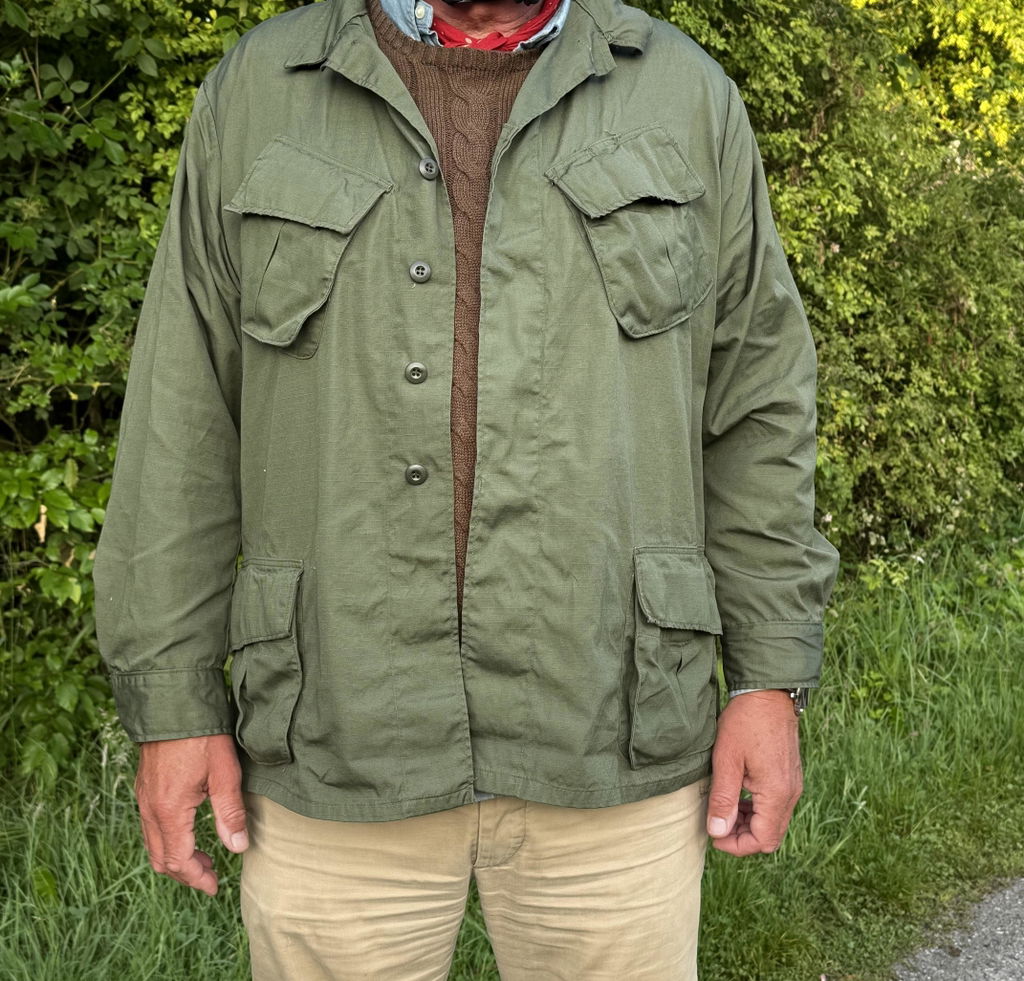
M-65 Field Jacket Collector's Guide: Early Models, Labels, Zippers & Camouflage

Rare Gear USA’s original photography and research are protected. Images and text may not be reproduced or used commercially without prior written permission.
RARE GEAR USA · MILITARY COLLECTOR REFERENCE
The strongest way to identify an M-65 field jacket is to connect the entire garment with its labels and hardware. A shoulder strap, a silver zipper or a faded green shell is a clue, not a complete identification. This guide brings together early no-epaulette examples, later olive-green production, camouflage coats, removable liners and original zipper close-ups from Rare Gear USA's inventory.
Recent archive photography has been selected for the main later-model comparisons. Earlier photographs are retained where they document a rare early coat or a particularly useful hardware detail. Photographs remain unaltered: no recreated labels, generated garments or competitor photographs are used.
1. Identify the garment before assigning a date
The M-65 is a cold-weather field coat, not simply any green military jacket. The archive examples below combine a zip-front opening under a snap-fastened storm flap, four front pockets, a substantial collar with a hood compartment, adjustable cuffs and internal provision for a removable liner. Our 1970 example also documents the waist and hem drawcord arrangement. Inspect this complete combination before concentrating on one small part.
The model name M-1965 does not mean that every example was made in 1965. Likewise, the year a photograph entered our archive does not date the coat. A jacket photographed in 2026 can have a 1967 contract reference; the two dates describe different events.
| Garment family | Useful first distinction | Common identification error |
|---|---|---|
| M-65 field jacket | Four-pocket field-coat construction, front zipper and hood stored at the collar. | Dating the coat from the model name alone. |
| M-51 field jacket | Compare its conventional shirt-style collar with the M-65's hood-storage collar. | Trusting an old product URL that says M-51 when the garment and record identify an M-65. |
| Tropical Combat Jacket | A different uniform family; compare its slanted upper cargo pockets and button-front construction. | Calling every Vietnam-era olive jacket an M-65. |
| M-65 fishtail parka | A separate, longer parka design, not a field jacket pattern. | Applying the field jacket's parts and identification rules to the parka. |
The M-51 comparison and first-pattern terminology are also discussed in the secondary guides listed at the end. The specimen identifications throughout this article refer to our own linked inventory records.
2. Early M-65 jackets without epaulettes
Collectors commonly call the early no-epaulette configuration the first pattern. Heddels describes the early period as 1965–1966; this is a historical overview, not a way to turn an undated coat into a documented 1965 example. Our two featured early jackets are cataloged as 1966.
Absence of shoulder straps deserves careful examination. Compare both shoulders, the seams where fittings would normally sit, the collar and the interior labels. A clean original shoulder construction is different from a later coat with straps cut away. Stitch holes, interrupted stitching or protected patches of darker fabric can justify further investigation, but a single photograph does not prove when an alteration occurred.
1966 Small Short — ARMYWJ0221
The archive explicitly describes this coat as first pattern without epaulettes. Its recorded identifiers are DSA 100-1690 and stock number 8405-782-2935. The catalog records a CONMAR aluminum zipper. Keep that hardware attribution attached to this specific coat rather than transferring it to every early M-65.


Open ARMYWJ0221 and its complete original gallery.
1966 Large Regular — ARMYWJ0852
This separate first-pattern archive example has DSA 100-3491, stock number 8405-782-2942 and an aluminum zipper recorded in its listing. Its newer photographic set gives a second early reference without sacrificing the rare Small Short example above. The differing contract and size identifiers belong to different coats.


Open ARMYWJ0852 and its full photo set.
3. M-65 zipper close-up gallery
This is a hardware reference, not a collection of distant jacket photographs. The following photographs isolate the front zipper, slider, teeth, tape and surrounding snap-fastened opening. Each image is linked to its original file and paired with the jacket record it belongs to. Tap a photograph to inspect the original.
Color is not chemistry. Silver-tone and brass-tone describe the visible finish. Where a listing identifies aluminum or a maker, that catalog attribution is stated separately. An exact alloy cannot be established from color alone. A front zipper and a collar zipper must also be recorded separately; neither is a liner attachment.
1967 — silver-tone front zipper, ARMYWJ0942
The jacket record gives DSA 100-67-C-3536, stock number 8405-782-2936 and Rolane Sportswear as manufacturer. Its storefront hardware field names TALON, while the product description says aluminum. The close-up is retained as evidence, but the maker attribution still requires a full-resolution comparison with the slider marking; the catalog field is not treated as a verified reading of the photograph.

1968 — front slider and bottom-box detail, ARMYWJ0023
This older close-up is worth retaining because it shows the working parts at a much more useful scale than a full jacket view. Compare the slider, pull arrangement, silver-tone teeth, olive tape and bottom box. Differences in the appearance of adjacent components should be described individually instead of assuming that the whole assembly has one finish. A definitive maker transcription is reserved for full-resolution review.

1970 — recently photographed front hardware, ARMYWJ0995
This recently added archive set supplies a dedicated zipper photograph alongside separate size and instruction-label photographs. The record gives DSA100-70-C-0645. The image's catalog description identifies the front metal zipper, pull and snap; no maker is transcribed from metadata alone. The label and construction photographs for this same coat appear below.

1971 — silver-tone zipper, ARMYWJ0353
This Small Long coat is recorded with DSA 100-71-C-0201 and stock number 8405-782-2937. The photograph shows the slider and the lower separating assembly together. The archive identifies the garment manufacturer as So-Sew Styles and the zipper as aluminum, but does not provide a maker name in the retrieved hardware field.

1981 and 1982 — brass-tone SCOVILL catalog examples
The first coat is a John Ownbey Small Regular with DLA100-81-C-3070. The second is an Alpha Industries Medium Regular with DLA 100-82-C-0575. Both storefront records identify SCOVILL hardware. The photographs are useful for comparing the yellow-metal tone, pull shapes, fabric extensions and tape without treating all SCOVILL assemblies as identical.


1999 Woodland — newer front-closure detail, ARMYWJ0997
The newer Woodland set includes a dedicated front zipper and snap photograph. It is linked here to the jacket's SP0100-99-D-0303 record. The same set also documents the jacket label, separate liner label and jacket with the liner removed. A maker or polymer classification is not assigned until the actual hardware can be examined at full resolution.

4. Zippers by date, maker and visible finish
The table distinguishes documented examples from a universal production timetable. A date below belongs to a jacket record or contract transcription. It is not the first or last year a zipper supplier operated, and it does not prove that the hardware has never been replaced.
| Garment date / reference | Maker evidence | Finish or material evidence | Photographic status |
|---|---|---|---|
| 1966 · ARMYWJ0221 DSA 100-1690 |
CONMAR recorded in the archive. | Aluminum recorded in the archive. | Early garment views retained; a separately verified maker macro remains desirable. |
| 1967 · ARMYWJ0977 DSA 100-67-C-4426 |
RAPID in the storefront hardware field. | Aluminum in the record. | Newer garment set linked below; not substituted for another coat's zipper. |
| 1967 · ARMYWJ0942 DSA 100-67-C-3536 |
TALON in catalog; slider reading still under review. | Silver-tone photograph; aluminum in the record. | Dedicated front-zipper photograph above. |
| 1968 · ARMYWJ0023 | Not conclusively transcribed in this edition. | Silver-tone teeth and differently toned lower components visible. | Dedicated slider and bottom-box macro above. |
| 1969 · ARMYWJ0891 DSA100-69-C-1082 |
SCOVILL recorded in the listing. | Aluminum recorded in the listing. | Newer Rolane garment set linked below; hardware attribution remains catalog-based. |
| 1970 · ARMYWJ0995 DSA100-70-C-0645 |
Not transcribed. | Metal zipper identified in image metadata; finish awaiting direct review. | Dedicated recent close-up above. |
| 1971 · ARMYWJ0353 DSA 100-71-C-0201 |
Not identified in the retrieved hardware field. | Silver-tone photograph; aluminum in the record. | Front assembly close-up above. |
| 1981 · ARMYWJ0362 DLA100-81-C-3070 |
SCOVILL in catalog. | Brass-tone visible in photograph. | Front zipper close-up above. |
| 1982 contract · ARMYWJ0524 DLA 100-82-C-0575 |
SCOVILL in catalog. | Brass-tone visible in photograph. | Macro above; conflicting 1981 metadata flagged. |
| 1999 · ARMYWJ0997 SP0100-99-D-0303 |
Not transcribed. | Not classified from metadata alone. | Front zipper/snap image included; full-resolution hardware review remains open. |
Why not use a rigid silver / brass / plastic calendar?
Omega Militaria presents a convenient broad sequence of early silver-colored metal, subsequent brass and later plastic fasteners. That is a useful research starting point, but we do not treat its boundary years as exception-free rules. The table above instead shows which combinations our own records actually document. A verified polymer-zipper maker close-up is still a gap in this edition, not an excuse to borrow another dealer's photograph.
Separate the zipper maker from the jacket manufacturer
CONMAR, RAPID, TALON and SCOVILL appear in the archive's hardware descriptions. Alpha Industries, Rolane Sportswear, John Ownbey and other names identify garment contractors in the relevant records. A slider name does not establish the manufacturer of the jacket. Nor does a manufacturer's civilian label prove that a particular coat was government-issued.
Inspect the complete assembly
Record the slider front and back, pull, teeth, tape, top stops, separating pin and bottom box. Compare their wear and the stitching that attaches the tape to the coat. A replaced slider is a different observation from an entirely replaced zipper. Missing thread, extra needle holes or a tape color mismatch can motivate investigation, but none alone proves a repair date.
Photograph the collar zipper independently. Do not assign the front zipper's brand to it merely because both are on one jacket. This edition's dedicated hardware gallery shows front closures; a complete collar-maker macro comparison remains a separate review item.
5. Expanded archive: later models in newer photographs
The following sets broaden the comparison without relying on the older full-jacket pictures for every period. They were added to the catalog during 2025–2026. These dates describe the archive entries, not the dates the garments were manufactured.
1967 Alpha Industries — ARMYWJ0977
The Small Short record gives DSA 100-67-C-4426, Alpha Industries and an aluminum zipper. The storefront hardware field specifies RAPID. This is a separate specimen from the 1967 Rolane coat used in the close-up gallery, so its maker information is kept separate.


Inspect the complete 1967 Alpha record.
1967 Rolane and 1969 Rolane — different contracts, separate records
The 1967 Small Regular example is ARMYWJ0942, DSA 100-67-C-3536. The 1969 Large Regular is ARMYWJ0891, DSA100-69-C-1082; its listing records Rolane Sportswear and SCOVILL aluminum hardware. Studying two contracts is more useful than assigning every jacket from a contractor the same zipper or year.


1970 X-Small Regular — ARMYWJ0995
This newer set is especially useful because it separates the whole garment, its labels, the front zipper and interior construction. Its product description records DSA100-70-C-0645. The stock-number prefix differs between description text and image metadata, so the label photograph is preserved rather than resolving that discrepancy by guesswork.


1976 Alpha Industries with liner — ARMYWJ0982
The archive records a Medium Regular coat with liner, described as new old stock, with DSA100-76-C-1003. It is identified as post-Vietnam in its listing. The recorded stock number ends in 2938; that transcription is not used to overrule the garment's size designation without checking its label.


Open the complete 1976 Alpha gallery.
1986 Alpha Industries with liner — ARMYWJ0984
This Medium Regular olive-green example is cataloged as deadstock with a liner. Its record gives DLA 100-86-C-0442 and stock number 8415-00-782-2939. It supplies a newer photographic comparison for later solid-color production instead of requiring the older 1987 full-jacket photographs as the main illustration.


Open the complete 1986 Alpha record.
6. Contract labels, stock numbers and maker identification
Keep four questions separate: What garment is this? What procurement information survives? What can be said about manufacture? What service history is documented? A contract label can be excellent evidence without answering all four.
Write down the complete garment nomenclature, size and length, contractor, stock number and contract reference. Preserve prefixes, punctuation and ambiguous characters. A supply number identifies an item of supply; it is not an individual coat's serial number. A specification number identifies a technical document, not a personal issue date.
Later references in this archive include DSA100-70-C-0645, DLA100-81-C-3070 and SP0100-99-D-0303. Their two-digit year fields are useful contract-era evidence. They should not be described as exact manufacturing dates or dates on which a soldier received a coat. The early short DSA forms above require a different treatment and should not be forced into the later decoding format.


When title, URL, metadata and label disagree
Our 1971 Small Long coat still has a URL containing 1966. The Alpha coat with DLA 100-82-C-0575 has an older 1981 issue-date field despite its 1982 title and contract transcription. These are examples of catalog inconsistency, not evidence of unusual military production. Preserve the actual garment photographs, flag the conflicting fields and resolve them against readable labels. The guide does not change the underlying product records.
7. Construction details worth photographing
Collar and hood: record the collar open and closed, its fastener and the hood itself. An empty compartment may indicate a removed hood, not a separate production pattern. Check attachment seams before describing a piece as complete.
Cuffs: inspect them open, including the hook-and-loop adjustment, any internal gusset and the sleeve edge. Omega's guide discusses gusset changes as a production clue. Do not assign an exact changeover year to an individual coat without checking the relevant contract and construction. A shortened sleeve or replacement cuff can disguise the original arrangement.
Pockets and snaps: examine the pocket bags, flap closures and reinforcement from both sides. Record mismatched or replaced snaps individually. A pocket's shape is more useful when the photograph shows its attachment and depth, not just a flattened front view.
Drawcords and interior: show the routing of the cords, eyelets, lining and front opening. This makes a guide useful to someone examining an actual coat, rather than simply comparing silhouettes.


8. Liners: button-in insulation, not a liner zipper
The standard removable M-65 field-jacket liner attaches with buttons. It should not be confused with a zip-in liner from another garment. The front zipper closes the coat; the collar zipper opens the hood compartment. Neither is the standard liner attachment.
The sewn-in lining is part of the jacket. The removable quilted liner is a separate piece with its own size, contractor and procurement record. A compatible liner can be added years later. Matching color and size do not establish an original factory pairing, and a later liner does not automatically invalidate an earlier shell.


For a complete liner record, photograph both sides, the label, quilting and all attachment points. Check that every required button can be used without pulling the liner out of shape. Describe missing fasteners or repairs plainly rather than treating the presence of any quilted liner as proof of completeness.
9. Olive green, Woodland and desert camouflage
The color or camouflage print identifies the textile's appearance; it does not by itself establish a contract, manufacturer or deployment. The later camouflage coats here are not presented as Vietnam-worn garments. Compare their labels and construction with the olive-green examples instead of assigning a date from camouflage alone.
1999 Woodland Large Regular — ARMYWJ0997
This newer inventory set records SP0100-99-D-0303 and stock number 8415-01-099-7838. It now supplies the principal Woodland construction and liner illustrations in the guide. Its dedicated zipper and label photographs are shown in their corresponding sections rather than mixed into an unexplained image dump.


1999 desert Medium Short — ARMYWJ0897
This newer desert-camouflage reference replaces the older desert full-jacket pictures as the main visual comparison. Its record gives SP0100-99-D-0303 and describes several patches. The contract text alone does not establish a particular deployment, and the patches are not proof of a named wearer. Their provenance should be investigated separately.


Open the complete desert-jacket gallery.
1997 Propper Woodland — keep the non-issue disclosure
The earlier guide's Propper XL Regular reference, ARMYWJ0732, remains relevant because its listing explicitly says Non Military Issue. It also contains a military-format number, SPO100-97-C-9620. That combination is a reason to investigate the record, not to silently remove the disclosure or certify government issue. Its description and some image text also differ on the stock-number ending.


Read the original Propper record and disclosure.
Other camouflage categories, including UCP and commercially marketed prints, require their own authenticated archive examples. No outside photograph has been inserted to make an unrepresented category appear documented. A camouflage print shared with a uniform does not automatically establish the procurement status of an M-65 made from it.
10. Earlier reference records retained for comparison
The newer photography changes the presentation, not the existence of these useful earlier records. Their complete galleries remain available through the links below.
| Earlier archive example | Recorded information | Continuing research value |
|---|---|---|
| 1968 Small Short · ARMYS0234 | Cataloged deadstock; exact contract was not supplied in the retrieved text. | Preserved early coat for condition and construction comparison. Deadstock does not independently prove never-issued status. |
| 1980 Medium Long · ARMYWJ0273 | DLA100-80-C-2529; stock 8415-00-782-2940; John Ownbey and SCOVILL recorded in the earlier research. | Separate garment-contractor and hardware-maker example. Its recorded fabric composition should not be generalized to every M-65. |
| 1987 Medium Long with liner · ARMYS0161 | Cataloged deadstock M-65 with liner; old URL contains M-51. | Useful pairing record, but no documented claim that shell and liner were originally issued together. |
| 1999 USAF-associated desert coat · ARMYWJ0103 | Large Short; cataloged USCENTAF and lieutenant-colonel insignia. | Additional insignia reference, not proof of an identified officer or deployment. |
11. Authentication: evidence before a story
A useful authentication record is a chain of observations, not one dramatic detail. Start with overall construction. Add readable labels, coherent hardware and stitching, then any documented provenance. Keep confidence proportional to the evidence available.
Original issue versus commercial manufacture: assess the full label and garment together. A recognized military contractor also may have produced civilian goods. A military-style stock number or period-looking label is not a substitute for coherent procurement evidence. Conversely, a replacement zipper or repaired seam is a condition issue that does not automatically make the entire garment a reproduction.
Removed epaulettes: look for both the fastening location and the outer attachment seam. Compare the two shoulders and inspect the inside where possible. A missing shoulder button is not the same thing as an originally strapless coat.
Names and patches: photograph their stitching and any associated documentation. A sewn name tape, rank badge or unit patch can be genuine as an object without proving who applied it or when. Distinguish a catalog description from a researched service history.
Fabric and hardware: retain label wording rather than inferring fiber percentages from touch, color or another jacket. Record a visible silver finish separately from an aluminum attribution. Describe a suspected replacement as suspected until inspection or provenance supports a stronger conclusion.
12. Sizing, condition and buying intelligently
A designation such as Small Short or Medium Long combines a body size with a length. It is not an automatic equivalent to a modern brand's size. Compare the actual coat's measurements with a jacket that fits, allowing for the intended layers and removable liner.
Measure the chest flat with the front closed and drawcord relaxed; record exactly how the measurement was taken. Measure shoulders seam to seam, sleeves from the shoulder seam to the cuff, and back length from a consistent point below the collar. Do not compare an over-collar measurement with a below-collar measurement as though they were identical. Note shortened sleeves or other alterations.
Inspect the separating zipper at the bottom, missing or bent teeth, snap operation, cuff fasteners, pocket bags, drawcord channels and liner attachments. Distinguish normal wear from damage that prevents use. Ask for photographs of defects rather than accepting an overall condition adjective as a substitute.
For cleaning, follow the actual garment's care label and account for weakened fabric, damaged labels and historic insignia. Do not apply a universal restoration treatment to every archived coat. Aggressive cleaning or alteration undertaken only to make a jacket appear newer can erase useful evidence.
Prices in historical listings are asking-price records unless a completed transaction is separately documented. Rarity, condition, size, completeness and provenance are separate considerations; none should be inferred from price alone.
13. Frequently asked collector questions
Does an M-1965 label mean the jacket was manufactured in 1965?
No. It identifies the model. Look for procurement evidence and garment-specific documentation.
Does no epaulettes prove a first-pattern jacket?
No. It is an important clue, but removed fittings and altered seams must be ruled out. Compare the whole coat and its labels.
Can I date an M-65 by its zipper color?
Not precisely. Use color and construction as supporting evidence. The dated examples in this guide are not an exception-free production calendar.
Must the collar zipper match the front zipper?
Record them independently. Do not assume the maker or material of one from the other, and distinguish an original assembly from a later repair.
Does the removable liner zip in?
The standard M-65 field-jacket liner buttons in. The hood-storage zipper and front zipper serve other purposes.
Is every Alpha or Propper M-65 military issue?
The manufacturer's name alone does not establish the procurement status of a particular coat. Read the full label and preserve any non-issue disclosure.
Are the coats pictured available to buy?
These are reference examples from current and sold inventory. Their linked product pages indicate availability; inclusion in this guide is not a stock promise.
Sources, documentation and editorial review
Primary specimen records: the linked Rare Gear USA inventory entries supply the garment photographs, catalog identifications and transcribed numbers. The guide differentiates those records from direct photographic observations and unresolved readings. No competitor photographs are reproduced.
Manufacturer background: Alpha Industries' M-65 history and Propper's M-65 background provide manufacturer accounts of the design. Their descriptions do not authenticate any individual secondhand jacket.
Specification reference: the DLA ASSIST entry for the MIL-C/MIL-DTL-43455 specification family is the official document lookup. Exact component-change dates require the applicable specification revision or amendment. An accessible catalog entry is not equivalent to examining the complete historic specification.
Secondary comparison reading: Heddels' M-65 buyer's guide was reviewed for its introductory model and buyer coverage; Omega Militaria's visual guide was reviewed for its hardware, cuff, label and liner coverage. Their chronology is not silently converted into verified findings about our garments. This article's comparison tables are built around the separately linked Rare Gear USA records.
This revision adds newer garment sets, seven dedicated front-zipper photographs, label comparisons and a button-in liner sequence. Five historical zipper close-ups were inspectable through indexed image previews; the newer 1970 and 1999 zipper photographs and other newly selected details were matched to their Shopify image records and descriptions. Full-resolution retrieval was unavailable during this revision, so a complete visual audit is not claimed.
Before publication, verify the 1967 hardware maker against its slider, resolve the noted label/metadata discrepancies, confirm the new images render correctly on mobile and desktop, and review any exact production-change dates. A confirmed 1965 specimen, a verified polymer-maker macro and a separately documented collar-zipper macro sequence are not yet supplied. The guide does not claim every zipper maker, camouflage category or production variant is photographically represented.
Explore Military Guides · Military contract-number dating · Tropical Combat Jacket identification · Browse field jackets
© 2026 Rare Gear USA. All rights reserved. To request permission to use our photographs or content, contact cs@raregearusa.com. Third-party names, trademarks and insignia belong to their respective owners. Copyright & Image Use Policy.