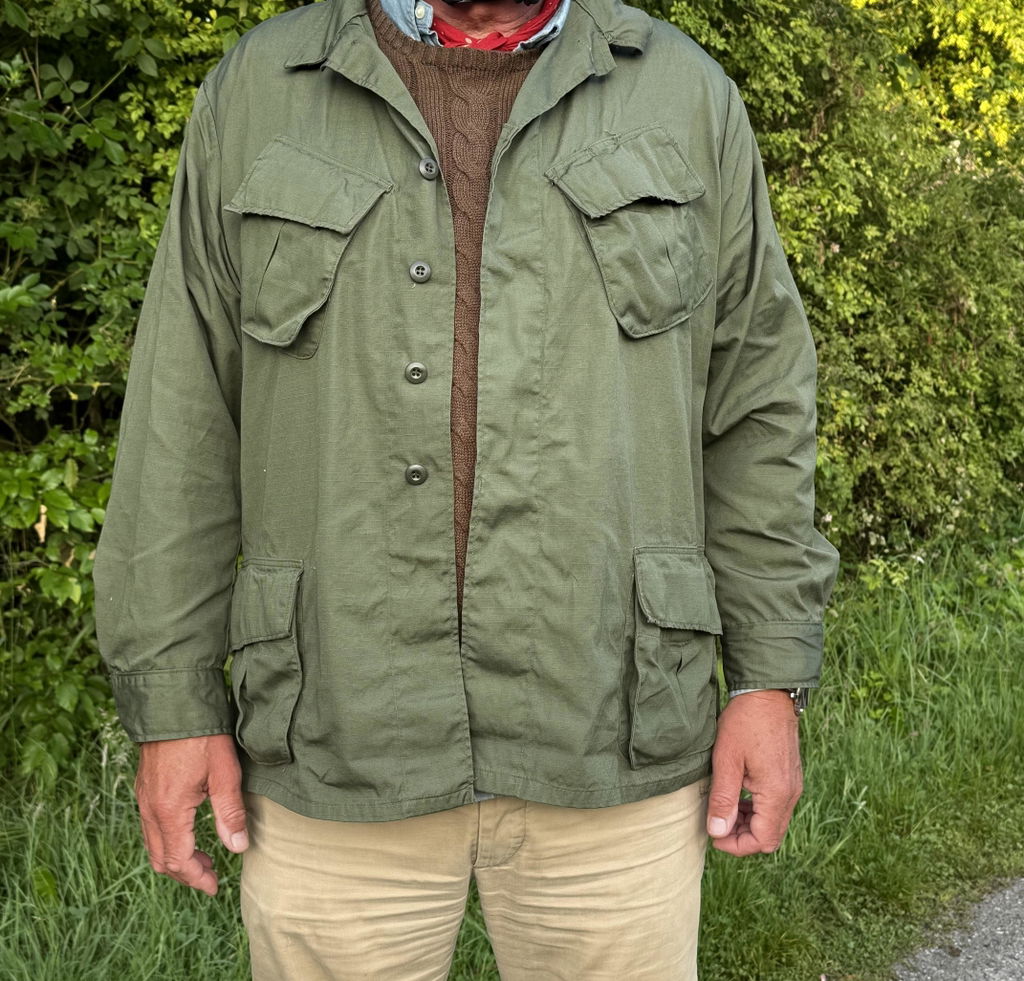
USN A-2 Deck Jackets: The Advanced Collector’s Guide

RARE GEAR USA · MILITARY COLLECTOR REFERENCE
The US Navy A-2 deck jacket rewards close inspection. A pointed chest-pocket flap, a partly hidden contract number, a changed zipper or a ship’s stencil can each tell a different part of its story. This guide uses original Rare Gear USA archive photographs to separate those clues and explain what they can actually establish.
Quick identification: the classic olive A-2 deck jacket combines a cloth collar, pile lining, one external chest pocket, two lower slash pockets, a zipper beneath a buttoned front and adjustable straps at the lower sides. Read the label and examine the whole garment before assigning a date or pattern.
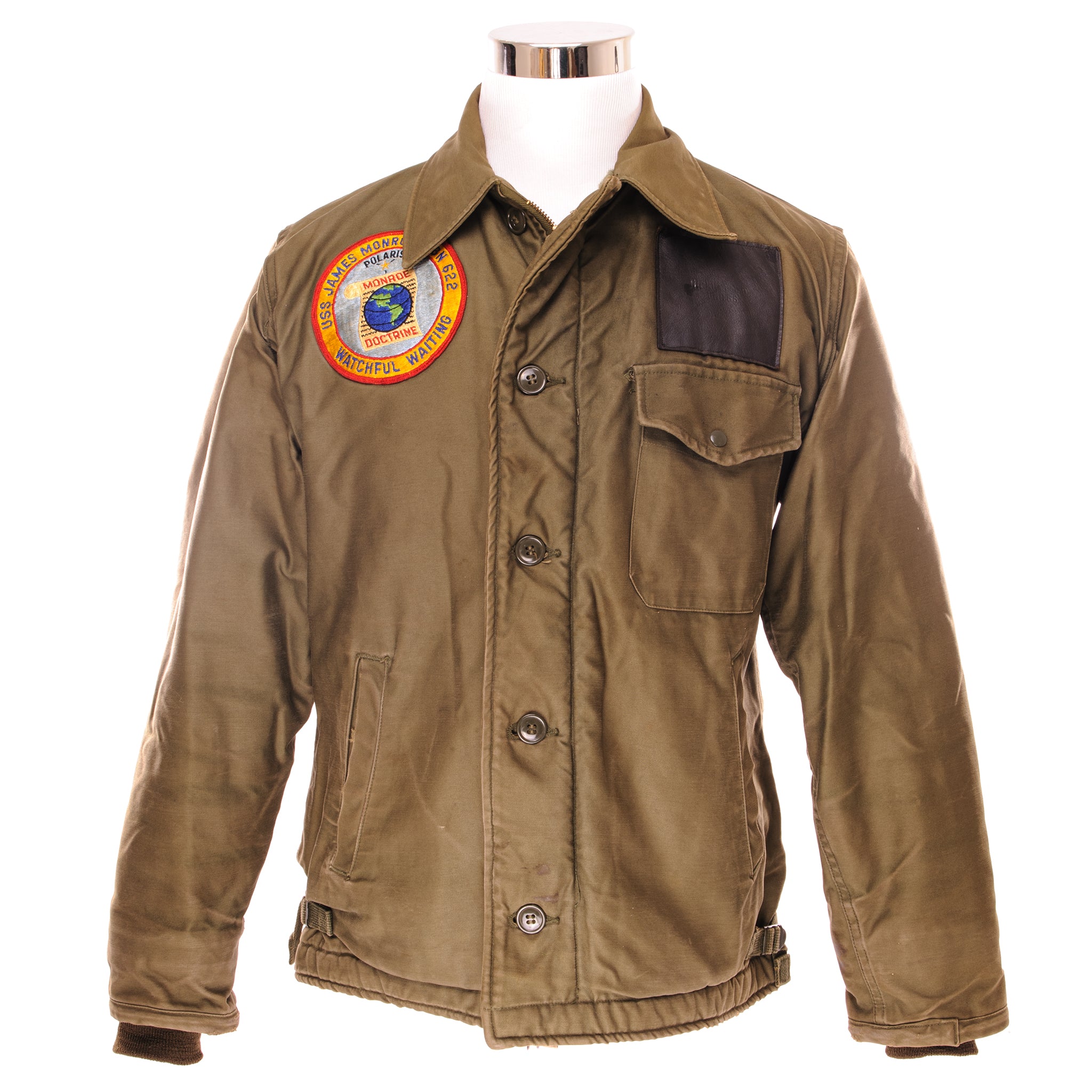
Featured early example: our 1964 USS James Monroe SSBN-622 jacket has the distinctive pointed chest-pocket flap. We describe it as an early pointed-flap A-2; the first-pattern discussion explains why a more specific ordinal needs qualification.
1. How to identify an A-2 deck jacket
Begin with the garment’s architecture. The olive examples in this guide have a practical, relatively straight body, a substantial pile interior and cloth sleeves with knitted wrist seals concealed inside their ends. The front combines a separating zipper with an overlapping buttoned placket. A single patch pocket sits on the wearer’s left chest, above two lower angled openings. Webbing straps and metal buckles adjust the lower sides.
The A-2 deck jacket is a different garment from the leather A-2 flight jacket. Searches for “A2 jacket” mix both, so include “US Navy,” “deck,” “pile lined” or the actual contract number when researching a specimen. Neither a leather flight-jacket contract list nor a bomber-jacket sizing chart can identify this cloth naval work jacket.
Use five photographs for a first assessment: full front, full back, complete interior, readable label and both ends of the zipper. Add the chest-pocket flap and turned-back cuffs when an early-pattern claim is involved. This small record establishes far more than a close-up of an attractive patch.
Labels vary in wording. Some explicitly include A-2; others describe an intermediate cold-weather or permeable cold-weather jacket. A missing A-2 designation is therefore not an automatic rejection. Conversely, a reproduction label can repeat military terminology. Construction, label, hardware and provenance should support one another.
2. From the N-1 to the A-2
The A-2 belongs to the Navy’s cold-weather deck-clothing tradition. Its relationship to the earlier N-1 is easiest to understand through construction: both families use a protective cloth exterior, warm pile interior and concealed wrist knits, while the familiar A-2 introduces a conspicuous chest pocket, a cloth-faced collar and side adjustment straps.
Our archive provides dated comparison points from the 1960s through later Cold War production. It also contains blue flame-resistant cold-weather jackets from the 1990s that require their own material description. Treat this as a sequence of documented examples, not a claim that every contract or transitional detail appears here.
| Feature | Classic N-1 reference | Olive A-2 examples here |
|---|---|---|
| Collar | Pile-faced collar is a prominent recognition feature. | Cloth-faced turn-down collar. |
| External pockets | Two lower pockets; no matching A-2-style chest pocket. | One left chest pocket plus two lower slash pockets. |
| Lower adjustment | Check the N-1’s own hem construction. | Webbing straps with buckles at the lower sides. |
| Interior and cuffs | Pile lining and concealed wrist knits. | Pile lining and concealed wrist knits continue; materials must be checked individually. |
| Dating | Read the actual Navy procurement markings. | Read the complete DSA, DLA or later contract rather than styling alone. |
For the earlier outfit, including the separate trouser and overall questions, see our N-1 deck jacket, trousers and overalls guide. Do not transfer a jacket’s date to an accompanying pair of trousers merely because the colors match.
The official specification record supplies another useful boundary: the Defense Logistics Agency’s cancellation notice identifies MIL-J-21708G, dated 1 July 1987, and cancels it without replacement on 15 May 1999. That is a document-history fact. It does not establish the day the last jacket was manufactured, issued or worn. Read the official notice.
3. Is a 1964 A-2 the first pattern?
“Early pointed-flap A-2” is the clearest description of our 1964 example. “First pattern” appears in collector descriptions, but the term needs a definition: it may describe a broad early appearance rather than the very first contract or a formally numbered Navy pattern.
In his published research for Buzz Rickson’s, Yasuhiro Kameya distinguishes an earliest 1962 back-sateen version from a 1964 jungle-cloth version, which he calls the second model. He describes pointed chest-pocket flaps on both, followed by straight-edged flaps and a return to back sateen. His account also identifies brown ribbing on the 1964 version. This is a named researcher’s chronology, not an official Navy “Pattern 1 / Pattern 2” classification. Read the original Japanese manufacturer research.
For our jacket, the pointed flap is directly visible, the label supports a 1964 contract year, and the cuffs are brown. The photographs are useful for comparing cloth texture, but they are not sufficient for a definitive weave or fiber analysis. We therefore keep “jungle-cloth second model” as a qualified comparison, rather than silently converting a 1964 date into a guaranteed fabric identification.
Recommended catalog wording: “1964 US Navy A-2 deck jacket, early pointed-flap version, with USS James Monroe SSBN-622 patch.” If “first pattern” is used as a search term, explain the terminology in the description and retain the actual contract evidence.
The 1968 Mason & Hughes jacket below already has a straight lower edge to its chest-pocket flap. Compare that directly with the pointed flap on the featured 1964 jacket above. These two specimens establish their own differences; they do not establish a universal changeover date for every contractor.


4. Archive case study: the 1964 USS James Monroe jacket
This Medium jacket is the central early specimen in our guide. Its combination of a pointed flap, compact horizontal label, brown wrist knits and submarine insignia makes it particularly useful for studying construction and later personalization separately.
The label and date
The label identifies an intermediate cold-weather A-2 and Medium, with a 38–40 size range. The archive catalog records the contract as DSA-1-3918-64-C. Handwritten ink obscures part of the printed line, so the full transcription should be distinguished from the portions independently readable in the photograph. The visible 64-C ending supports the catalog’s 1964 dating. No contractor name can be reliably read here; we do not assign one by resemblance to another jacket.
The ship’s patch
The round patch reads USS James Monroe SSBN 622 and carries the motto Watchful Waiting, with a globe and Monroe Doctrine imagery. Naval History and Heritage Command records that the submarine was commissioned on 7 December 1963; its insignia catalog describes the design adopted in 1963. That chronology is compatible with a 1964-contract jacket.
Compatibility is not a complete service history. The photograph alone cannot establish when the patch was sewn on, identify the wearer or prove participation in a particular patrol. The dark rectangular chest attachment also deserves its own condition record rather than an invented name or rank. Preserve any family paperwork or service photographs that might connect the garment to a person.


Brown cuffs, pile interior and zipper evidence
The turned-back sleeves show brown knitted cuffs inside the cloth ends. The open interior records the pile’s coverage and condition. These details can support comparison with other early jackets, but a knit color alone cannot authenticate or date a garment; cuffs are replaceable parts.
The zipper photograph shows a CONMAR-marked pull, while the lower box appears to carry a YKK mark. That is a useful inspection point: the visible pull should not be used to certify an entirely untouched original zipper assembly. A closer examination of the bottom fitting, tape seams and any repair history would be needed. We illustrate the photograph in the hardware section without retouching or concealing the mixed markings.


5. Construction: the details worth comparing
Chest pocket and flap
Record the pocket’s position, outline, flap shape, closure and stitching. A pointed flap is a useful early visual clue; a straight flap appears on the later examples illustrated here. Check underneath the flap and inside the pocket for altered stitching, repairs or a replacement closure. A flap that has been recut can imitate a pattern distinction, so do not inspect only its silhouette.
Cloth collar and front closure
The collar belongs in the same assessment as the neck label and upper lining. Look at the underside, fold line and points for abrasion or replacement seams. On the front, check the relationship between zipper tape, facing, buttonholes and outer placket. Buttons should be photographed on both sides where accessible, including their attachment thread.
Differences in button shine or thread color can reflect routine repair. Record them rather than forcing every component into a single factory-original story. A sound repaired service jacket can still be a worthwhile collector’s garment when its condition is described accurately.
Lower pockets, side straps and hem
The lower slash-pocket openings are frequent wear points. Check both corners, pocket bags and adjacent lining. At the sides, inspect the straps, buckles and stitching where adjustment tension enters the shell. A missing strap is easy to overlook in a front photograph but affects completeness and the ability to adjust the hem.


Concealed wrist seals
Turn back the sleeve ends gently to inspect the knits. Their position inside the cloth sleeve distinguishes them from the conspicuous exposed waistband-and-cuff arrangement of many flight jackets. Check for holes, repairs, loss of elasticity and differences between the two cuffs. Shortened sleeves can change how much knit is exposed, so apparent cuff length is not a reliable dating rule.
6. Shell fabric, color and pile lining
Read fiber information from a specific label whenever available. Our 1984 Centre example explicitly lists 50% nylon and 50% cotton base fabric. The 1980 Vanderbilt and 1985 So-Sew Styles labels also identify this blend. Those statements describe their base fabric; they do not make the whole jacket, including its pile and knits, a 50/50 composition.
“Sateen” describes a fabric construction, while cotton and nylon describe fibers. “OG 107” is a color designation, not a blanket promise of all-cotton material. Keep these categories separate. If a faded early label gives no composition, do not fill the gap with the material printed on a later contract.
Color can vary with exposure, laundering, storage and photography. The same garment may look browner in a warm close-up and greener in a full-length image. Compare protected and exposed areas within one jacket before treating shade as a manufacturing difference. A pale shell does not, by itself, demonstrate tropical service or a rare factory color.
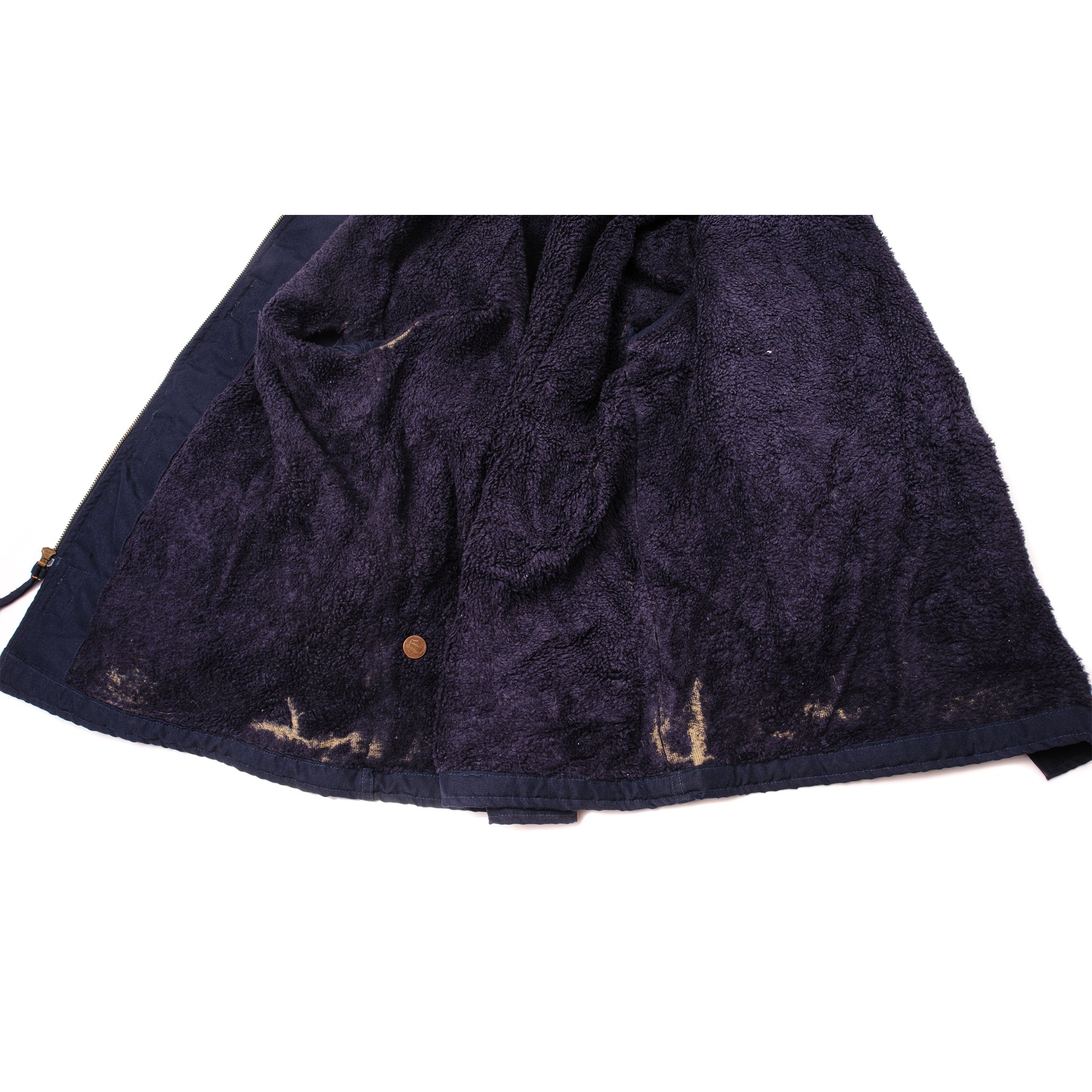
The pile should be examined as a structure: density, coverage, attachment, backing and areas of loss matter. Do not call every fuzzy deck-jacket lining alpaca. The later blue jacket below actually states a rayon/wool pile composition on its label, demonstrating why visible texture alone is inadequate.


7. How to read an A-2 deck-jacket label
Transcribe the complete label before interpreting it. Preserve punctuation and uncertain characters in your notes, and retain an unedited photograph. A useful record includes the nomenclature, stock number, contract, manufacturer, size, material statement and laundering panel. Handwritten names and stamped numbers belong in separate fields.
The 1968 Mason & Hughes example names a cold-weather, permeable A-2. The 1972 Alpha label instead uses intermediate cold weather and OG 107. Both jackets can be studied within the A-2 family through their construction and procurement information. Label wording is a comparison tool, not a rigid one-line authenticity test.
Keep a contract number separate from a stock number. In the photographs here, numbers beginning 8415 identify the supply item, while DSA100 or DLA100 introduces a procurement reference. The final digits of a stock number are not a production year. The Medium examples repeatedly show the 753-5612 item sequence; that repetition is not evidence that they were made together.
A specification revision, when present, is another independent field. Do not confuse it with the contract year, a laundry number or a sailor’s handwritten identification. Likewise, wording such as Type I or Class 1 should not be converted into the collector phrase “first pattern.” Read it in the context of that specification and garment category.


8. Contract dating: read the year in its correct position
These archive examples show why one universal character-counting shortcut fails. The early recorded contract DSA-1-3918-64-C places the year near the end. The later DSA100-72-C-0886 and DLA100-84-C-0480 formats put the two-digit year after the six-character office identifier.
In those later examples, 72 indicates the 1972 contract year and 84 indicates 1984. The following C is part of the procurement identifier, not a jacket-pattern revision. Hyphens help readability but are not always printed identically. Photograph the entire line so that an isolated pair of digits is not mistaken for a date.
The DSA-to-DLA change reflects procurement administration. DLA’s own historical account dates the agency’s renaming to 1 January 1977. A label prefix can therefore help establish context, but the full contract is more useful than the prefix alone. Do not assume every label layout or contractor’s stock changed at one instant.
A contract year is not a complete manufacturing or service timeline. It does not establish a particular delivery month, first issue, ship assignment or patch-application date. A garment may remain in use after its procurement year. Describe a 1972-contract jacket as such unless additional records support a more exact claim.
| Contract year | Contractor on label | Contract as transcribed | Evidence and scope |
|---|---|---|---|
| 1964 | Not reliably readable | DSA-1-3918-64-C | Archive transcription; photograph partly obscured by ink. Early pointed flap. |
| 1968 | Mason & Hughes, Inc. | DSA-100-68-C-1163 | Readable label; straight chest-pocket flap in the accompanying archive photos. |
| 1972 | Alpha Industries, Inc. | DSA100-72-C-0886 | Readable label; Medium 38–40; OG 107 nomenclature. |
| 1974 | Lancer Clothing Corporation | DSA100-74-C-1031 | Readable label; X-Large 46–48; permeable A-2 nomenclature. |
| 1984 | Centre Mfg. Co., Inc. | DLA100-84-C-0480 | Readable label; Medium 38–40; 50/50 nylon-cotton base fabric. |
| 1985 | So-Sew Styles, Inc. | DLA100-85-C-0607 | Readable label; Medium 38–40; USS Wisconsin-marked archive specimen. |
| 1994 | Tennier Industries, Inc. | SPO100-94-C-0316 | Readable label; blue Class 1 flame-resistant jacket; aramid shell. |
The 1994 label is transcribed with the O-shaped character shown in SPO100. When searching databases, check the source image and any normalized identifier rather than silently correcting similar-looking letters and digits. For broader procurement interpretation, start with the label photograph and then consult the relevant contract record.


9. Manufacturers and normal variation
The archive documents Mason & Hughes, Alpha Industries, Lancer Clothing Corporation, Vanderbilt Shirt Co., Centre Manufacturing and So-Sew Styles on olive examples. Tennier Industries appears on the later blue flame-resistant comparison. These are observed names on individual jackets, not an exhaustive list of Navy suppliers.
A maker’s name can organize a collection, but it cannot authenticate an entire garment by itself. A company may produce military contracts and commercial clothing, and a military-looking label can be reproduced. Compare the full contract line with label printing, stitching, shell construction and the rest of the jacket.
For useful research, compare like with like: two jackets from the same contract are better evidence for a manufacturing variation than two jackets separated by twenty years. Record small differences without immediately declaring a new pattern. Button changes, replacement cuffs and swapped sliders may belong to an individual jacket’s repair history.


10. Zippers: maker marks, sliders and repairs
Photograph the pull, slider body, teeth, top stops and bottom box. Also examine the zipper tape where it is sewn to the jacket. A recognizable pull identifies that component; it does not necessarily identify the entire assembly or prove that it was installed when the jacket was made.
The archive includes clearly marked Conmar, General and Scovill components. The Scovill examples illustrate both a narrow pull with a cloth extension and a larger Gripper pull with a circular opening. This is direct evidence of hardware variety, not a dependable rule assigning one brand to one decade.


Signs worth investigating include a second row of needle holes, interrupted stitching, an unusually fresh tape, mismatched components or a repaired insertion pin. None independently proves a modern rebuild. Repairs can be old, and factory workmanship can vary. The useful conclusion is often simply “zipper alteration possible; inspect further.”
Do not force a stiff zipper to demonstrate that it works. Check whether fabric or pile has caught in the teeth and whether the bottom pin seats correctly. In a sale or collection record, distinguish a cosmetic replacement pull, a replaced slider and an entirely replaced zipper; these are different levels of alteration.
11. Blue flame-resistant jackets: read the Class 1 label
Later blue Navy cold-weather jackets are often grouped with A-2 deck jackets in vintage catalogs. Our 1994 Tennier example makes the material distinction explicit: its label identifies a flame-resistant, Class 1 cold-weather jacket with a 100% aramid shell. The lining statement specifies 65% rayon / 35% wool pile and a 100% aramid backing.
Those are the jacket’s printed specifications, not assumptions based on its dark color. They distinguish this garment from the olive nylon/cotton example shown earlier. The blue jacket also has a different front fastening arrangement, with visible hook-and-loop tabs; compare the actual front rather than describing every deck jacket as button-front.


Aramid is a fiber family; a brand name such as Nomex should not be substituted automatically when the label only says aramid. Likewise, a historical flame-resistant label is evidence of the original intended specification, not a present-day performance certification for a used collectible.
The blue example’s brass-colored zipper and YKK-marked lower fitting are useful comparison details. A YKK mark on a documented later jacket is not inherently evidence of fakery. Its meaning depends on the complete garment and contract. For the different aviation garments, see our CWU-45/P and CWU-36/P flight jacket guide.


12. Stencils, patches and originality
A ship’s name adds a research lead. It does not replace the contract label or establish when a jacket was marked. Our 1985 So-Sew Styles example carries a USS Wisconsin BB64 back stencil; the early James Monroe jacket has much fainter rear markings. Photograph both strong and faint marks before cleaning or repairs change their visibility.
Record a marking exactly as seen, including its location, dimensions, color and uncertain characters. Keep observations separate from interpretation: “ship name stenciled on back” is an observation, while “issued aboard that ship in the contract year” requires additional evidence. A handwritten name can support research only when a reliable connection to the wearer exists.


For patch originality, inspect the reverse stitching where accessible, old stitch holes, fading beneath the patch and wear around its edges. These observations may reveal changes, but photographs rarely prove the precise date of attachment. A reproduction patch on an original jacket and an original patch transferred to another jacket are both possible combinations.
Authenticity is cumulative. Evaluate cloth, construction, label, hardware and condition together. A believable contract does not automatically validate every component; a repaired cuff does not automatically invalidate the garment. The strongest description states which parts are observed, which are supported by records and which remain uncertain.
13. Sizing: the tag is only the starting point
The photographed labels include Medium 38–40 and X-Large 46–48, while the later blue archive also includes Large 42–44. These are labeled body-size ranges, not the jacket’s actual circumference. Room for lining and layers means that a flat chest measurement will exceed half the nominal body measurement.
For an individual purchase, compare measurements with a jacket you already wear comfortably. Request the same measuring method on both garments. A broad chest cannot compensate for short sleeves or a tight upper arm, and a thick pile interior reduces usable space compared with an unlined shell of similar external dimensions.
| Measurement | How to record it | Why it matters |
|---|---|---|
| Chest | Fasten the jacket, lay it flat without stretching and measure armpit to armpit. | Compare consistently; doubling the flat width gives an approximate outer circumference, not usable interior space. |
| Shoulders | Measure across the back between the shoulder seams. | Helps assess upper-body fit alongside sleeve length. |
| Sleeves | Measure shoulder seam to cloth sleeve end; record the knit separately. | Prevents a long exposed cuff from disguising a shortened cloth sleeve. |
| Back length | Measure from the collar seam at center back to the hem. | Use the same start point when comparing listings. |
| Hem | Measure with the side straps relaxed and note available adjustment. | Shows how much the lower opening can be reduced. |
Do not size down automatically because the cut looks generous on a mannequin. Laundering, repairs and alterations can change a vintage jacket’s dimensions. Keep the labeled size and measured size in the listing together, and disclose shortened sleeves or a modified hem.
14. Condition, cleaning and preservation
Inspect the hidden areas before judging condition from the front. Turn back both sleeves to check the knits, open the jacket to examine the lining and feel carefully inside the pockets. Note whether damage is limited to a replaceable component or extends into the shell and its attachment seams.
Common inspection points in this archive include cuff holes, abrasion at sleeve ends, worn pocket corners, thinning lining and small shell defects marked with a coin in the photographs. Describe location and extent rather than relying only on “good vintage condition.” The reason for a hole cannot always be determined from its appearance.

Read the care label before choosing a treatment
Several olive examples here explicitly prohibit dry cleaning. The 1994 blue label also prohibits dry cleaning and adds restrictions on starch and bleach. Do not transfer the cleaning directions from a leather jacket, a CWU flight jacket or another deck-jacket contract.
The original labels describe intended service laundering, including temperatures and drying methods. They do not assess a garment after decades of aging, repairs, ink additions and patch attachment. Document a significant jacket before cleaning, and have fragile fabric, unstable markings or uncertain attachments assessed by a textile conservator before treatment.
For preservation, use broad support for a sound jacket; store weak garments flat with supported folds. Keep textiles away from strong light, heat and damp storage, and inspect periodically for pests. Avoid thin wire hangers and tightly packed garment rails. These principles follow the Canadian Conservation Institute’s textile-care guidance; they do not override a jacket’s own material restrictions.
15. Building a useful A-2 collection
Choose a research question before choosing a premium. An early flap comparison, a sequence of readable contract labels, a study of naval markings or a wearable later jacket each calls for different priorities. A readable ordinary example can teach more than a heavily altered garment advertised with an impressive pattern name.
For a compact reference collection, seek an early pointed-flap example with documented dating, a later olive jacket with a complete label and a clearly labeled blue flame-resistant comparison. Preserve full photographs and measurements for each. This creates a coherent construction and material study without pretending that three jackets represent every contract.
- Confirm the family: cloth Navy deck jacket, with construction consistent across front, back and interior.
- Read the label: keep the stock number, contract, maker and size separate.
- Check the pattern claim: compare flap shape and label evidence; define “first pattern” if used.
- Inspect all hardware: include the bottom zipper fitting and tape seams.
- Record alterations: cuffs, zipper, buttons, patches and shortened areas.
- Verify fit and condition: use measurements and interior photographs.
- Preserve provenance: retain paperwork and the original archive listing.
Judge a price against comparable documented examples, condition, completeness and your collecting purpose. This guide does not assign a fixed market premium to a pointed flap or a ship patch. Scarcity claims require broader evidence than the number of examples in one archive.
16. A-2 deck jacket collector questions
Is the A-2 deck jacket the same as the leather A-2 flight jacket?
No. This guide covers the cloth, pile-lined Navy deck-jacket family. The leather A-2 flight jacket is a separate garment with different construction and contract research.
Is the 1964 USS James Monroe jacket first pattern?
It is securely described here as an early pointed-flap example. “First pattern” needs qualification: the detailed chronology discussed above separates earlier production from the 1964 variant. The archive photographs do not justify claiming the very first Navy model.
Does a pointed flap prove a 1964 contract?
No. Flap shape is a construction clue. Use the contract label to date the individual garment, and inspect for alteration before relying on the flap alone.
Does every original label say A-2?
No. The illustrated labels vary: some include A-2, while others use intermediate cold-weather or permeable cold-weather wording. Read the full label and compare the garment’s construction.
Are all olive A-2 jackets entirely cotton?
No. The later olive labels illustrated here include a 50% nylon and 50% cotton base-fabric statement. That statement also should not be extended to the lining or every earlier contract.
Is the pile lining always alpaca?
Do not assume that from its appearance. Read available material statements. The blue Tennier example explicitly specifies rayon/wool pile with an aramid backing.
Can I date an A-2 by its zipper brand?
A zipper mark identifies a component, not a dependable year. Sliders and whole assemblies can be replaced. Inspect the complete hardware and label, including the bottom fitting.
Does Class 1 mean first pattern?
No. The blue example’s Class 1 wording is part of its flame-resistant cold-weather nomenclature. It is not an ordinal for the early olive A-2 patterns.
Does a Vietnam-era contract prove use in Vietnam?
No. A contract establishes procurement dating, not a deployment. Specific theater or shipboard use requires supporting provenance.
What size should I buy?
Compare actual chest, shoulder, sleeve, back and hem measurements with a jacket that fits over your intended layers. Keep the tag size as reference, allowing for the pile lining and any shrinkage or alterations.
Should I dry-clean my vintage A-2?
Do not assume so. Several pictured labels explicitly say not to dry-clean. Read the individual care panel and consider aged fabric, repairs, patches and markings before any treatment.
Does the 1999 specification cancellation date prove the last year of wear?
No. The official notice dates the cancellation of MIL-J-21708G. It does not identify the last jacket made, the last issue or the end of service use.
17. Sources and archive method
This guide is based on the photographed Rare Gear USA specimens linked beneath each image. Contract transcriptions are taken from readable labels; the partly obscured 1964 contract is explicitly identified as an archive-catalog transcription. Product titles and older URL slugs are not substituted for label evidence. Photographs document visible condition and construction, rather than proving every component’s installation date.
- Buzz Rickson’s / Yasuhiro Kameya: Type DECK A-2, Jungle Cloth Version — attributed early-model chronology; no manufacturer photographs reproduced here.
- DLA: MIL-J-21708G Notice 1 — specification date and 15 May 1999 cancellation. The notice is not a full production history.
- DLA FY2019 Agency Financial Report — agency-history reference for the DSA-to-DLA renaming.
- Naval History and Heritage Command: James Monroe (SSBN-622) — ship chronology.
- NHHC photograph record NH 64730-KN — ship-insignia identification.
- Canadian Conservation Institute: Basic care — Textiles — preservation principles.
All garment photographs in this guide come from Rare Gear USA’s own archive. No generated garment illustrations or external dealer photographs are used. Archive listings may describe sold specimens; they remain useful identification references.