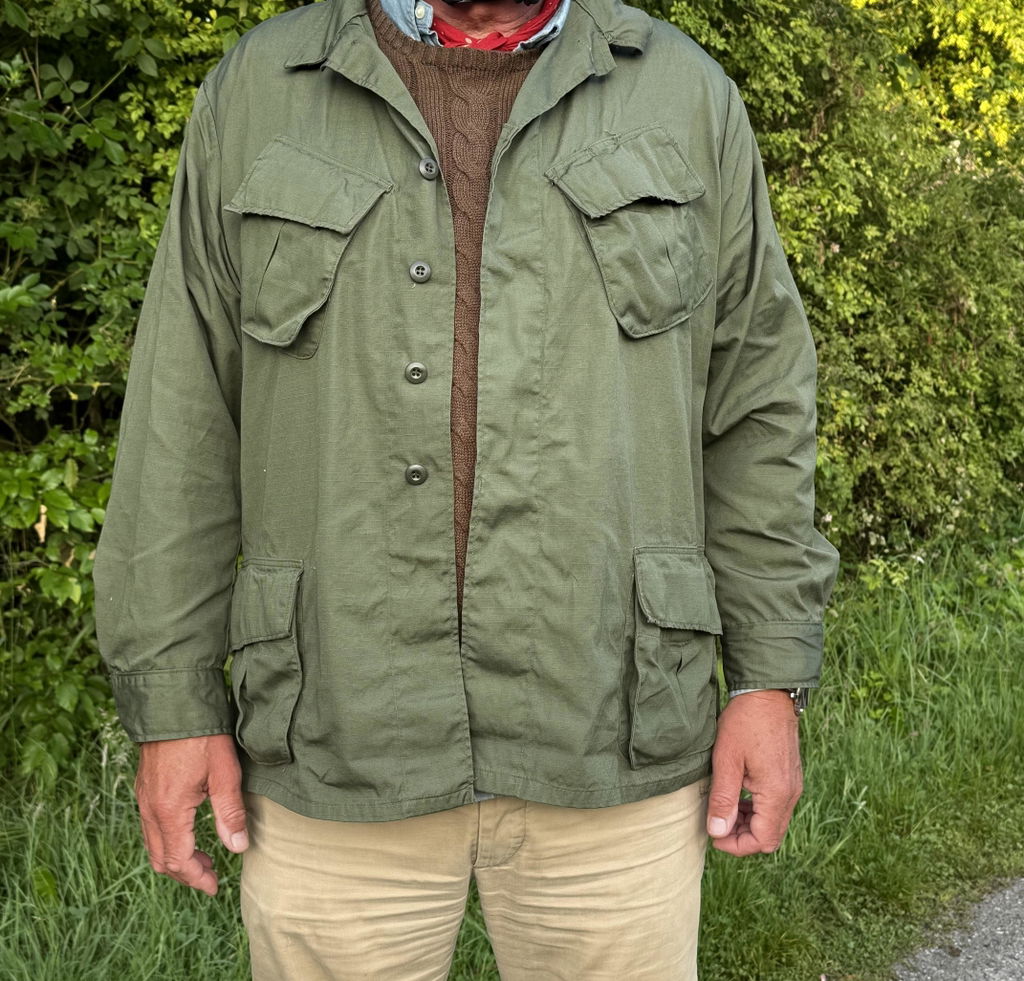
OG-107 & OG-507 Utility Uniforms: The Advanced Collector’s Guide

RARE GEAR USA · MILITARY COLLECTOR REFERENCE
The OG-107 utility uniform is one of the foundations of American military clothing collecting: olive cotton sateen, practical pockets and a long service life that reaches well beyond the Vietnam War. Identifying one accurately takes more than recognizing a green fatigue shirt.
OG-107 vs. OG-507, at a glance: OG-107 identifies an olive green shade; the classic Army utility garments discussed here are cotton sateen. The later OG-507 utility uniform uses polyester/cotton durable-press cloth. Neither number is a year or a pattern number. Identify the garment’s construction first, then confirm its cloth, label and contract.
This guide compares the Army’s straight-flap, clipped-flap and pointed-flap shirts; the Marine Corps P53/P56 family; cotton utility trousers; and the transition to OG-507. Every garment photograph comes from the Rare Gear USA archive. Full-size images and individual specimen pages are linked beneath the photographs.
How the evidence is presented: readable labels establish the transcriptions below. A catalog date is identified as such when the photograph does not establish it. Pattern names such as “P58,” “P63” and “P64” are useful collector shorthand, not substitutes for the wording on a military label. Archive specimens may already be sold.

1. Identify the uniform before dating it
Start with the fabric and pocket layout. Then examine the front fastening, sleeves and label. A cuff, button or patch can have been replaced; a coherent group of construction details is much stronger evidence than one isolated feature.
| Garment or family | First visual checks | What needs confirmation |
|---|---|---|
| Army straight-flap / P58 family | Two chest pockets with straight-bottom flaps; plain sleeve ends; early open-neck appearance. | Early family originates in the 1950s. “P58” does not mean every example was made in 1958. |
| Army P63 / second pattern | Clipped corners on the pocket flaps; back shaping darts; revised front button arrangement. | Sleeve adjustment tabs occur, but tabless examples also exist. Check several features together. |
| Army P64 / third pattern | Distinctly pointed pocket flaps and button-fastened cuffs. | This construction continued beyond the Vietnam War. The label dates the contract. |
| USMC P53 / P56 | Covered front fastening; pointed pocket flaps; Marine pattern construction. | P53 uses HBT; P56 uses sateen. A USMC stencil on an Army-style shirt does not make it a P56. |
| Cotton OG-107 trousers | Large front patch pockets; rear flap pockets; cotton sateen. | Study waist adjusters, fly, sizing and label separately. Shirt pattern numbering does not transfer neatly to trousers. |
| OG-507 utilities | Later durable-press construction; a label naming polyester/cotton and OG-507. | Color alone is unreliable. The trousers illustrated here have a zipper fly and front slash pockets. |
| Tropical combat clothing | Four-pocket tropical jacket layout, often with slanted chest pockets. | An OG-107 shade designation does not turn a tropical combat coat into a two-pocket utility shirt. |
For the four-pocket Vietnam uniform, use our separate tropical combat jacket identification guide. “Fatigues,” “utilities” and “jungle uniform” are often mixed together in listings, but they are not precise pattern identifications.
2. A timeline that separates design from production
The Army’s cotton OG-107 utility family began before the major American ground commitment in Vietnam. The Army historical survey places the jacket specification in August 1952 and the trouser specification in November 1952, with production beginning in 1953. The later revisions explain why two authentic cotton shirts can look quite different.
| Date | Development | Collector significance |
|---|---|---|
| 1952–1953 | OG-107 cotton utility specifications and initial production. | The straight-flap family predates the shorthand “P58.” |
| 17 October 1958 | MIL-S-3001C, associated with the P58 designation in collector references. | Useful revision marker within the early family, not the beginning of all OG-107 clothing. |
| 12 April 1963 | MIL-S-3001E: clipped-flap Army shirt revision. | The design commonly called P63 or second pattern. |
| 6 November 1964 | MIL-S-3001F: pointed-flap, button-cuff Army shirt revision. | The familiar P64 or third pattern; production continued for years. |
| 25 August 1975 | OG-507 polyester/cotton durable-press uniform specifications. | Introduction of a successor did not instantly end cotton OG-107 procurement or use. |
| Late 1970s–1980s | OG-507 in service, followed by the transition to the BDU. | Avoid assigning a universal last-use date to every service, unit and individual garment. |
Sources: David Cole’s Army historical survey, printed p. 103; VietnamGear’s P58, P63 and P64 entries, which identify the MIL-S-3001 revisions. See source links.
Keep three dates separate. A pattern date identifies a design revision. A contract year identifies procurement. A service date describes when and where a person wore the garment. A 1967 contract can support “Vietnam War-era production”; it cannot, by itself, prove service in Vietnam.
3. HBT, cotton sateen and OG-507 cloth
Herringbone twill: look for the reversing diagonal
HBT describes a weave with a repeating broken, zigzag diagonal. It is not a single uniform model. Army and Marine garments can both use HBT while differing in cut, pockets and fastening. The Army archive shirt below is a weave reference; it is not presented as a Marine P53.
Cotton sateen: the classic OG-107 utility fabric
Sateen has a relatively smooth face and a different weave structure from herringbone twill. On worn utility clothing, laundering and abrasion can soften the surface and reduce its sheen. Fading, stiffness and apparent color vary with condition and photography. A beautifully faded green shirt is not automatically older than a darker one.


OG-507: polyester/cotton durable press
The Army repair manual describes OG-507 utility clothing as polyester/cotton twill with a durable-press finish. Our 1978 trouser label explicitly states 50% polyester and 50% cotton. Do not classify the later cloth as cotton sateen merely because a resale title uses the word “sateen.” Read the composition and nomenclature on the actual garment.
Technical reference: TM 10-8400-201-23, chapter 2, description of OG-507 shirts, trousers and cloth specifications.
4. Army OG-107 shirts: P58, P63 and P64
P58 / first-pattern family: straight pocket flaps
The early Army cotton utility shirt has the least shaped pocket flaps of these three families: the bottom edge runs straight across. Plain sleeve ends and the relatively open upper-front arrangement help complete the identification. Early references may call a closely related garment a utility jacket; modern listings also use fatigue shirt or utility shirt.
The patched example below is cataloged by Rare Gear USA as a 1959 P58. Its construction supports the early straight-flap classification. Because its surviving contract label is too faded for a secure transcription from these photographs, 1959 remains the archive’s attribution rather than a newly verified contract date.


P63 / second pattern: clipped flaps and back darts
The 1963 revision is easiest to understand between the shirts on either side of it. The flap’s lower corners are clipped away, but it does not have the pronounced central point of a P64 flap. Back darts add shaping, and the front button arrangement changes. Collector references also describe a change from 8.5-ounce to 8.8-ounce cotton sateen.
Adjustable sleeve tabs are associated with P63 construction, but documented tabless examples exist. Our archive shirt is especially useful because it shows why a missing tab cannot be the entire identification test. Compare its pocket shape, back darts, sleeve finish and label as a group.


The P63 is cataloged as 1963/64. Its construction supports the pattern attribution, but the short-format contract shown does not independently supply that exact date range. Keep that distinction in a collection record.
P64 / third pattern: pointed flaps and button cuffs
The 1964 revision combines pointed pocket flaps with button-fastened cuffs. Domed buttons are also associated with this pattern, but a button is an easily replaced component. The cuff, flap, front construction and surviving label together make a stronger identification.
The patched shirt below carries DSA 100-67-C-1402, a fiscal-year 1967 contract. The cleaner example used at the opening of this guide carries a 1973 contract. Both belong to the same broad P64 family. Condition does not move the 1973 example back into the 1960s.


5. Marine Corps P53 and P56: a separate pattern family
The Marine Corps P53 and P56 are not simply the Army’s first and second patterns with different markings. The Marine design uses a covered front fastening and its own construction details. P53 refers to the HBT version; P56 to the succeeding sateen version.
| Feature | Marine P53 | Marine P56 | Army-style P64 with USMC markings |
|---|---|---|---|
| Cloth | Herringbone twill cotton. | Cotton sateen. | Cotton sateen on the archive example below. |
| Front | Covered three-button fastening. | Same basic covered-front arrangement. | Exposed front buttons. |
| Pockets / sleeves | Pointed pocket flaps, button cuffs and an inner map compartment behind the left pocket. | Carries over the P53 design in the newer fabric. | Pointed flaps and button cuffs in the Army P64 configuration. |
| Identification trap | HBT alone does not establish P53. | Sateen or a USMC stencil alone does not establish P56. | Branch markings do not change the underlying pattern. |
VietnamGear’s references place the change from the P56 to the Army-type OG-107 utility uniform in 1964. Treat that as a transition in issue, not proof that every older Marine garment disappeared on one date. The P53/P56 comparison here is textual: the photographs below show an actual USMC-marked P64 from our archive, not a P53 or P56.


Marine comparison sources: VietnamGear P53 and P56 entries, citing the Marine Corps Museum’s Cataloging and Identification Guide for 20th Century Uniforms (1987). The museum guide is cited through those entries, not represented here as independently examined.
6. OG-107 utility trousers: pockets, waist and fly
Cotton OG-107 utility pants are often called fatigue pants or baker pants in the vintage market. The Army examples illustrated here have large front patch pockets and rear pockets with buttoned flaps. They are work trousers, distinct from tropical combat trousers with additional cargo-pocket construction.
Do not force the shirt’s P58/P63/P64 sequence onto every trouser. Record the trousers’ own features: cloth, front and rear pockets, waist adjustment, fly closure, size system and label. “Type I, Class I” on a government label is a specification classification; it does not automatically mean “first pattern” in a dealer’s three-pattern shirt system.
The 1963 example: adjustment tabs and a button fly
Our Large-size pair combines waist adjustment tabs, a button fly, front patch pockets and two rear flap pockets. The contract reads DSA-1-1252-63-C, with an explicit 1963 year element. The label calls the material cotton sateen and identifies olive green shade 107.


Later cotton trousers: use a dated specimen, not an assumed cutoff
The Watts Manufacturing pair below carries DSA100-75-C-0540 and a tagged size of 32 × 31. It remains cotton OG-107. Compared with the 1963 pair, its numbered sizing and waist construction are useful observations. Two examples do not establish the universal first or last year of each detail.


Trouser identification sequence: front patch or slash pockets → rear pocket arrangement → waist adjusters → fly construction → cloth description → contract and size labels. If one element disagrees, investigate alterations and the exact specification before deciding that the whole garment is incorrect.
7. OG-107 vs. OG-507: the transition is visible in the labels
The strongest distinction is the material and garment nomenclature. Cotton OG-107 and polyester/cotton OG-507 can look similar at a distance. Light, fading, white balance and finishing make color comparisons particularly weak when photographs come from different listings.
| Check | Cotton OG-107 examples in this guide | OG-507 example in this guide |
|---|---|---|
| Label wording | Cotton sateen; OG-107 or olive green shade 107. | Polyester/cotton; durable press; OG-507. |
| Composition | Cotton, as identified by the specimen labels. | 50% polyester / 50% cotton on the 1978 Coastal Industries pair. |
| Trouser front pockets | Large external patch pockets. | Slash pockets rather than the earlier large front patch pockets. |
| Trouser fly | Button flies on the illustrated 1963 and 1975 pairs. | Zipper fly on the 1978 pair. |
| Useful dating evidence | 1963, 1967, 1973, 1975 and 1976 year-bearing contracts. | DLA100-78-C-0691: fiscal-year 1978 contract. |
| Care label | Read the individual instructions and assess current condition. | Durable-press label includes no-starch / no-bleach instructions. Historical directions still require a condition assessment. |
A documented 1978 OG-507 trouser
The Coastal Industries pair provides a useful anchor for the later uniform. Its label states the blend and shade directly. A zipper fly, front slash pockets and durable-press labeling agree with the OG-507 trousers described in the Army repair manual. This is a stronger identification than relying on a green color or a familiar vintage-store title.


The overlap matters. The Army historical survey dates the OG-507 specifications to 1975, while our Selma Apparel cotton OG-107 shirt carries a 1976 contract. Introduction, procurement and replacement are different events. A later cotton shirt is not a reproduction merely because it postdates the introduction of the blend.
Technical reference: TM 10-8400-201-23 describes the OG-507 shirt under MIL-S-43929, the trousers under MIL-T-43932 and polyester/cotton twill cloth under MIL-C-43791. These specification numbers identify standards, not the production year of an individual garment.
8. Read labels and contracts without inventing a date
Photograph each label square-on, in good indirect light, before attempting a transcription. Distinguish a clearly legible character from an assumption. Record line breaks when they help, and keep the original image alongside the transcription.
- Nomenclature: shirt or trousers; utility; cotton sateen or polyester/cotton; the shade designation.
- Size: a letter size, neck/sleeve combination or waist/inseam designation. Size numbers are not contract years.
- Contract: copy the complete sequence, including its DSA or DLA prefix and any explicit year element.
- Manufacturer: record the exact company name. A familiar contractor supports research but is not an authentication guarantee.
- Stock and specification numbers: keep them separate from the contract. They serve different purposes.
| Archive specimen | Readable contract | What it supports |
|---|---|---|
| P63 shirt | DSA-1-4849 | Short-format contract. No explicit two-digit year in this transcription; do not decode “4849” as a date. |
| Cotton trousers, Large | DSA-1-1252-63-C | Fiscal-year 1963 contract element. |
| Patched Army P64 shirt | DSA 100-67-C-1402 | Fiscal-year 1967 contract. |
| USMC-marked P64 shirt | DSA-100-67-C-0351 | Fiscal-year 1967 contract; branch marking and pattern assessed separately. |
| R. Wynn, Inc., P64 shirt | DSA100-73-C-1080 | Fiscal-year 1973 contract for cotton OG-107. |
| Watts Mfg. Corp., trousers | DSA100-75-C-0540 | Fiscal-year 1975 contract for cotton OG-107. |
| Selma Apparel Corporation, shirt | DSA100-76-C-1480 | Fiscal-year 1976 contract for cotton OG-107. |
| Coastal Industries, Inc., trousers | DLA100-78-C-0691 | Fiscal-year 1978 contract for polyester/cotton OG-507. |


What a year-bearing contract does—and does not—say
The year element supports a fiscal-year procurement attribution. It is not an exact sewing date, delivery date or first day of wear. Avoid silently converting a fiscal year into a precise calendar date. Older contract formats require their own references; a string of digits is not automatically a date.
A stock number identifies an item within the supply system. On these garments, numbers beginning with 8405 appear separately from the contract. Neither the last four digits of a stock number nor a size marking should be treated as a manufacturing year. The presence of an older stock-number format can be context, but it is not a complete dating method.
FSN vs. NSN: count the digits
The 1963 trouser shows the 11-digit Federal Stock Number 8405-222-1946. The 1975 pair shows the 13-digit National Stock Number 8405-00-082-6611. In an NSN, the first four digits identify the Federal Supply Class; the following nine identify the supply item. The additional two-digit codification element is part of that nine-digit identifier. It is not a year.
For the current NSN structure, see the Defense Logistics Agency’s National Stock Numbers reference. A stock number identifies an item category in the supply system, not a unique serial number assigned to this individual pair of trousers.
For an archive entry, a strong description is: “Cotton sateen OG-107 utility shirt, P64 construction, Selma Apparel, DSA100-76-C-1480; fiscal-year 1976 contract.” “1960s Vietnam combat shirt” would add claims that this label does not establish.
9. Authenticity, insignia, tailoring and repairs
Evaluate the garment as an assembly. Original cloth and a convincing label do not prove that every button, patch and seam is untouched. Conversely, an honest military repair does not make the underlying uniform a reproduction. The Army maintenance manual includes replacement of buttons and zippers, repair of seams and pockets, and adjustment of sizing records after cleaning.
Construction checks that matter
- Compare both sides. Check matching pockets, cuff construction and seam allowances. Differences can point to repairs, tailoring or replacement parts.
- Examine the inside. Look for extra stitch lines, abandoned needle holes, cut seam allowances and fabric trapped beneath newer work.
- Inspect the label attachment. Compare the stitching and surrounding wear. A genuine loose label can be transferred to another garment.
- Assess wear in context. Collar, cuffs, elbows, seat and pocket edges should be considered alongside protected areas. No single fading pattern authenticates a garment.
- Check hardware as supporting evidence. Shape and material can help, but replaced buttons and repaired flies are common enough to require caution.
Patches and Vietnam provenance
A unit patch can identify the insignia sewn on a shirt today. It does not by itself establish who wore it, when it was attached or where the shirt served. Full-color and subdued insignia belong in a wider chronological assessment; they should not overrule a clearly readable garment contract.
More convincing provenance connects the specific garment to a named wearer through a reliable acquisition history, contemporary photographs or associated records. A period-correct combination is still different from documented service. Keep claims proportionate to the evidence, particularly for elite-unit and combat attributions.
Short sleeves, fitted waists and mixed components
Utility shirts may have been shortened, narrowed or otherwise tailored. A neatly finished short sleeve does not, by itself, establish a separate factory pattern. Check the new hem, sleeve proportions and evidence of removed cuffs. Locally made and privately purchased garments also need their own comparison rather than being forced into the issued-shirt sequence.
A shirt and trousers with different contract years can form a plausible period outfit, but they should not be sold or recorded as a documented original set without evidence. Describe each piece individually.
What makes a better collector example?
Prioritize secure identification, readable labels, useful construction details, sound fabric and well-supported provenance. An uncommon pattern can be interesting in worn condition; a clean later example can be valuable as a reference. Scarcity claims and asking prices need their own market evidence. “Rare,” “Vietnam” and “deadstock” in a title are not substitutes for an examination.
10. Sizing, condition and preservation
Measure the garment you are buying
A shirt marked 15½ × 33 uses a neck-and-sleeve designation; that is not its flat chest width. A trouser size such as 32 × 31 gives a nominal waist and inseam. Decades of laundering, alteration and storage can change fit. A size mismatch does not establish shrinkage as the sole cause.
The archive trouser below is cataloged as measuring smaller than its original 38 × 33 tag. Its DSA-100-594 contract is also a useful reminder that a short contract needs independent dating research; the catalog’s 1966 attribution is not directly readable as a year in that code.


| Garment | Useful measurements | Keep the method consistent |
|---|---|---|
| Shirt | Pit-to-pit chest, shoulder width, back length and sleeve. | State whether sleeve length is measured from the shoulder seam or center back. The methods are not interchangeable. |
| Trousers | Waist laid flat, front rise, inseam, thigh and hem opening. | Close the waistband; lay flat without stretching. Explain whether the reported waist is the flat measurement doubled. |
| Collector record | Tagged size, present measurements and alterations. | Record all three. Avoid assigning a precise modern size from the tag alone. |
Check condition beyond the front photograph
Inspect the inside collar, cuffs, underarms, crotch, seat, waistband and pocket corners. Look for weakened cloth as well as visible holes. Deadstock can still have storage discoloration, oxidation around hardware or damage from poor storage. A crisp label is useful evidence, not a guarantee of perfect fabric.
Preserve the evidence
Photograph labels, markings, patches and repairs before any cleaning. Avoid bleaching, aggressive stain treatment or heavy starch as a default. Old care labels describe service laundering; they do not account for today’s weakened fabric, unstable inks or collectible insignia. For a fragile or important piece, seek textile-conservation advice before wet cleaning.
Store garments clean and dry, protected from strong light. Support weak shoulders and avoid forcing brittle folds. Never remove an apparently mismatched patch or repair simply to make a garment conform to a preferred story; document it first.
11. OG-107 and OG-507 collector questions
What does OG-107 mean?
OG means olive green, and 107 identifies the shade. It is not a year, a fabric weight or the number of a shirt pattern. The classic utility garments in this guide use cotton sateen, but the shade designation also appears on other military clothing.
What is the difference between OG-107 and OG-507?
For these utility uniforms, the principal distinction is cotton sateen OG-107 versus later polyester/cotton durable-press OG-507. Read the label and construction together. The 1978 OG-507 trouser illustrated here states a 50/50 polyester-cotton blend.
Did the OG-107 uniform start in 1952 or 1958?
The Army cotton utility family was specified in 1952, with production beginning in 1953. P58 is collector shorthand associated with a 1958 shirt specification revision. It does not date the entire family’s introduction.
How can I tell P63 from P64?
P63 shirts have clipped pocket-flap corners and back darts; sleeve adjustment tabs occur but are not universal. P64 shirts have distinctly pointed pocket flaps and button cuffs. Confirm the complete construction rather than identifying a shirt from one button or sleeve.
Is every USMC-marked sateen shirt a P56?
No. Marine P56 construction belongs to a covered-front design derived from the HBT P53. The archive’s 1967-contract USMC-marked shirt has exposed buttons and Army-style P64 construction.
Were all OG-107 shirts made during the Vietnam War?
No. The family began in the early 1950s and cotton production continued into the postwar period. The Selma Apparel shirt shown here carries a 1976 contract. A Vietnam-era contract alone also does not establish service in Vietnam.
Does a contract number give the exact manufacturing date?
Not ordinarily. An explicit year element supports a fiscal-year contract attribution, not an exact sewing or issue date. Short-format DSA contracts require separate research; do not extract a year from an arbitrary group of digits.
Are OG-107 trousers the same as jungle trousers?
No. The cotton Army utility trousers shown here have large front patch pockets and rear flap pockets. Tropical combat trousers are a separate design family. The shared olive color is not enough to classify them.
Are zipper-fly utility trousers always OG-507?
A zipper alone is insufficient. The 1978 pair in this guide combines a zipper fly with the appropriate pockets and an explicit polyester/cotton OG-507 label. Evaluate the full construction and possible repairs.
Can original uniforms have replacement buttons or altered sleeves?
Yes. Repairs and tailoring must be described, but do not automatically make the base garment a reproduction. Distinguish an original garment with changes from an untouched example, and avoid assigning an undocumented history to the alteration.
Should I buy by the original size tag?
Use the tag as historical information and request current measurements. Shirts and trousers may have shrunk, been altered or been measured by different methods. Compare the same measurements with a garment that fits you.
12. Sources and archive method
This guide combines construction observed in Rare Gear USA’s own photographs with historical and technical references. Label transcriptions follow the photographed labels rather than inherited product titles, image filenames or older image descriptions. No third-party garment photographs are reproduced.
- David Cole, Survey of U.S. Army Uniforms, Weapons and Accoutrements (2007). Army historical survey, especially printed pp. 102–103 for the utility uniform and OG-507 transition. Read the survey PDF (mirror).
- TM 10-8400-201-23, General Repair Procedures for Clothing and Individual Equipment. Chapter 2 covers OG-507 descriptions, specifications, repairs and measurements. Read the technical manual PDF (mirror).
- VietnamGear, Army utility shirt references. P58, P63 and P64. Useful for MIL-S-3001 revision dates and the P63 sleeve-tab exception.
- VietnamGear, Marine Corps utility references. P53 shirt, P56 shirt and P56 trousers. These distinguish the Marine pattern family from the Army designs.
- Rare Gear USA photographic archive. Eleven individual garments are linked throughout the guide. The images document the examples examined; they are not a claim that every contract or production variation has been covered.
Scope: this is an identification guide to the illustrated U.S. utility families, with the Army cotton shirts and trousers as its main focus. It is not a complete catalog of every service-specific utility, women’s uniform, locally made garment or reproduction. New, clearly documented examples can refine the comparisons.
Explore more Rare Gear USA military collector guides · Return to the identification chart