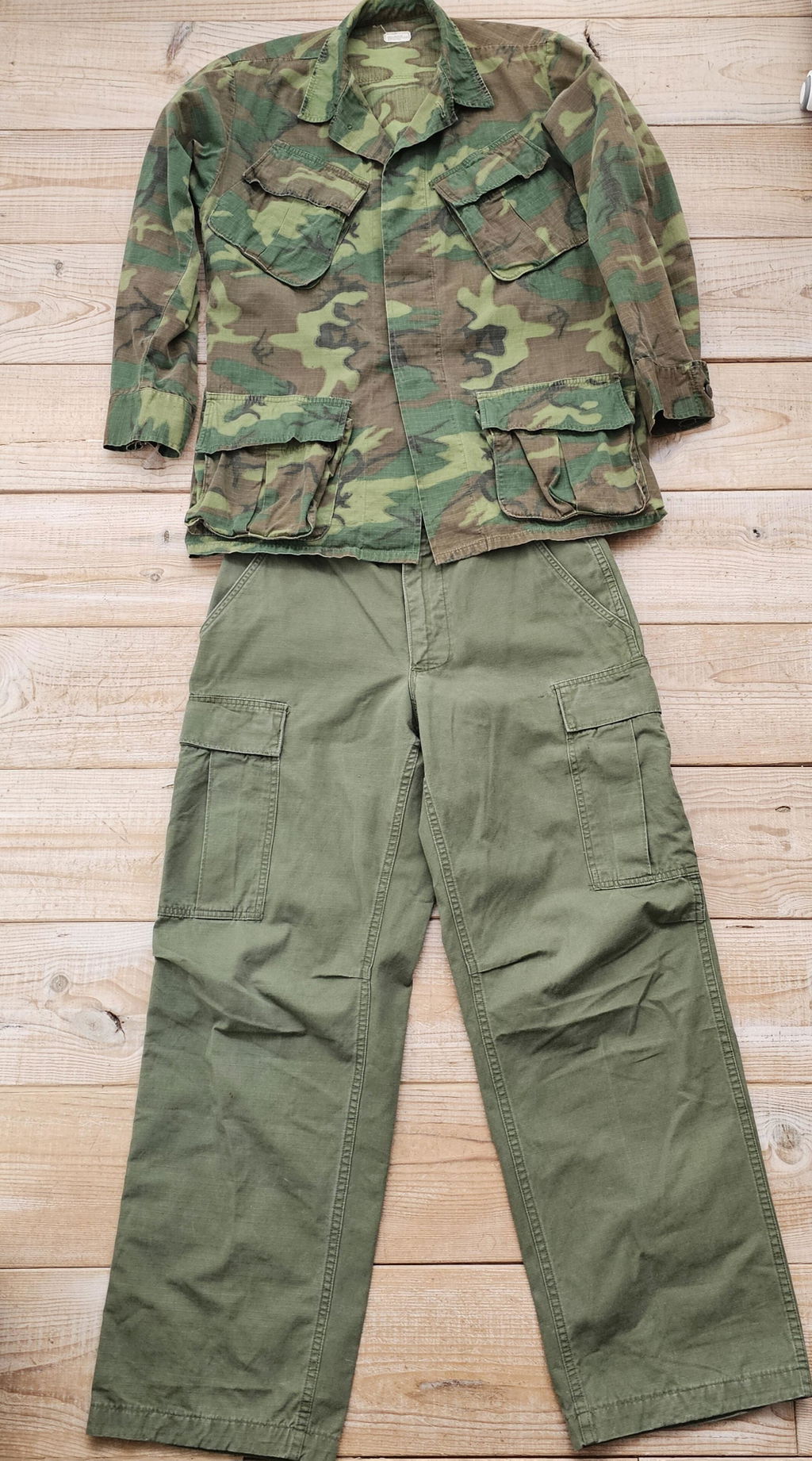
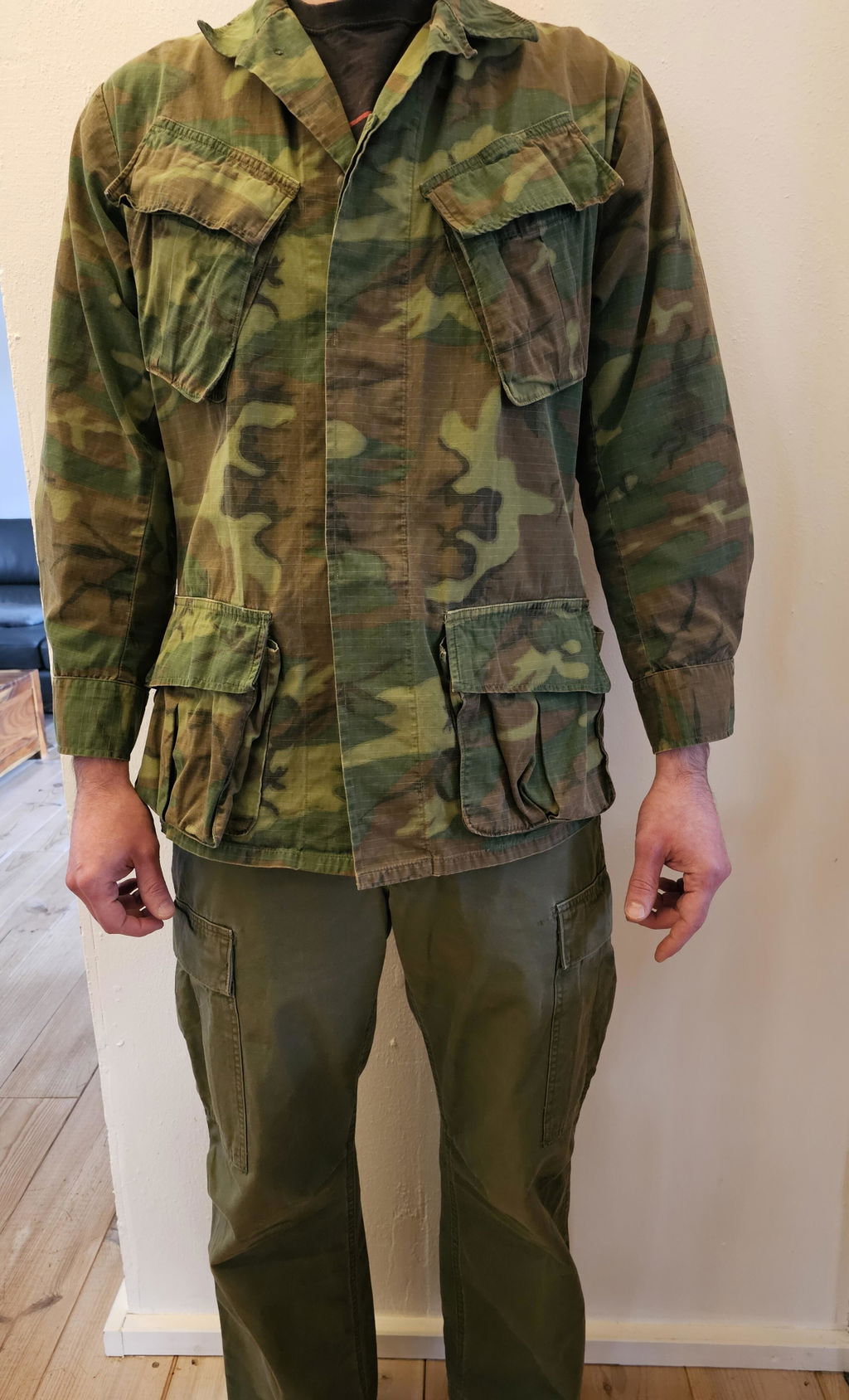
Vintage Vietnam War Tropical Combat Jackets Accurate Pattern Identification Guide


U.S. Vietnam War Tropical Combat Jackets
Accurate Pattern Identification Guide (1st–5th Pattern)
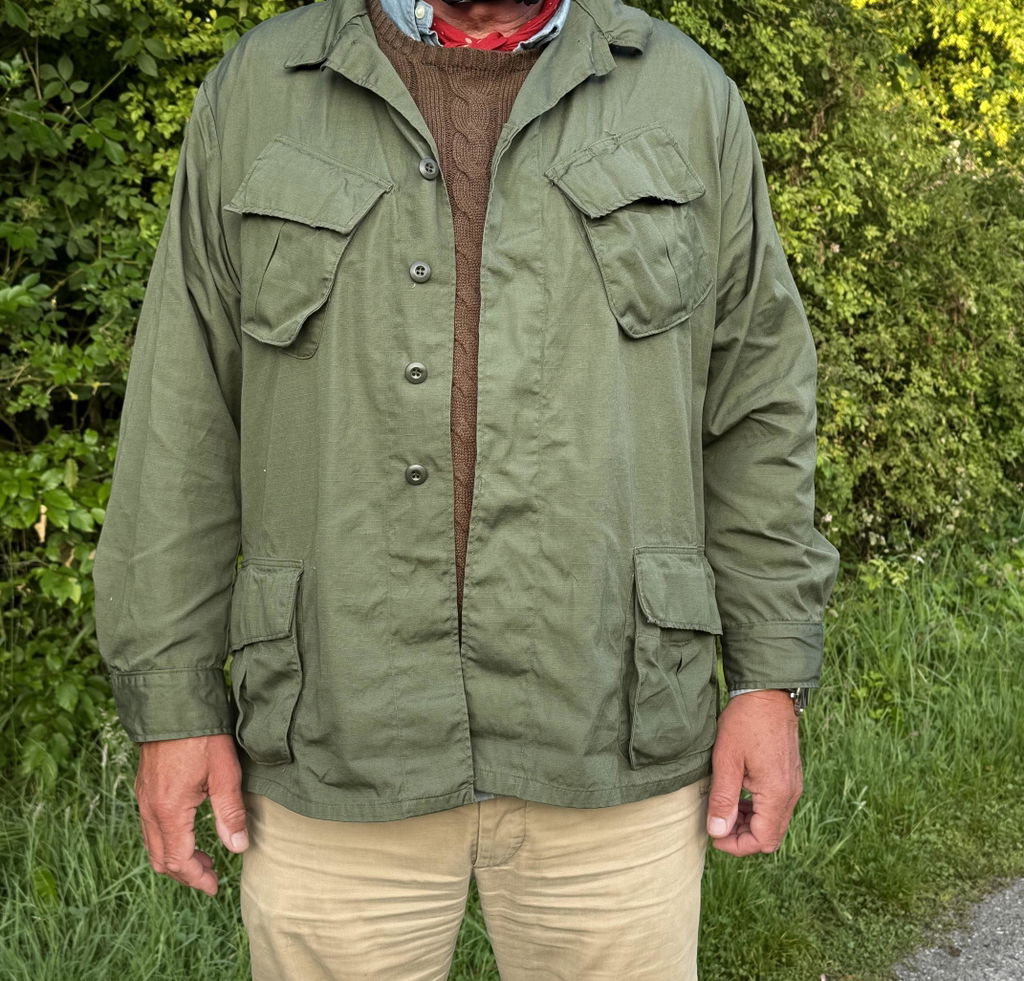
The U.S. Tropical Combat Jacket — commonly called the “Jungle Jacket” — was developed for combat in Vietnam’s extreme heat and humidity. Lightweight cotton construction replaced heavier utility uniforms, and between 1963 and the early 1970s the jacket evolved through five distinct patterns.
These patterns are identified by construction changes — not by speculation or fabric alone. Critical identifiers include:
-
Gas flap presence
-
Epaulets
-
Waist adjustment tabs
-
Pocket drain holes
-
Back yoke
-
Fabric type (poplin vs. ripstop)
-
Hanger loop
Below is the accurate breakdown.
1st Pattern (1963–1964)
The earliest standard-issue jungle jacket.
Construction features:
-
5.5 oz wind-resistant cotton poplin (smooth weave)
-
Exposed pocket buttons
-
Epaulets
-
Adjustable waist tabs
-
Interior gas flap behind zipper
-
Slanted chest pockets
-
Drain holes in pockets
-
Hanger loop present
The hanger loop is sewn into the interior collar seam and is consistent on 1st pattern production.
These are scarce and command strong collector interest.


2nd Pattern (1965)
Refinement of the 1st pattern, primarily modifying pocket closures.
Construction features:
-
Cotton poplin (non-ripstop)
-
Concealed (covered) pocket buttons
-
Epaulets retained
-
Waist tabs retained
-
Gas flap retained
-
Drain holes retained
-
Hanger loop present
The concealed buttons were introduced to reduce snagging in vegetation.
If a jacket has covered buttons + epaulets + gas flap + hanger loop, it is a 2nd pattern.


3rd Pattern (1966–1967)
Significant simplification of the jacket’s structure. Introduction of the ERDL camo version
Construction features:
-
Cotton poplin
-
No epaulets
-
No waist tabs
-
No gas flap
-
No pocket drain holes
-
Back yoke added
-
Hanger loop present
This is the last pattern to include the hanger loop.
Collectors sometimes misidentify this pattern due to the stripped appearance. The absence of drain holes combined with the presence of a hanger loop is the key identifier.


*Some of the ERDL Camo Jacket don't have the Hanger Loop


4th Pattern (Late 1967–1968)
Structural reinforcement reintroduced while continuing simplification.
Construction features:
-
Rip Stop Cotton
-
Back yoke retained
-
Drain holes returned
-
No epaulets
-
No waist tabs
-
No gas flap
-
Hanger loop removed
This is the first pattern without a hanger loop.
The addition of the back yoke distinguishes it from the 3rd pattern.


5th Pattern (1968 onward)
Final Vietnam-era jungle jacket production version.
Construction features:
-
Rip-stop cotton poplin (visible grid weave)
-
Back yoke retained
-
Drain holes present
-
No epaulets
-
No waist tabs
-
No gas flap
-
Simplified single sleeve pen pocket
-
No hanger loop
Ripstop fabric becomes standard with this pattern.
This is the most commonly encountered Vietnam-era jungle jacket today.


Fabric Transition
Poplin (smooth weave):
Used in 1st, 2nd, 3rd, and early 4th pattern jackets.
Ripstop (grid weave):
Introduced with 4th pattern production to prevent tearing from spreading.
Fabric alone should never determine pattern identification without checking structural features.
Camouflage & Color Variants
OG-107 (Olive Green)
Standard solid olive drab used throughout the war.
ERDL Camouflage
Four-color leaf pattern.
-
Early green-dominant version
-
Later brown-dominant version
ERDL appears in later production runs (3rd–5th patterns), with higher collector demand compared to OG-107.
Quick Identification Table
| Pattern | Fabric | Gas Flap | Drain Holes | Back Yoke | Hanger Loop |
|---|---|---|---|---|---|
| 1st | Poplin | Yes | Yes | No | Yes |
| 2nd | Poplin | Yes | Yes | No | Yes |
| 3rd | Poplin | No | No | Yes | Yes |
| 4th | Ripstop | No | Yes | Yes | No |
| 5th | Ripstop | No | Yes | Yes | No |
Final Notes for Collectors
-
Hanger loop present = 1st–3rd pattern only.
-
Hanger loop absent = 4th–5th pattern.
-
Back yoke appears starting in 3th pattern.
-
Ripstop appears in 4th pattern.
-
No single feature should be used in isolation.
Accurate identification requires examining all construction elements together.