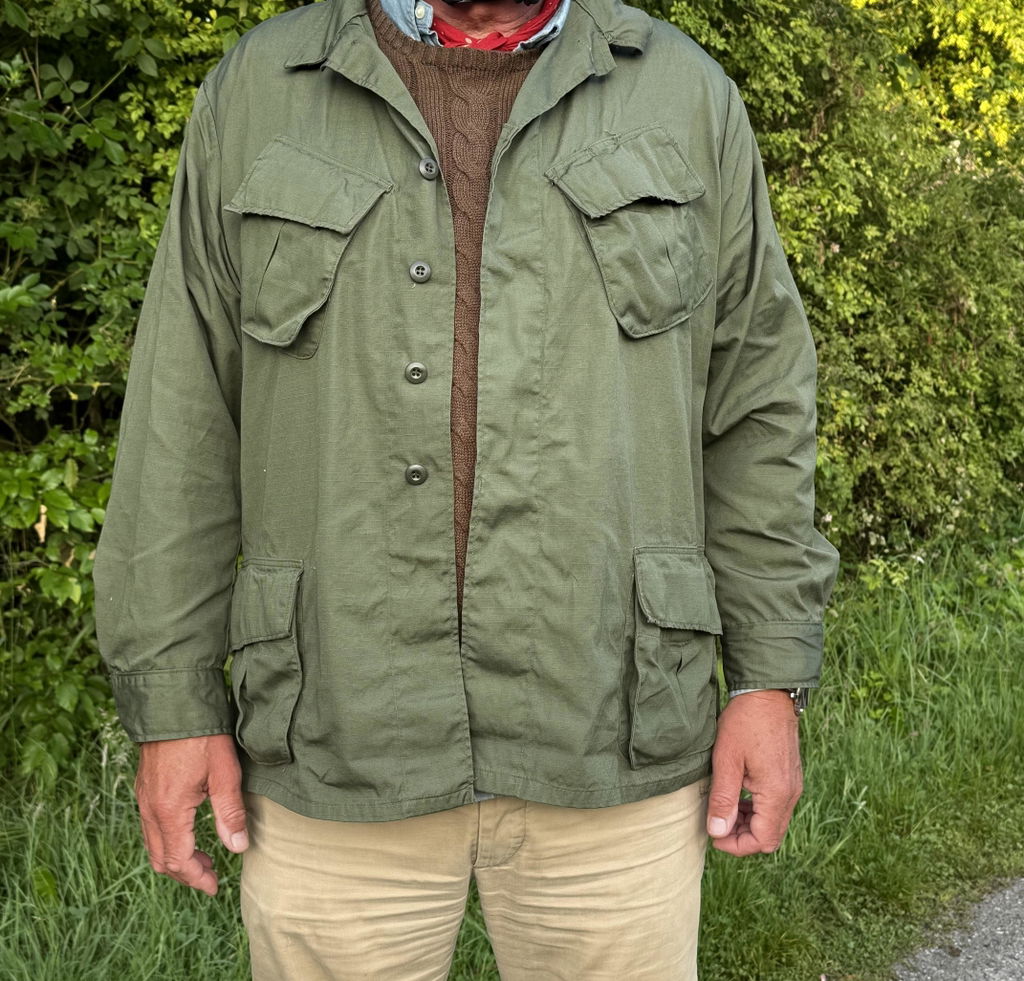
Vietnam Jungle Jackets: Pattern Identification & Buying Guide


Felix Mohen’s original reference organizes Vietnam-era tropical combat jackets by their changing construction. Use the photographs to compare the actual garment: pocket closures, shoulder details, waist tabs, fabric, back seams and labels. This edition keeps the original photo sequence and adds a practical inspection workflow, buying advice and links to the longer collector study.
Shop available tropical combat jackets
Compare original pieces, sizes and condition before choosing.

Vintage US Army Tropical Combat Jacket 5th Pattern 1969 Small Short
Small / Green$165.00 USDView availability
VINTAGE US ARMY TROPICAL COMBAT JACKET 1967 VIETNAM WAR MEDIUM LONG NOS NEW
Medium / Green$225.00 USDView availability
VINTAGE US ARMY TROPICAL COMBAT JACKET 1969 VIETNAM WAR LARGE LONG NOS NEW
Large / OG$145.00 USDView availability
VINTAGE US ARMY TROPICAL COMBAT JACKET RIP STOP 1969 VIETNAM WAR XL REGULAR NOS
XL / OG$275.00 USDView availability
Check the collection for current prices and availability. Swipe to browse.
Shop the collection →- Photograph front, back, labels, pocket closures and waist details.
- Use the combined construction rather than one hanger loop or fabric clue.
- Distinguish a collector pattern description from a date printed on a label.
How to use the original pattern photographs
Collector pattern numbering is a convenient way to group construction changes. It is not a substitute for the garment’s own specification, contract or physical details. The five groups in Felix’s original reference remain below, but their boundaries should not be read as rigid manufacture-year cutoffs. Some archive examples carry dates that overlap the commonly quoted chronology.
Start with the closures and shoulders
Compare exposed pocket buttons with covered closures, then examine epaulets and waist adjustment tabs. An early-style garment with removed tabs can appear simpler than it originally was. Check for stitch shadows, unused button positions and repairs before deciding that a missing feature is a factory pattern change.
Open the front and inspect the protective flap behind the button closure. Inspect both sides of the garment rather than relying on a single front photograph. The presence or absence of a collar hanger loop is supporting evidence only: loops can be removed, and the original archive itself notes variation among camouflage examples.
Fabric and back construction
Poplin presents a smoother field of weave; ripstop has a visible reinforcement grid. Examine a clear close-up instead of treating a seller’s pattern number as a fabric description. A back yoke is a seam/construction detail, while a printed camouflage boundary is not. Use a rear photograph that shows the collar-to-shoulder area clearly.
Two jackets can have similar front silhouettes but different fabric and finishing. Conversely, an olive example and an ERDL example may share construction features while looking very different at a glance. Record color or camouflage separately from the feature checklist.
| Check | Useful evidence | Common mistake |
|---|---|---|
| Pocket closures | Exposed or covered buttons and original stitching. | Treating a missing button as a pattern feature. |
| Waist and shoulders | Tabs, epaulets and any removal traces. | Calling a modified early jacket a later pattern. |
| Fabric | Clear weave photograph or readable material label. | Assuming every green jacket is poplin. |
| Collar loop / back seams | Actual seam and attachment construction. | Dating a garment from one loop alone. |
| Contract | Complete readable procurement string. | Using a product-title year as a label transcription. |
A useful photo set before buying
Ask for front, rear, all labels, pocket closures, waist details and one close fabric view. Check underarms, cuffs, pocket corners and collar folds for wear. Inspect repairs separately from original construction. A patched or altered jacket can be a worthwhile vintage garment, but its description should explain what has changed.
Match chest, shoulder, sleeve and length measurements to your intended use. A tropical jacket may be worn over a light layer, but a tag such as Medium-Long does not describe its present measurements after wear and laundering. Do not assume that an oversized or shortened example is a different military pattern.
Original reference and advanced study
This page is the practical pattern and buying reference built from Felix’s original sequence. The expanded tropical-jacket collector study provides more archive cases and detailed comparisons. Use the matching tropical-trouser guide for the lower half of the uniform and the contract-number guide for label interpretation.
Frequently asked questions
Does a missing hanger loop prove a later pattern? No. Compare the complete construction and look for removal or repair.
Does a Vietnam-era contract prove Vietnam service? No. Procurement date and service provenance are separate claims.
Should an archive listing be treated as available stock? No. Use the current shopping row and collection for availability; the original photo references remain valuable after sale.
Additional archive detail study
Compare these close views with the full pattern sequence below. Labels, hardware and stitching should be assessed together.


Felix Mohen’s original illustrated reference
Rare Gear USA’s original photography and research are protected. Images and text may not be reproduced or used commercially without prior written permission.
U.S. Vietnam War Tropical Combat Jackets
Accurate Pattern Identification Guide — archive comparison group
The U.S. Tropical Combat Jacket — commonly called the “Jungle Jacket” — was developed for combat in Vietnam’s extreme heat and humidity. Lightweight cotton construction replaced heavier utility uniforms, and between 1963 and the early 1970s the jacket evolved through five distinct patterns.
These patterns are identified by construction changes — not by speculation or fabric alone. Critical identifiers include:
-
Gas flap presence
-
Epaulets
-
Waist adjustment tabs
-
Pocket drain holes
-
Back yoke
-
Fabric type (poplin vs. ripstop)
-
Hanger loop
Below is Felix’s original archive grouping, supplemented by the comparison notes in this edition.
1st Pattern — archive comparison group
The earliest standard-issue jungle jacket.
Construction features:
-
5.5 oz wind-resistant cotton poplin (smooth weave)
-
Exposed pocket buttons
-
Epaulets
-
Adjustable waist tabs
-
Interior gas flap behind the front button closure
-
Slanted chest pockets
-
Drain holes in pockets
-
Hanger loop present
The hanger loop is sewn into the interior collar seam and is consistent on 1st pattern production.
These are scarce and command strong collector interest.


2nd Pattern — archive comparison group
Refinement of the 1st pattern, primarily modifying pocket closures.
Construction features:
-
Cotton poplin (non-ripstop)
-
Concealed (covered) pocket buttons
-
Epaulets retained
-
Waist tabs retained
-
Gas flap retained
-
Drain holes retained
-
Hanger loop present
The concealed buttons were introduced to reduce snagging in vegetation.
If a jacket has covered buttons + epaulets + gas flap + hanger loop, it is a 2nd pattern.


3rd Pattern — archive comparison group
Significant simplification of the jacket’s structure. Introduction of the ERDL camo version
Construction features:
-
Cotton poplin
-
No epaulets
-
No waist tabs
-
No gas flap
-
No pocket drain holes
-
Back yoke added
-
Hanger loop present
Hanger-loop details can vary; compare the actual collar construction.
Collectors sometimes misidentify this pattern due to the stripped appearance. The absence of drain holes combined with the presence of a hanger loop is the key identifier.


*Some of the ERDL Camo Jacket don't have the Hanger Loop


4th Pattern — archive comparison group
Structural reinforcement reintroduced while continuing simplification.
Construction features:
-
Rip Stop Cotton
-
Back yoke retained
-
Drain holes returned
-
No epaulets
-
No waist tabs
-
No gas flap
-
Hanger loop removed
The examples in this group should be compared with the earlier collar construction.
The back yoke is already present in the preceding archive group; compare fabric and the complete construction instead.


5th Pattern — archive comparison group
Final Vietnam-era jungle jacket production version.
Construction features:
-
Rip-stop cotton poplin (visible grid weave)
-
Back yoke retained
-
Drain holes present
-
No epaulets
-
No waist tabs
-
No gas flap
-
Simplified single sleeve pen pocket
-
No hanger loop
Ripstop fabric becomes standard with this pattern.
This is the most commonly encountered Vietnam-era jungle jacket today.


Fabric Transition
Poplin (smooth weave):
Used in 1st, 2nd, 3rd, and early 4th pattern jackets.
Ripstop (grid weave):
Introduced with 4th pattern production to prevent tearing from spreading.
Fabric alone should never determine pattern identification without checking structural features.
Camouflage & Color Variants
OG-107 (Olive Green)
Standard solid olive drab used throughout the war.
ERDL Camouflage
Four-color leaf pattern.
-
Early green-dominant version
-
Later brown-dominant version
ERDL appears in later production runs (3rd–5th patterns), with higher collector demand compared to OG-107.
Quick Identification Table
| Pattern | Fabric | Gas Flap | Drain Holes | Back Yoke | Hanger Loop |
|---|---|---|---|---|---|
| 1st | Poplin | Yes | Yes | No | Yes |
| 2nd | Poplin | Yes | Yes | No | Yes |
| 3rd | Poplin | No | No | Yes | Yes |
| 4th | Ripstop | No | Yes | Yes | No |
| 5th | Ripstop | No | Yes | Yes | No |
Final Notes for Collectors
-
A surviving hanger loop is supporting evidence; inspect the complete construction.
-
A missing hanger loop alone cannot establish a later pattern: it may be absent, removed or repaired.
-
Back yoke appears starting in 3rd pattern.
-
Ripstop appears in 4th pattern.
-
No single feature should be used in isolation.
Accurate identification requires examining all construction elements together.
© 2026 Rare Gear USA. All rights reserved. To request permission to use our photographs or content, contact cs@raregearusa.com. Third-party names, trademarks and insignia belong to their respective owners. Copyright & Image Use Policy.
Find an original piece
Use the photographs above to identify the details that matter to you, then compare the measurements, label and condition on the actual listing. Archive examples may be sold; availability and price are shown on the current product page.
Shop available tropical combat jackets →